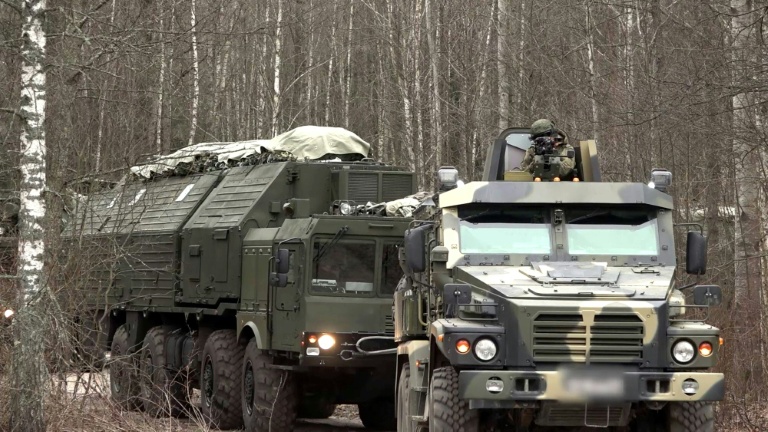
Russia’s Oreshnik missile attack on Ukraine near the EU border was intended to intimidate Kiev’s Western allies and demonstrate Vladimir Putin’s dissatisfaction with recent foreign policy setbacks including in Venezuela, analysts said on Friday.
Days after European and U.S. negotiators unveiled a post-war peacekeeping plan for Ukraine, Russia targeted an infrastructure facility in the Lviv region in the west of the country overnight Thursday through Friday with an Oreshnik nuclear-tipped intermediate-range ballistic missile (IRBM).
This is believed to be the weapon’s second known combat use.
While Moscow said the attack was in response to an alleged drone attack on Putin’s official residence in December, nearly four years after Russia invaded Ukraine, analysts said the move was intended to send a clear message to Western leaders and scare ordinary Europeans.
Cyril Brett, a Russia expert at the Montaigne Institute in Paris, told AFP: “Vladimir Putin is using it to communicate with the West because he can undoubtedly achieve the same operational effect without such missiles.”
“As the Europeans are developing their air defense capabilities, this is a way of reminding them of their vulnerability,” he added.
The Kremlin has touted the Oreshnik as a “state-of-the-art” weapon that flies at hypersonic speeds, can hit targets across Europe and cannot be intercepted.
A British government spokesman said the leaders of Britain, France and Germany said in a conference call on Friday that Russia’s use of missiles was “escalated and unacceptable.”
A spokesman for British Prime Minister Keir Starmer said Russia was using “fabricated accusations to justify the attack.” Ukraine denies attack on Putin’s residence.
Lviv Mayor Andrei Sadovy said on Facebook that the attack was a “new threat – not only to Ukraine, but also to European security.”
The missile, named after the Russian word for hazel tree, was first launched in 2024 towards the central Ukrainian city of Dnipro.
-‘Psychological weapons’-
Observers said the choice of the new target, about 70 kilometers (40 miles) from the EU border, was significant.
“It’s much closer to the EU border,” Etienne Marcuz, an associate research fellow at the French think tank Fondation d’Or, told X.
“This should probably be seen as a message to European countries,” he said, adding that the consequences of the attack were “probably more psychological than operational.”
Some observers viewed the attack as Putin’s attempt to reassert his authority after a series of setbacks, including Washington’s capture of Venezuelan leader Nicolas Maduro, the seizure of a Russian-flagged ship in the North Atlantic and fresh demonstrations in Iran challenging allied authorities in Moscow.
Mick Ryan, a retired Australian Army major general and Ukraine war analyst, wrote: “This is a psychological weapon, a tool for Putin to wage cognitive warfare against Ukraine and the West, not a weapon of mass physical destruction.”
He said the use of Oreshnik was “a sign of a fearful, worried leader, not a leader who is confident and looking forward to victory.”
He added that the move did not obscure the fact that Russia had little power “to influence events among its allies and friends abroad or to respond to military contingencies.”
Timothy Ash, an emerging markets economist who studies Russia, made similar remarks, noting that damage on the ground following a missile strike was relatively limited.
“The Oreshniks are very effective, but also very costly, and from a cost-benefit analysis it makes no sense to deploy these missiles in Ukraine,” he wrote.
“The deployment of the Oreshnik therefore appears to be more of a public relations exercise, perhaps to signal to the Trump administration that Russia is unhappy with the situation in the world more broadly,” he added.
Although Russia calls the Oreshnik missile a hypersonic missile, Western defense analysts say it is not a revolutionary weapon.
“This is most likely not a hypersonic missile,” Markuz said, adding that Europe had the means to intercept intermediate-range ballistic missiles.
“Oreshnik’s multiple warheads could cause problems depending on the timing of their release,” he added.
In December, Belarusian President Alexander Lukashenko, a Putin ally, said the weapon was deployed in Belarus, which borders NATO’s eastern flank.
fz-dab-as/ah/cc