Author: Abhirup Roy
SAN FRANCISCO, Dec 27 (Reuters) – A widespread power outage in San Francisco stalled Waymo robotaxis and caused traffic jams earlier this month, raising concerns about the readiness of self-driving car operators to deal with major emergencies such as earthquakes and flooding.
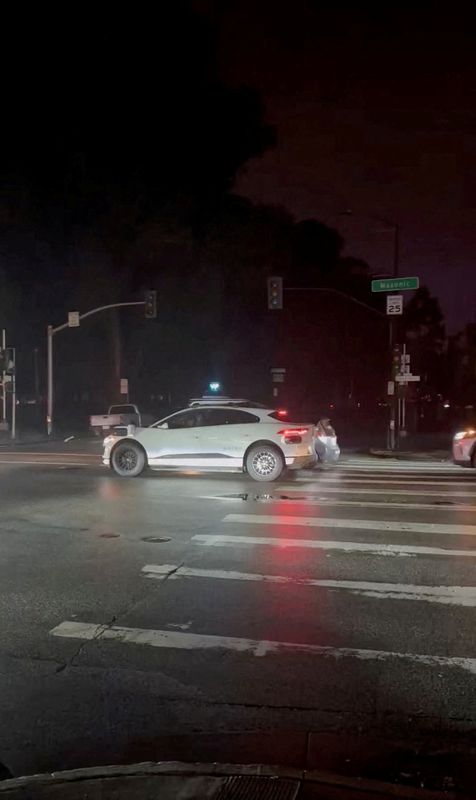
Video posted on social media showed a Dec. 20 fire at a PG&E substation that knocked out power to about a third of the city and left Alphabet subsidiary Waymo’s self-driving taxis stuck at intersections, with hazard lights turned on and traffic lights stopped working. Waymo halted operations and resumed operations a day later.
The incident renews calls for tighter regulation of the nascent but fast-growing industry as other companies, including Tesla and Amazon.com Inc.’s Zoox, race to expand robotaxi services in multiple cities.
“If your response to a blackout is wrong, then regulators would be derelict in their duty if they don’t require some kind of proof that a seismic situation will be handled appropriately,” said Philip Koopman, a computer engineering professor at Carnegie Mellon University and an expert on autonomous technology.
Waymo said in a statement on Tuesday that while its robotaxis are designed to serve as four-way stops handling non-operating traffic signals, they occasionally require confirmation checks. Waymo said that while the vehicles successfully navigated more than 7,000 dark signals on Saturday, the “outage caused a concentrated surge in confirmation requests” that “resulted in response delays and congestion on already overburdened streets.”
Robotaxi operators around the world use human remote access (known in the industry as “teleoperation”) to varying degrees to monitor and control their vehicles. Waymo, for example, has a team of human “fleet response” agents who answer questions posed by its robot Waymo Drivers when they encounter specific situations.
But Missy Cummings, director of the Center for Autonomy and Robotics at George Mason University and a former adviser to U.S. road safety regulators, said such remote assistance has its limitations, and Waymo’s glitches underscore the need to regulate how robo-taxi operators use the technology.
“The whole point of doing remote operations is so that humans can be there when the system isn’t responding the way it should be,” she said. “The federal government needs to regulate remote operations,” Cummings said. “They need to make sure they have backup remote operations in the event of some kind of catastrophic failure.”
The California Department of Motor Vehicles and the California Public Utilities Commission, which regulate and issue licenses for robotaxi testing and commercial deployment, said they were investigating the incident.
The DMV said it is discussing emergency response-related actions with Waymo and other self-driving car manufacturers. It also said it was developing regulations to ensure remote drivers “meet high standards of safety, responsibility and responsiveness”.
“Bow and arrow shot”
Deployment and commercialization of fully autonomous vehicles has been harder than expected, requiring significant investments to ensure the technology is safe and public outcry after crashes forced many to close their doors.
In 2023, regulators revoked its license after a high-profile incident in which one of General Motors’ Cruise’s robotaxis dragged a pedestrian.
But with Tesla launching service in Austin, Texas, earlier this year and CEO Elon Musk promising rapid expansion, robotaxis are back in the spotlight. Waymo has grown slowly but steadily over the years since it launched as Google’s self-driving project in 2009, while also accelerating its expansion.
Waymo has a fleet of more than 2,500 vehicles and operates in the San Francisco Bay Area, Los Angeles, Phoenix, Austin and Atlanta.
The company said the validation processes its vehicles follow were established during early deployments and are currently being refined to match its current scale. Waymo is implementing a fleet-wide update that gives vehicles “specific outage environments so they can navigate more decisively.”
Both Cummings and Koopman said that once robo-taxi operators exceed a certain fleet size, they should face additional licensing requirements to ensure they are adequately equipped to handle large-scale failures.
“If this was an earthquake, that would be a problem,” Koopman said. “It’s just an arrow in the bow.”
(Reporting by Abhirup Roy in San Francisco; Editing by Sayantani Ghosh and Alistair Bell)