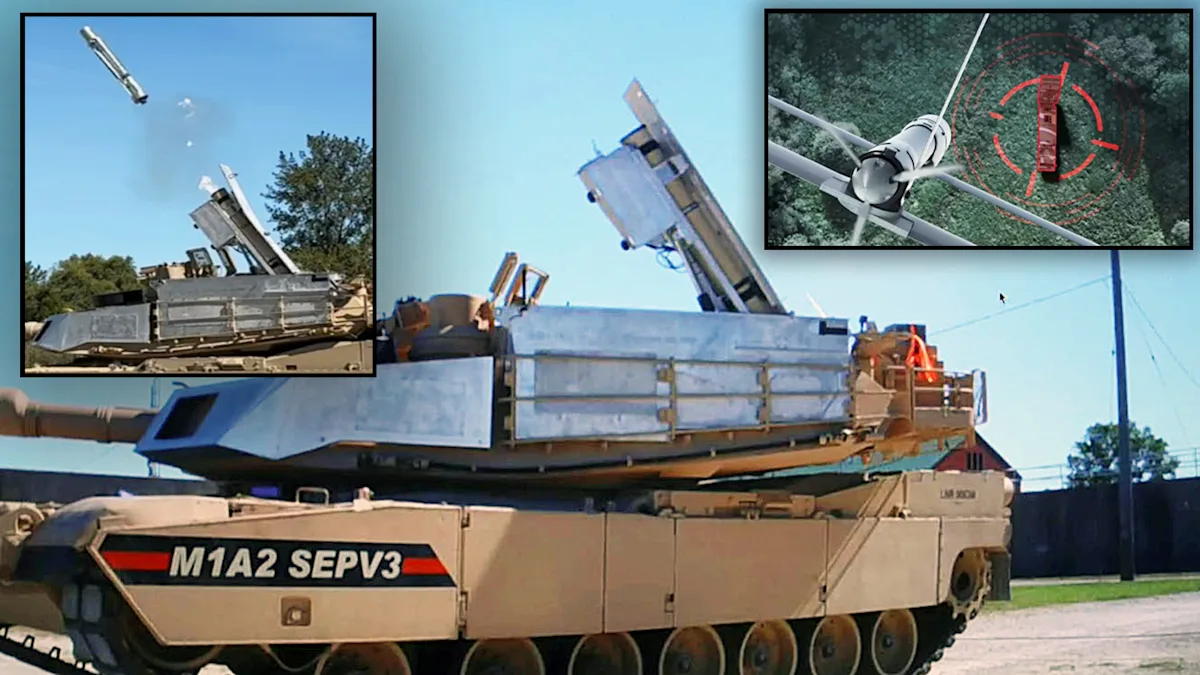
General Dynamics Land Systems (GDLS) has revealed more details about its ongoing efforts to equip the M1A2 Abrams main battle tank with the Switchblade family of loitering munitions through a system called Precision Effects and Reconnaissance in Cans (PERCH). After industry-funded trials, the company now hopes to win a U.S. Army contract to conduct further testing of an improved version of the system.
GDLS also recently released a photo showing one of the loitering munitions being fired from a pop-up cartridge mounted on the tank’s turret, which replaces the standard loader bay.
The disclosures follow the demonstration of the PERCH system, which integrates Switchblade 300 and Switchblade 600 loitering munitions into the M1A2 Abrams SEPv3, the latest version of the tank in service with the US Army. PERCH can also be integrated on the Stryker 8×8 infantry carrier vehicle and potentially other platforms. The transmitter can accommodate three Switchblade 300 and one 600 simultaneously.
PERCH was developed by GDLS and AeroVironment, which manufactures the Switchblade, and was demonstrated at the Army’s Machine-Assisted Rugged Engineer (MARS) event at Fort Hood, Texas, from Oct. 26-30. Led by the 36th Engineer Brigade and 3rd Armored Corps, MARS focuses on soldiers using autonomous technologies to complete breach operations and reduce the overall risk they face.

U.S. Army soldiers watch a live-fire demonstration of Operation Breach as part of the Machine-Assisted Rugged Engineer (MARS) event at Fort Hood, Texas, Oct. 30, 2025. U.S. Army Photography: SGT Gabriel Villalobos Sgt. Gabriel Villalobos
As a modular system, PERCH is designed to be simply bolted to an armored vehicle; in the case of the Abrams, it is held in place using existing attachment points. At the MARS event, PERCH was operated via a tablet interface, but GDLS says future iterations will be fully integrated with existing vehicle computer systems.
By leveraging the Switchblade, PERCH can provide not only long-range surveillance of vehicles, but also beyond-visual-range lethality. In some cases, this can even extend to Beyond Visual Line of Sight (BLOS), where loitering munitions are used in autonomous, pre-programmed modes to fly along a course and/or hit fixed targets.
As we’ve outlined in the past, the Switchblade 300 is a relatively small loitering munition, a weapon also commonly known as a kamikaze drone, that can carry a four-pound high-explosive warhead. It has a maximum range of just over 6 miles and can stay aloft for about 15 minutes.
A member of the U.S. Marine Corps fires an early version of the Switchblade 300. United States Marine Corps
A camera in the nose allows the operator to see what the drone is seeing until close to the moment of impact. Controllers can make course corrections or even completely block an attack for any reason until the final moments of the flight. During the final part of its terminal attack run, once it has locked on to the target, the loitering munition automatically controls itself so that it can hit the target even after losing connection with the controller while very low to the ground.
The larger, longer-range Switchblade 600 provides long-range, higher-endurance reconnaissance and strike capabilities and is equipped with the same multi-purpose warhead as the Javelin anti-tank guided missile (ATGM). The -300 model can pursue light vehicles and personnel, while the -600 model can destroy armor and destroy buildings.
Both versions of the loitering munition are in service in Ukraine, including against Russian armored forces.
The flexibility of the Abrams/Switchblade combination was demonstrated during the Mars campaign, where users completed complex barrier breaches, loitering munitions for long-range reconnaissance and beyond visual range targeting of high-value targets.
“PERCH allows troops to deploy Switchblade loitering munitions farther across the battlefield while maintaining their own concealment,” Jim Pasquarette, GDLS vice president of U.S. strategy and business development, explained in a subsequent press release. “We are seeing a lot of Soldier interest in this off-the-shelf, effective concept, and we look forward to future demonstrations.”
Providing combat vehicles with an easy-to-install, combat-proven loitering munitions system is a quick way to extend their range and survivability. In the case of the Abrams, PERCH enables the tank to deliver precision effects through indirect fire, including engaging targets from protected positions at long range, in which case the tank would be unable to use its main gun.
At the same time, carrying these loitering munitions gives the tank organic long-range surveillance capabilities, meaning it can detect potential threats or other dangers in advance without having to rely on information provided by other units. Pairing the loitering munition with a drone repeater/receiver that can remain above (or even tethered to) the Abrams missile would provide further benefits, significantly extending line-of-sight connectivity, especially in complex terrain. Such systems can also provide localized surveillance and enhanced situational awareness.
A PERCH model with a switchblade wanderer ammo on the exhibition stand. GDLS
Overall, the emergence of PERCH is long overdue.
Adding such drones to armor gives them new standoff indirect fire capabilities and critical reconnaissance tools, all in a modular and easy-to-use package.
While PERCH’s long-term future with the Army has yet to be determined, it’s worth noting that while the MARS event involves demonstrations funded by industry, the next phase of testing appears to be paid for by the Pentagon.
Reports emerged last week that GDLS was in talks with the Army to provide an upgraded version of PERCH for testing in the second half of next year.
Planned improvements for the new version include making loitering ammunition easier to reload.
A spokesman for GDLS said Janes If an agreement is reached, the upgraded PERCH will be integrated into the tank as part of the 1st Cavalry Division’s 2nd Armored Brigade Combat Team’s Pegasus Forge exercise in the second half of 2026.
If successful, the next evaluation could pave the way for more Army Abrams tanks to gain Switchblade loitering ammunition capability via the PERCH launcher.
Regardless of how PERCH progresses, it seems more likely that loitering ammunition will become the standard for armor on future battlefields.
Contact the author: thomas@thewarzone.com