It’s the biggest cosmic murder mystery of the year: How does a black hole destroy a star—and what type of black hole is the culprit?
Astronomers around the world have been following the case since July 2, when they received text messages alerting them that NASA’s Fermi Gamma-ray Space Telescope had detected a signal of gamma rays, the highest-energy form of light known. Gamma rays are a well-known signature of black holes destroying cosmic objects such as stars. This is because such events release huge amounts of energy.
Typically, so-called “gamma-ray bursts,” sudden flashes of extremely high-energy radiation from the universe, last on average between one second and half an hour. The burst lasted seven hours, making it the longest gamma-ray burst ever recorded.
Another strange clue came from the Einstein probe, a Chinese-European satellite that saw bright X-rays emitting from the same location in the sky a day earlier. Normally, cosmic explosions start with the highest-energy light and then fade in brightness, not the other way around. Nothing like this has been observed since the discovery of gamma rays in 1973.
“That makes it a very unusual, bizarre explosion that we’ve probably never seen before,” said astrophysicist Eleonora Troja of the University of Rome’s Torvegata.
The leading theory about how the stellar murders unfolded describes scenes that have never been observed. “For me personally, all the different things could be different versions of excitement,” said Jonathan Carney, a doctoral student at the University of North Carolina at Chapel Hill who led a study on the event published in Astrophysical Journal Letters.
(The brightest explosions ever seen in space continue to amaze scientists.)
What we know about gamma-ray bursts
The mysterious cosmic event, known as GRB 250702B, has so far generated 10 different papers on the preprint site arXiv.org, some of which have now been published in peer-reviewed journals. Scientists have been using all the tools at their disposal, both in space and on the ground, to investigate.
“On Independence Day, we were still writing the proposal and trying to point all the telescopes at this part of the sky to really understand what’s going on,” said Brendan O’Connor, an astronomer at Carnegie Mellon University. Astrophysical Journal Letters.
Initially, scientists thought the gamma-ray signal might come from within the Milky Way, which would be easier to explain. “If it were within our own galaxy, it wouldn’t have to be as strong as it would be in a very distant galaxy,” because the brightness could be explained by more common cosmic events relatively nearby, said astrophysicist Andrew Levine of Radboud University in the Netherlands.
Follow-up observations quickly debunked this theory. Once NASA’s Neil Garrels Swift Observatory pinpointed where in the sky the event occurred, the European Southern Observatory’s Very Large Telescope in Chile spotted the faded afterglow next to a stain on the sky, and NASA’s Hubble Space Telescope revealed that the stain was a previously unknown galaxy. The James Webb Space Telescope then used its infrared vision to penetrate thick cosmic dust, helping a team of scientist detectives figure out that light from the crime scene had been traveling toward us for 8 billion years.
“It’s brighter and more brilliant than you might imagine because it’s hidden behind a lot of dust in the Milky Way,” Levine said.

NASA’s James Webb Space Telescope has given astronomers the clearest view yet of the home of GRB 250702B, a large, dusty galaxy about 8 billion light-years from Earth. In the enlarged inset, the location of the burst (indicated by tick marks) is near the top edge of the galaxy’s dark dust lanes, eliminating the possibility that the burst is related to the supermassive black hole at the galaxy’s core. NASA/ESA/CSA/H. Sears, Rutgers. Image processing: A. Pagan, STScI
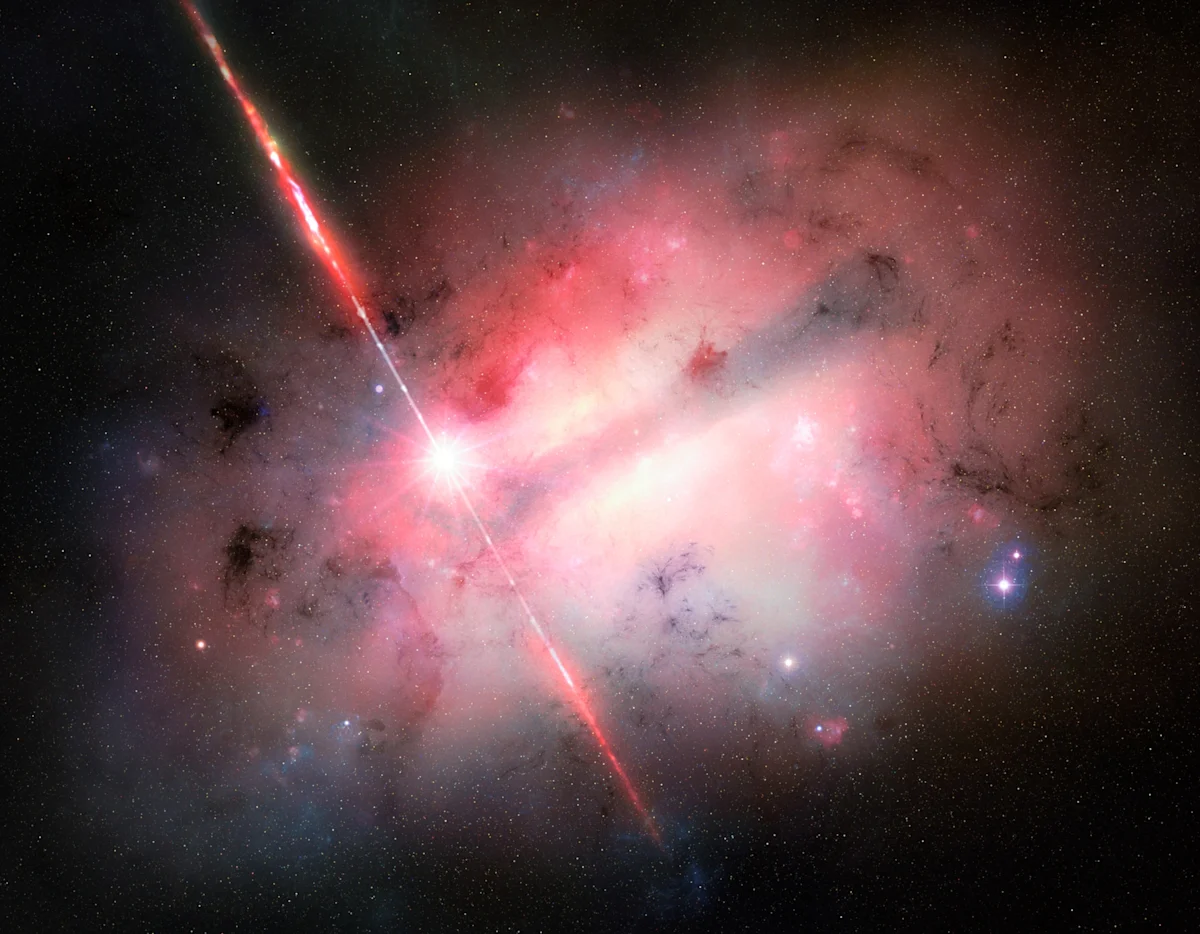
Scientists following the saga agree that the star’s destruction must have produced a stream of particles that shot out from the crime scene at nearly the speed of light, creating the gamma rays. The big mystery, Levine said, became: “What made that jet happen in the first place? What sat in the middle and actually powered that jet?”
This is where scientists disagree.
Black holes merge with stars before swallowing them
Some scientists say the gamma-ray signal looks similar to other signals seen from black holes with a mass of about 5 to 30 times the sun (the smallest black holes we have ever observed). If this interesting-sized black hole merged with a “helium star” (a star that has essentially lost its outer layer of hydrogen), something pretty tricky would happen.
Scientists say the black hole will begin to eat the star from the inside out, creating jets of high-energy particles and light. When the supply ends, only the black hole remains.
“I think the idea alone is pretty cool,” says Eric Burns, an astrophysicist at Louisiana State University who and his colleagues provided evidence for this hypothesis in a recent study. Royal Astronomical Society monthly notices. “This should happen in the universe, no matter how ridiculous it is, but it’s not something we’ve actually seen before.”
The smoking gun supporting this claim is the observation of supernovae – that is, fragments of stars being blown into space rather than being eaten. But the thick dust in the galaxy where this occurs, and its alignment with the Milky Way, may obscure it, even from the Webb telescope’s view.
(Are we living in a black hole?? )
Intermediate-mass black holes tear stars apart
Other scientists believe that forensic evidence may also point to an intermediate-mass black hole as the culprit. This would be scientifically exciting because most black holes in the universe are either stellar-mass or supermassive – weighing more than 100,000 suns. Stars with masses between 100 and 100,000 suns are more difficult to obtain. In fact, there is still debate over which known black holes, if any, actually have “intermediate masses.”
In this case, the intense gravity of a lingering intermediate-mass black hole would tear apart a white dwarf, a once-sun-like star that has now reached the end of its life. This way of destroying a star is less dramatic than exploding from within.
The problem with this explanation, Burns said, is that the variability seen by Fermi—the ups and downs in gamma-ray brightness—is associated only with stellar-mass black holes.
Specifically, “bigger things just take longer to impact the whole thing,” Burns explained. In practical terms, this means that the telescope cannot see the light brightening and dimming faster than the time it takes for the light to travel through the entire black hole. Given that Fermi observed changes on the one-second time scale, this suggests that the black hole must be relatively small.
While some scientists say the case for intermediate-mass black holes cannot be ruled out, “to me, it’s more like a horse and a unicorn,” Burns said.
Another option is that a stellar-mass black hole could tear apart its companion star, an event called a “microtidal disruption event” that typically occurs in supermassive black holes. That’s more plausible than an intervening black hole as the culprit, said Eliza Neights, a researcher at NASA’s Goddard Space Flight Center who led the work on the “Black holes eat stars” paper with Burns. Still, she and Burns and their co-authors believe the rapid changes in the signal support the idea that a black hole merged with a star and then blew it up.
(Here’s how astronomers discovered one of the rarest phenomena in space.)
The case remains unsolved
For now, the debate over the size of the black hole and the method of star extinction remains unresolved, with some saying the jury is still out on one explanation versus another. Astronomers are currently observing the aftermath of star destruction in X-rays and radio waves, looking for more clues about what happened.
“Every time we open a new window into the universe, we learn something we didn’t understand before,” Troha said. “This may serve as a reminder of our awe and reverence for the universe.”
