


Dozens of modern electric vehicles have been tested for range in Mongolia’s freezing temperatures. Here is their ranking.
-
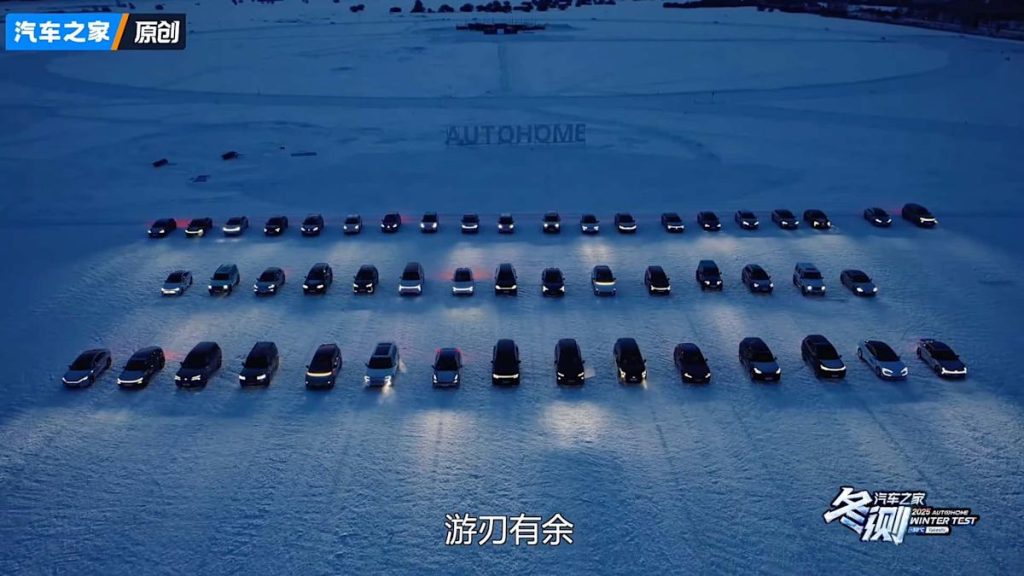
Chinese automotive experts drove 67 vehicles in Inner Mongolia, most of which were electric and hybrid vehicles.
-
In the world’s largest electric vehicle test, the team drove in temperatures as low as -22 degrees Fahrenheit.
-
Extreme weather and harsh driving conditions adversely affect the driving range of all electric vehicles.
The world’s largest-ever winter test of electric vehicles has just concluded in China, and the results show the impact of extreme cold on driving range. Chinese electric cars dominate the rankings, but one American model and one Japanese model still make the top ten.
Tested by car homeChina’s largest automotive media, shipped approximately 67 new electric and hybrid vehicles to Yakeshi, Inner Mongolia. There, around 100 automotive experts put the vehicles through rigorous testing to check their range, charging performance, driving performance on ice, acceleration and safety tests.


Tesla Model YL winter range test
Overall, the performance of Chinese electric vehicles is significantly better than that of Tesla Model Y, Model YL and even Model 3. Still, despite temperatures well below freezing (ranging from 14 degrees Fahrenheit to -22 degrees Fahrenheit in some cases), Tesla’s electric sedan managed to crack the top ten for range retention.
The problem is, when mercury levels drop, EV batteries simply aren’t performing at their best. Batteries don’t like cold. Modern electric vehicles are still designed to withstand extreme cold, with sophisticated thermal management systems and wide operating temperature ranges, but there are still inherent limitations in today’s lithium-ion chemistries. These limitations are most evident in reduced driving range – since the car must use a significant portion of its energy to heat its own battery. (Gasoline vehicles cannot avoid efficiency drops in extreme winters.)
One of the main goals of this test is to measure how much range an electric vehicle can maintain in extremely cold conditions, compared to manufacturer ratings. The driving range of almost all vehicles has dropped dramatically. Most of them lost more than half their claimed range, which, frankly, shouldn’t surprise anyone.
Cold temperatures increase the viscosity (or thickness) of the electrolyte inside a lithium-ion battery, the liquid chemical that allows ions to shuttle during charging and discharging. This creates some internal resistance in the battery, which slows down the movement of ions. Therefore, the battery has to work harder to keep the wheels turning, resulting in higher energy consumption. It also has to use a heat pump or resistive heater to keep its own batteries warm.
Plus, there’s a huge difference in approach here. These results compare real-world winter mileage to CLTC ratings, which are already too optimistic in the industry. So if compared to the relatively more accurate EPA ratings, the gap definitely looks bigger than it actually is.

Electric sedan winter range test results
Also worth noting: This test is different from the 60-70 mph highway range tests we’re used to seeing here in the United States. Testers seemed to be doing it at about 70-80 km/h (43-49 mph), which is more in line with average driving speeds in China. Still, the icy surfaces and sub-zero temperatures mean the batteries are under extreme stress anyway.
Ultimately, the sedan was the clear winner thanks to its superior aerodynamics and lower weight. The Xpeng P7 came out on top, able to travel 366.7 kilometers (227 miles) on a full charge, retaining nearly 53.9% of its 680 kilometers (422 miles) CLTC range. The Yangwang U7 achieved 51.8% of its original range, followed by the Zeekr 001 at 49.6%.
Tesla Model 3 and Nissan N7 rounded out the top five, retaining approximately 48% and 47.4% of their rated range respectively. Interestingly, the new Mercedes-Benz CLA falls well short of its CLTC range of 866 kilometers (566 miles), lagging Tesla and other Chinese EVs, retaining only 37% of its claimed range under rigorous testing. That’s a bit disappointing considering it’s one of the newest, most modern, and most advanced electric cars in the group.
|
Model |
Range is in miles (via car home) |
% of rated range |
|
Xpeng P7 |
228 |
53.9% |
|
Yangwang U7 |
Chapter 232 |
51.8% |
|
Zekel001 |
225 |
49.6% |
|
Tesla Model 3 |
225 |
48.0% |
|
Nissan N7 |
184 |
47.4% |
|
BYD seal 06 |
155 |
45.6% |
|
Xiaopeng Mengna M03 |
168 |
45.0% |
|
Fengchengbao 3 |
140 |
44.9% |
|
AITO M7 |
175 |
44.4% |
|
BYD Hanlin |
164 |
43.9% |
Again, don’t be misled by the drastic reduction in range on these EVs. Mongolia’s extreme weather, strong winds, unpaved roads and the fact that the testers kept the cabs warm meant that testing conditions were different from typical winter driving roads.
The long-wheelbase Tesla Model YL and the regular version ranked 29th and 31st respectively on the list, retaining approximately 35.2% and 36.1% of their claimed cruising range. That’s actually respectable, as the Chinese SUVs they face are far superior. Xiaomi SU7, Aito M7 and NIO ES8 all performed better than Tesla, each retaining more than 40% of the CLTC range.

Mercedes-Benz CLA winter range test results
Another revealing metric is energy consumption per 100 kilometers (62 miles). In this category, smaller, affordable electric vehicles outperform their heavier counterparts due to their light weight and simple architecture. BYD Seagull and Geely Xingyuan tied for first place, consuming approximately 23.5 kWh of electricity when driving 62 miles, or approximately 2.6 miles per kWh. BYD Seal 06 (24.6 kWh), Wuling Bingo S (24.9 kWh) and Tesla Model 3 (24.9 kWh) completed the top five in this test. Considering the rough conditions, that’s a good performance for all the cars here.
Despite China’s electric car lead, the results underscore that the Model 3 remains one of the most efficient electric cars on the planet.
Any tips? Contact the author: suvrat.kothari@insideevs.com