


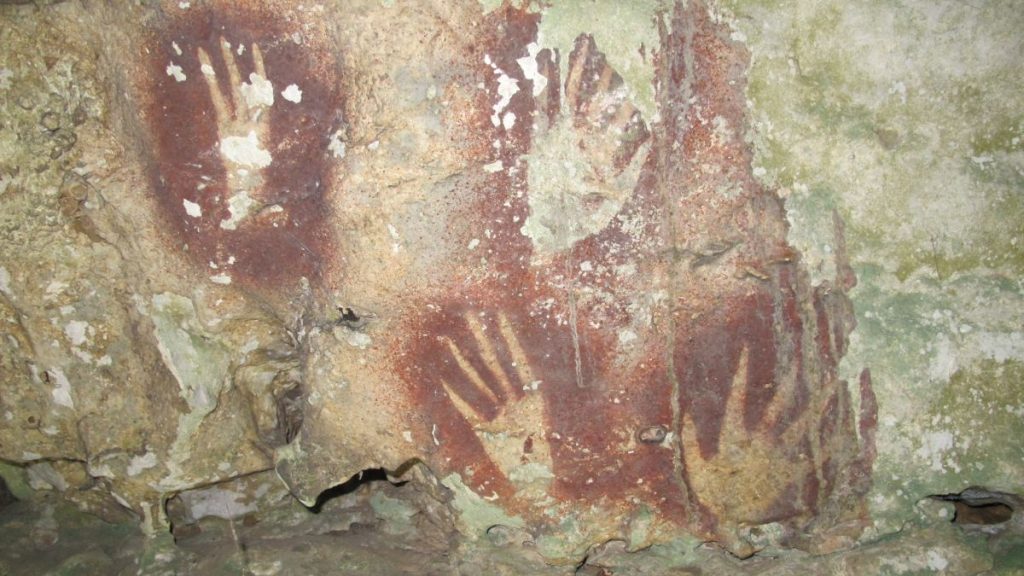
An ancient secret has just been revealed in the dark interior of a limestone cave on the island of Muna, off the coast of Sulawesi, Indonesia.
There, a team of archaeologists discovered man-made rock art older than any other reliably dated example, with a minimum age of 67,800 years ago. These eerie handprints with pointed fingers represent an important piece of the puzzle about how early humans moved through the region tens of thousands of years ago.
Maxime Aubert, an archaeologist at Australia’s Griffith University who co-led the study, told ScienceAlert: “What we are seeing in Indonesia may not be a series of isolated surprises, but the gradual revelation of a deeper, older cultural tradition that was invisible to us until recently.”
“The amount and age of the rock art found there suggest that this was not a marginal or temporary place. Rather, it was a cultural heartland where early humans lived, traveled and expressed their ideas through art for tens of thousands of years.”
Related: Cave drawings of pig hunting may be oldest story ever recorded
In recent years, the island of Sulawesi and the Indonesian part of Borneo have become unexpectedly important places to understand early human creativity and migration. In many cases, the cave paintings were discovered decades ago, but researchers lack a reliable way to determine their age.
Thanks to advances in dating techniques, scientists now know that some of these artworks are much older than previously thought, with the youngest being over 40,000 years old and even over 51,000 years old.
“Every time we apply these methods in new areas, the ages turn out to be much older than expected,” Obert said. “This tells us that the problem is not that early humans were suddenly making art in one place, but that we have been looking in the wrong places, or not looking carefully enough.”
The latest discovery was made at Liang Metaduno, a cave long known for containing ancient rock art. Obert and his colleagues wanted to determine where the creations in the cave fit into the timeline of ancient art in the Indonesian archipelago.


Maxime Aubert by Liang Medanduno. (Ahdi Agus Octaviana)
If the archaeologists are lucky, over a time span of thousands of years, a thin layer of calcite will be deposited on the artwork, precipitated by water flowing over the rock surface. This water often contains small amounts of uranium, which is soluble in the water. Over time, uranium decays into thorium, which is insoluble in water.
Because the rate at which uranium decays into thorium is precisely known, scientists can determine the age of a coating sample by looking at the ratio of uranium to thorium in it.
This means that it’s not the pigment itself that dates back 67,800 years, but the mineral shell that formed on top of it. Therefore, the art below must be at least that old.
And, combined with previous evidence, this suggests that many of the rock art in the area may be much older than previously estimated, which in turn will change our understanding of Sulawesi – a key stopping point for early human migration to Australia.


Archaeologist Shinatria Adhityatama from Griffith University and Indonesia’s National Archaeological Institute works in the cave. (Maxim Obert)
“As populations grow and groups interact more frequently, the arts may become especially important,” Obert said.
“One way to think about this is through a modern example. Big cities need traffic lights, but small villages don’t. Likewise, as social networks become larger and more complex, art, symbols and shared images may help people communicate identity, belonging and shared meaning.”
For archaeologists, this symbolic behavior is important because of the time and place where it occurred. The newly dated artwork lies on a proposed northern migration route that took early modern humans through the islands of Southeast Asia on their way to Sahul, the Ice Age landmass that once connected Australia and New Guinea.


Audition Now for ScienceAlert Castings
Finding evidence of complex artistic traditions along this corridor helps fill a long-standing gap between early sites on the Asian continent and the earliest traces of humans in Australia, and suggests humans may have arrived at Sahul as early as 65,000 years ago.
It also raises many more exciting questions, such as how much rock art from this era remains to be discovered in the surrounding area, how the symbolic tradition spread and spread, and whether earlier chapters of this story remain to be discovered.
“What excites us most is that this art shows that early people in Southeast Asia were expressing ideas, identities and meaning through images tens of thousands of years ago. These were not isolated experiments. They were part of an enduring cultural tradition,” Obert said.
“For us, this discovery is not the end of the story. It is an invitation to keep looking.”
The study was published in nature.