


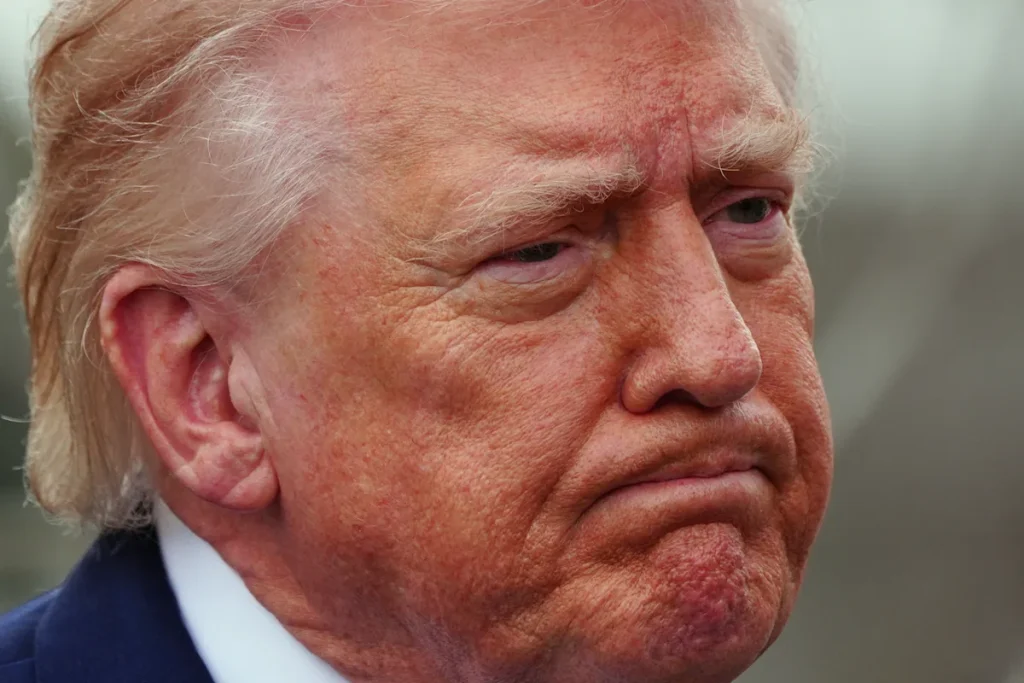
President Donald Trump often contradicts himself, sometimes within the same speech, social media post or even sentence. Over the past 24 hours, he has sent a series of mixed signals about the war with Iran, raising more questions about the direction of the conflict and his government’s strategy.
Within hours on Friday, Trump said he was considering ending the war, his administration confirmed it would send more troops to the Middle East and in an effort to lessen the economic impact on global energy markets, the United States lifted sanctions on some Iranian oil for the first time in decades, easing pressure that Washington has traditionally used as leverage.
The confusing mix of actions deepens a sense among Trump’s critics that the United States and Israel are waging a war against Iran without a clear long-term strategy. Now in its fourth week, the war remains on an unpredictable path, with a credible outcome unclear despite a turbulent global economy.
“Ending” the war
“As we consider winding down our great military operations in the Middle East, we are very close to achieving our goals,” Trump said on his social media networks on Friday afternoon after another difficult day in financial markets.
Trump claimed that the United States had sufficiently weakened Iran’s naval, missile and industrial capabilities and prevented Tehran from acquiring nuclear weapons.
The Republican president later said the United States could withdraw from the conflict without destabilizing the Strait of Hormuz, through which about a fifth of the world’s oil supplies are transported. During the war, the strait suffered damage from Iranian missile, drone and mine attacks.
“When necessary, the Strait of Hormuz must be guarded and regulated by other countries using the strait — but not the United States!” Trump wrote. But another contradiction is that he said the United States would help if requested, “but once the Iranian threat is eliminated, it will not be necessary.”
While oil that crosses the channel is typically destined for Asia and elsewhere rather than North America, the chaos still affects the United States. Oil is bought and sold around the world, so oil shortages in Asian countries have also led to higher prices for oil sold to U.S. companies.
That fact, combined with Israeli attacks on Iranian gas fields and Iranian retaliation that paralyzed a major terminal transporting liquefied natural gas from Qatar, contributed to U.S. stocks falling on Friday, with the S&P falling 1.5%. U.S. fuel prices have also risen sharply.
The United States sends more military forces to the Middle East
Although Trump said the United States was close to ending the war, the administration announced it would send three more warships and about 2,500 Marines to the Middle East. This is the second time this week that the government has said it will deploy more troops to the conflict. The military says about 50,000 people support the war effort.
Trump has ruled out sending ground troops, although his administration has hinted that Special Forces or similar forces may be deployed.
The Marines sent to the area were an expeditionary force designed for rapid amphibious landings, but their deployment did not mean a ground invasion was certain. Analysts say the U.S. military may need to be stationed there to ultimately ensure the security of the strait.
The troop surge comes just one day after news broke that the Pentagon is seeking an additional $200 billion from Congress for war funding. This extremely high number does not mean that the war is winding down.
Sanctions on Iranian oil sales
The U.S. government said it would lift sanctions on Iranian oil sales if the oil was already at sea as of Friday. The move is intended to help reduce soaring energy prices by allowing Iran to sell oil more freely through the strait. It also extends a financial lifeline to the Iranian government targeted by Trump.
His administration has tried other methods to lower oil prices. It tapped into the U.S. strategic oil reserves and lifted sanctions on some Russian oil. However, Brent crude oil remained at $112 a barrel on Friday, and analysts said that regardless of the next step in the war, oil prices are likely to remain high for months.
Treasury Secretary Scott Bessent writes on X that Iranian oil will eventually reach another country, but now the United States and its allies can also bid for it.
“Currently, sanctioned Iranian oil is being hoarded by China at low prices,” Bessant wrote. “By temporarily freeing up existing global supplies, the United States will quickly bring approximately 140 million barrels of oil to global markets, expanding global energy supplies and helping to relieve temporary supply pressures caused by Iran.”
While 140 million barrels may seem like a lot, it only amounts to a few days’ worth of oil on the global market.
Patrick De Haan, director of petroleum analysis at U.S. fuel tracking service GasBuddy, said he did not expect the temporary shutdown to have a significant impact on natural gas prices. He said the impact of closing the strait would actually be much greater. “As long as the Channel remains silent, prices will likely continue to rise,” DeHaan said.
And the contradiction in this position is evident in Bessant’s post announcing the move, which called Iran the “smuggler of global terrorism.” He said the government would take steps to prevent Tehran from profiting from the sales, but it was unclear how that would be done.
Even among some Republicans, the contradictions have fueled rare public skepticism.
“Bomb Iran with one hand, buy Iranian oil with the other,” South Carolina Rep. Nancy Mace posted on X on Saturday.
___
AP Business Writer Dee-Ann Durbin in Ann Arbor, Michigan, contributed to this report.