


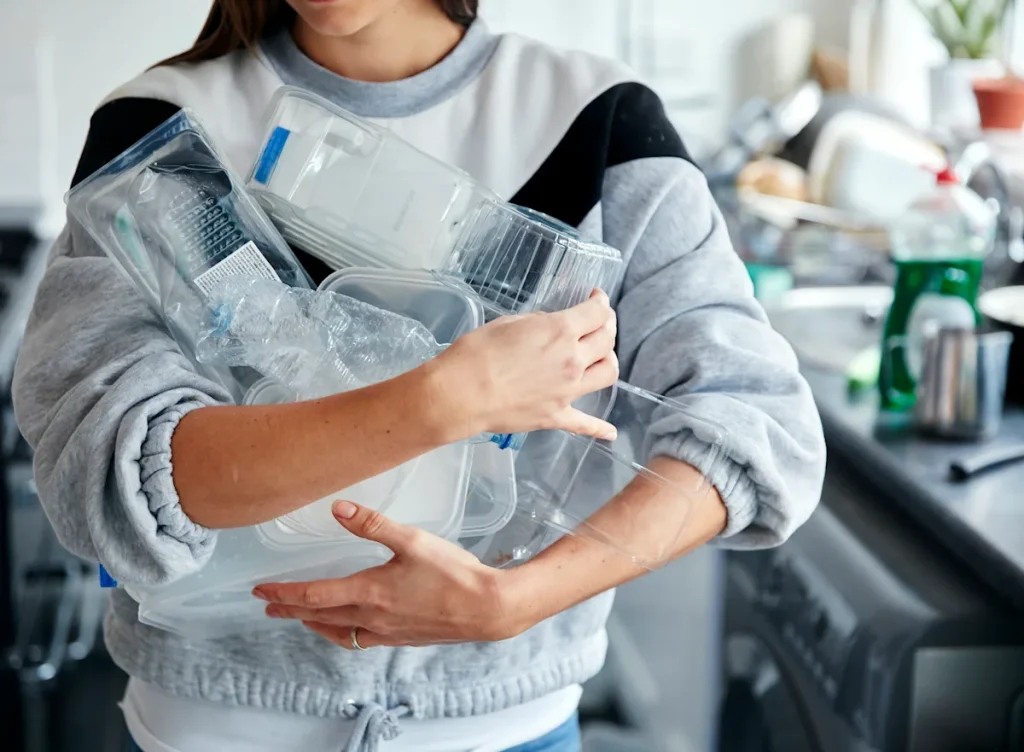
As British households prepare to put away their Christmas decorations for a year, many will also consider clearing out before a new start in 2026.
As well as Christmas trees and the odd unwanted present, expect to see plenty of families racking their brains as to how best to declutter their homes and get rid of mountains of ‘stuff’ that should have been thrown away months ago – many of which will be made of plastic.
Cheap, lightweight and (mostly) durable, plastic is ubiquitous in British homes, used in everything from food packaging to toys to kitchenware.
But consumer confidence in what can and cannot be recycled often remains a barrier to more people sifting through their trash and putting it in the right bin.
According to a study by climate action charity WRAP, 82% of UK households have added one or more items to their recycling collection that are not accepted locally. A study by the British Plastics Federation (BPF) found that 70% of people would recycle more plastic if they had a better understanding of which plastics could be recycled at home.
Worryingly, official figures show overall recycling rates have “leveled off” in recent years and the government hopes a series of initiatives, including new methods for household recycling that came into effect in March this year, will boost the figures.
But in the meantime, there’s a lot people can do, including learning more about what the recycling symbols on plastic packaging actually mean.
What does the recycling symbol mean?
While recycling can be a bit of a minefield, most manufacturers try to provide labels to indicate what something is made of and whether or how it can be recycled appropriately.
However, just because a product doesn’t have one of these labels, it doesn’t necessarily mean it can’t be recycled.
If in doubt, check the materials and consult your local government.
Recycle Now, the recycling campaign group covering England and Northern Ireland, has put together a practical guide on how to identify which plastic products can be recycled.

Symbols and icons on products and packaging can provide a wealth of recycling information – if you know what you’re looking at.
What they mean is this:
1. One of the most common recycling labels, this indicates that packaging is widely collected by local authorities for sorting, processing and recycling.
2. Similar to the previous label, but with additional instructions to make the product suitable for collection, in this case rinsing or cleaning. This is often used in food packaging to minimize contamination and deter pests.
3. Again, like the previous two labels, this indicates that the product can be recycled, but certain conditions need to be met. This is typically used for items such as soft drinks and milk cartons with lids.
4. This usually indicates that although the item can be recycled, it may not be accepted for the usual household kerbside collection (although you should check with your local authority first). Many supermarkets and other large stores can recycle such products.
5. This badge applies to material collected by less than half of UK local authorities. This is because the product is not recycled or parts of it cannot be recycled.
6. “Sapling” means that the packaging on which it is printed is industrially compostable. Compostable plastics bearing this symbol should be recycled with garden waste.
7. The “green dot” symbol indicates that the company that manufactures the product has made a financial contribution to the recycling program, but this does not necessarily mean that the product is recyclable.
8. The “Möbius strip” is perhaps one of the most well-known yet misunderstood recycling symbols. This indicates that an object can be recycled, but does not indicate that it is widely accepted for recycling. Sometimes it may include a percentage in the middle to indicate how much recycled material it contains. Plastic bottles, glass jars and newspapers often carry the “Mobius” symbol to indicate that they are made from recycled materials.
How will plastic recycling change in 2026?
Plastic recycling in the UK is set to undergo a major overhaul this year thanks to the government’s ‘Easier Recycling’ scheme.
From 31 March, all local authorities in England will be required to collect “core recyclable waste streams” (glass, metal, plastic, paper and card and food waste) from all households in England in a bid to eliminate the “postcode lottery” currently faced by households.
This is also to standardize recycling across areas, with paper and card being collected in one bin, while other recyclable materials such as plastics, glass and metal will all be collected in another bin.

Not even heavy snow can stop rubbish collection in Aberdeen, Scotland. (Alami)
Households should ultimately have four waste containers for:
-
Other dry recycling such as plastics, metals and glass
-
Food waste (mixed with garden waste if applicable)
From 31 March 2027, more plastics that previously ended up in landfill or incinerators from kerbside bin recycling will be added to this.
This includes some plastics that Brits might think have been recycled, but actually haven’t, such as plastic film and so-called “squeezable” plastics.
Any plastic labeled “compostable” or “biodegradable” will not be recycled in kerbside plastic collections. These include popular items such as coffee pods.
Plastic bottles containing motor oil, paint, antifreeze or white spirit cannot be recycled.
Polystyrene (often used in bubble wrap or packaging beads) and polyvinyl chloride (PVC) packaging used in shrink wrap and blister packaging will also not be recycled.
How much plastic is recycled in the UK?
Hopefully new recycling initiatives that come into effect this year will keep more plastic out of nature. (Getty)
Plastic waste typically does not break down and can persist in landfills or the environment for centuries, potentially contaminating rivers, oceans and soil.
Plastic recycling data in the UK can be difficult to collate due to the large volumes, uses and types in circulation.
A survey last year by Greenpeace UK and Daily Plastic revealed that British households throw away 1.7 billion pieces of plastic packaging every week.
However, while this will include some items that can be recycled, some of them will also be products that are not intended to be reused, such as food packaging and bin liners. For example, around 35.8 million plastic bottles are used every day in the UK, but only 19.8 million are recycled.
According to Greenpeace UK, only 17% of plastic used in the UK is recycled domestically.
A report from the House of Commons Library last year suggested the total was likely to be much higher, with 50% of plastic produced in the UK being recycled domestically or overseas. It also reiterates the UK’s stated target to eliminate avoidable plastic waste by the end of 2042.