


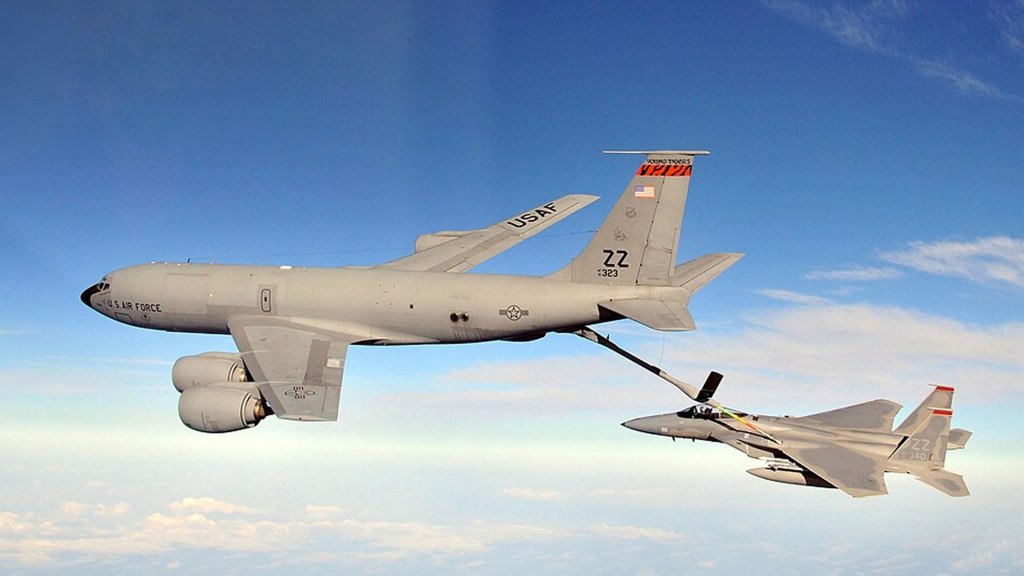
After a US Boeing KC-135 “Stratotanker” tanker crashed in Iraq on Thursday (March 12), it was discovered that the crew may not have had a parachute. The kits were reportedly removed in 2008 to save time and money.
The crash is part of the ongoing U.S. Operation Epic Fury in Iran, and officials with the operation have confirmed that the damage was not caused by enemy or friendly fire. According to reports, two KC-135 aircraft participated in the operation, the second of which landed safely.
This is the first KC-135 crash since 2013, when a plane with three crew members on board crashed in the Kyrgyz Republic due to a flight control system malfunction while on a combat air refueling mission.
Reports at the time showed that there were five crew members on board the missing KC-135 when the incident occurred, and no casualty report has yet been released publicly. U.S. officials also confirmed that rescue operations are underway to find and recover the missing crew members.
KC-135 lost in Iraq campaign
The KC-135 is a derivative of the early Boeing 747 airframe and can weigh up to 130 tons when fully loaded. They can operate at altitudes of 30,000 to 40,000 feet, serving as flying refueling stations for fighters, bombers and aerial reconnaissance aircraft.
The exact cause of the crash has not been disclosed, but it was likely caused by a mechanical failure, an aerial refueling accident or a fuel system failure. Other possibilities include structural failure or controlled flight into terrain.
On the face of it, however, the most surprising thing was the crew’s apparent lack of parachutes. However, it turns out that this situation is not uncommon for such aircraft.

“It may sound strange to remove a parachute from a military aircraft, but the KC-135 is unlike other aircraft. They are rarely involved in accidents, and the likelihood that a KC-135 crew will need to use a parachute is extremely low,” an Air Force press release stated in 2008.
“However, purchasing, maintaining and training to use parachutes costs significant time, manpower and money. According to the Air Force’s 21st Century Intelligent Operations Plan (commonly known as AFSO 21), the Air Force is keen on cost savings and efficiencies, so parachutes are considered obsolete,” it added.
Most large military and civilian aircraft often do not carry parachutes, including passenger aircraft, cargo aircraft, early warning aircraft, etc. Instead, safety principles focus on redundant systems, controlled emergency landings and crew resource management to try to land the aircraft safely without parachuting.
A parachute probably won’t help anyway
Even if crews had them, they are unlikely to be able to use them safely, escape the aircraft at high altitudes, and survive an emergency. For fighter ejection seats and other aircraft with specially designed escape systems, parachutes make more sense.
So, from that perspective, it’s not surprising that the KC-135 doesn’t have a parachute. Even more worrying is that the KC-135 is now very old (first manufactured in the late 1950s) and is in urgent need of retirement or upgrade.
The airframe is currently scheduled to remain in service until at least 2050, but upgrade plans have been continually delayed. It is now hoped that this latest tragedy will force the issue to prevent more similar losses in the future.
“Please remember these brave Airmen, their families, friends and troops,” Gen. Dan Kaine, chairman of the Joint Chiefs of Staff, told media during a Pentagon briefing on the matter. “In the hours and days that followed, our service members made incredible sacrifices to keep going and do what their country asked of them,” he added.