


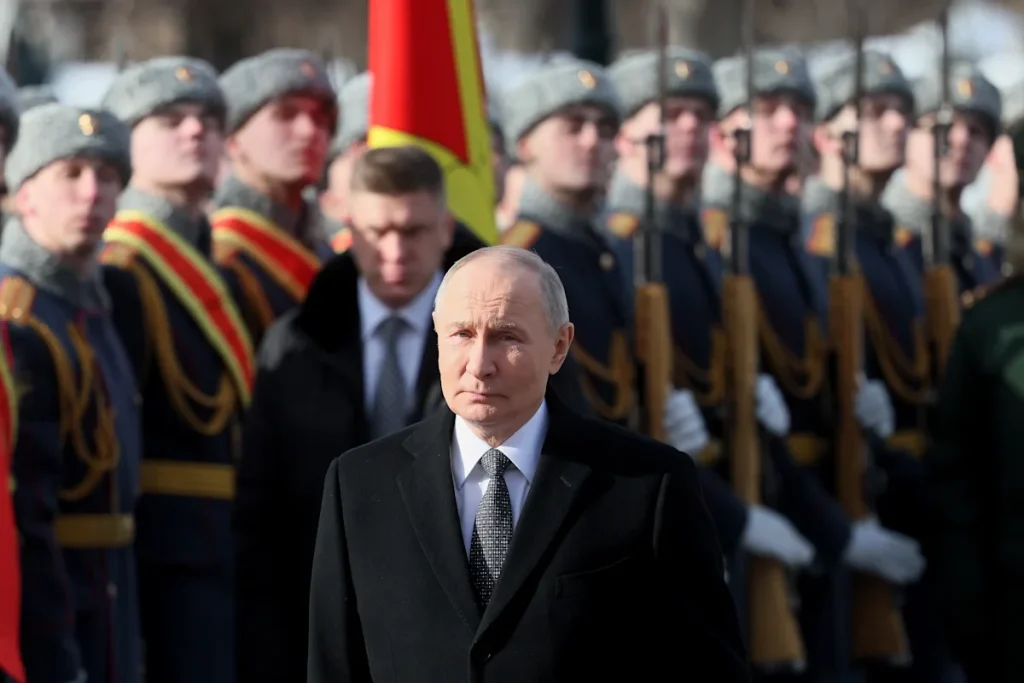
With U.S.-brokered peace talks in Ukraine on hold due to the war in the Middle East, Russian President Vladimir Putin is expected to try to expand military gains by launching a new offensive against the neighbor, which could put more pressure on Kyiv.
Windfalls from soaring global oil prices are filling Moscow’s war coffers, while U.S. air defense assets are rapidly being depleted by Iranian attacks in the Gulf, raising concerns that Ukraine will have little left in the fifth year of a full-scale Russian invasion.
Ukraine’s European allies have pledged to maintain their staunch support, but the ongoing dispute over a massive 90 billion euro ($106 billion) EU loan to cover Kyiv’s two-year military and economic needs reflects growing challenges.
NATO allies have refused to commit naval assets to help restore tanker traffic in the Strait of Hormuz, drawing an angry rebuke from President Donald Trump and highlighting another emerging fault line fraught with potential implications for Ukraine.
Ukrainian President Zelensky has dispatched more than 200 military experts to the Gulf region to provide their expertise in defending against Iranian Shahd drones in an attempt to attract Washington’s attention. However, Trump dismissed Zelensky’s offer of help, saying the United States did not need Kyiv’s aid.
As new rifts emerge in the Western alliance, Putin and his generals are considering plans for a spring and summer campaign across more than 1,200 kilometers (about 750 miles) of frontline.
Russia may launch new push
The Russian military appears to be preparing to launch another offensive to seize territorial sovereignty in the eastern Donetsk region still under Ukrainian control, and may launch offensives in several other areas.
Analysts have observed that Moscow has been building up reserves and its actions are expected to accelerate as spring warmth dries out the terrain.
The Washington-based Institute for the Study of War (ISW) noted that Russian forces have stepped up artillery attacks and drone strikes in an attempt to weaken Ukraine’s defenses ahead of a ground attack.
Ukraine is trying to undermine the Kremlin’s plans by launching counterattacks in the Dnipropetrovsk and Zaporozhye regions, where Russian forces are trying to carve out bridgeheads to advance toward the regional capital, which is a key industrial hub.
The ISW said in a recent battlefield assessment that successful Ukrainian retaliation in the Dnepropetrovsk region may continue to force Russia to “choose between defending against Ukrainian counterattacks and allocating manpower and materiel for offensive operations elsewhere on the front,” potentially undermining Russia’s anticipated offensive.
The report also stated that Ukrainian forces have stepped up medium-range strikes against Russian logistics, military equipment and manpower in an attempt to disrupt the expected offensive.
Russian war bloggers have warned that Moscow would need a significant troop buildup to launch any major offensive, posing a challenge to the Kremlin.
Early in the war, the Russian army “partially mobilized” 300,000 reservists and caused hundreds of thousands to flee the country to avoid conscription, sparking widespread unpopularity. The Russian military has since changed tactics, relying on volunteers and recruiting foreign fighters attracted by considerably higher wages and other benefits.
Putin said Russia has about 700,000 troops fighting in Ukraine, roughly the same number reported in Ukraine.
“A slow war of attrition”
In the early days of Russia’s 2022 invasion, with large numbers of tanks and mechanized infantry engaged in rapid maneuvers, the fighting has turned into a war of attrition, with small groups of soldiers engaged in fierce house-to-house fighting in the devastated towns and villages of eastern Ukraine. The ubiquity of drones limits troop concentration for any major operation.
Russia also relies on long-range missiles and drones to attack Ukraine’s energy facilities and other critical infrastructure.
Jack Watling, an analyst at Britain’s Royal United Services Institute, said Russia had been able to penetrate and disrupt Ukrainian defenses over the past year due to the “increasing lethality” of Moscow attacks and declining troop levels in Kiev.
He added that “despite the heavy human toll” in Ukraine, “Russia will likely be able to maintain its current recruitment pace.”
As part of preparations for a new offensive, Russia has increasingly sought to recruit students into its newly formed drone force, offering relatively high pay and deploying at a safe distance from the front lines.
Director of National Intelligence Tulsi Gabbard told the Senate Intelligence Committee on Wednesday that “Russia maintains the upper hand in its war with Ukraine.”
She said U.S.-led negotiations between Ukraine and Russia “are ongoing. Until such an agreement is reached, Moscow will likely continue to fight a slow war of attrition until they feel their goals have been achieved.”
deep-rooted stance
Several rounds of negotiations have not yielded a clear breakthrough, and the two sides still have serious differences on key issues.
Putin wants Ukraine to withdraw its troops from four regions that Russia illegally annexed but never fully occupied, abandon its membership of NATO, drastically reduce its military and lift restrictions on the Russian language and the Moscow-affiliated Orthodox Church — demands that Zelensky has rejected.
Zelensky has called for a ceasefire, U.S.-backed security guarantees to prevent another invasion by Moscow and rejected claims to Ukrainian territory.
Kiev’s European allies accuse Moscow of dragging out talks in the hope of gaining more and insist Europe must be present at the talks. Kremlin spokesman Dmitry Peskov rejected their involvement, saying “we do not consider it necessary or expedient.”
Moscow said it would not allow any European troops to monitor future ceasefires and would treat them as legitimate targets.
Zelensky said he sent a negotiating team to the United States for talks on Saturday, but Peskov said Russia would not join them, adding that the time and venue for another round of trilateral talks had not yet been determined.
Sam Green, a professor at King’s College London, said in a commentary that Moscow’s strategy is clear – “engagement with Washington is enough to prevent Ukraine from getting what it needs to change the balance on the ground, and enough to deter the Europeans, but not enough to make real progress.”
Trump targets Zelensky
The United States has granted Moscow a temporary exemption from oil sanctions, allowing the sale of Russian crude already at sea, frustrating Kiev and Europeans.
In addition, Trump also viewed Zelensky as an obstacle to peace. “He’s got to act, he’s got to make a deal,” Trump said of the Ukrainian leader earlier this month.
He told NBC News that while Putin was ready to reach a deal, “it would be much more difficult to reach a deal with Zelensky.”
Trump also rejected Zelensky’s offer to help protect U.S. troops and their Gulf allies from Iranian drone attacks. “No, we don’t need their help with drone defense,” Trump told Fox News Radio.
Zelensky, who took a more pragmatic public stance with Trump after a contentious White House meeting in February 2025, expressed growing concern that a war with Iran could harm Ukraine.
He told the BBC this week that he had a “very bad feeling” about the impact of the Middle East conflict on Ukraine’s war, noting that peace talks were “continuously delayed” while Russia profited from high oil prices and Ukraine could face a shortage of US-made Patriot missiles.