Site icon Technology Shout

Trump has said tariff revenues could pay for at least 9 different things; Democrats say tariffs have cost each American household $1,200

President Trump has floated at least nine different plans for how revenue from his tariffs could be spent, according to an analysis from Yahoo Finance’s Ben Werschkul, dating all the way back to the 2024 presidential campaign.

The promises have included everything from sending Americans $2,000 tariff dividend checks to paying for the tax cuts that Republicans instituted over the summer.

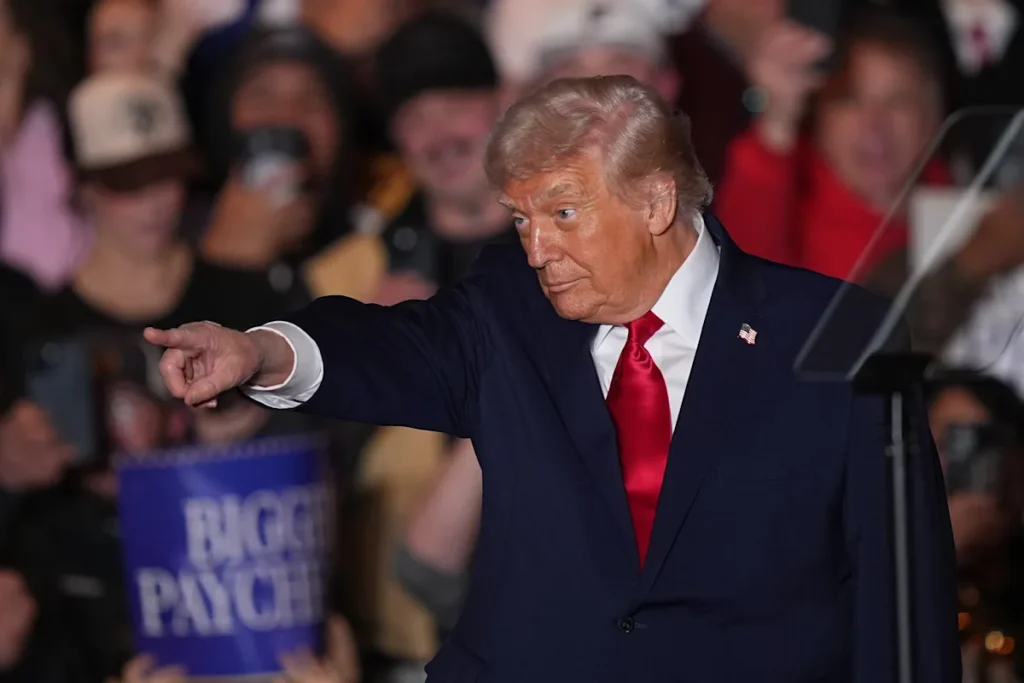
During a recent rally in Pennsylvania, Trump reiterated his feelings for the word “tariffs” during his remarks, telling the audience “I love it more than any other word in the dictionary.”

But after lifting some tariffs on items like coffee, oranges, and cocoa, monthly tariff revenues dropped, from $31.35 billion received in October to $30.76 billion last month. That marks the first decrease since Trump began implementing the duties.

Looming over all the tariff talk is the Supreme Court decision that could not only invalidate most of the new tariffs, but possibly force the government to issue refunds of up to $100 billion.

The administration announced a $12 billion bailout fund for farmers on Dec. 9, as the agricultural sector has been hard hit by tariff fallout. That money “would not be possible without tariffs,” the president said.

Soybean exports have come in particular focus, with trade slowing to a crawl as China virtually halted its purchases before the countries agreed to a trade truce in October.

Despite welcoming the support, US farmers have said they need more than a $12 billion aid package to fully offset low crop prices and lost export opportunities due to Trump’s trade war.

The farm bailout comes amid an increased push on Americans’ price concerns. In an interview published Tuesday, Trump allowed he may look for “some” additional carveouts, weeks after his administration slashed tariffs on items like beef, coffee, and bananas.

Read more: What Trump’s tariffs mean for the economy and your wallet

  • Following Trump’s acknowledgment that Americans are paying “something for tariffs,” Democrats estimate that on average, US households have paid nearly $1,200 in additional costs as a result of the duties.

  • Indonesia said that it hopes to conclude its trade agreement with the US by the end of 2025. This week, reports emerged that the trade deal between Washington and Jakarta was at risk of collapse due to Indonesia’s failure to implement its side of the agreement.

  • Trump gave the green light on Monday for Nvidia (NVDA) to sell some of its more powerful H200 chips to China. The US president said that China’s Xi Jinping had responded “positively” to the move.

  • Several US companies, such as Costco (COST), have filed lawsuits and claims to the US government for tariff refunds in the belief Trump’s tariffs will be struck down by the US Supreme Court. If the courts rule against Trump’s tariffs, the president may be forced to repay billions of dollars in collected revenue from imports, according to a report in the New York Times.

LIVE 150 updates

  • Trump voters give the president mixed reviews on how his tariffs are affecting their spending power

    The majority of a group of 24 Trump voters told Reuters that they still support the president, and believe his economic policies will eventually lead to lower prices. While most acknowledged feeling the pain of the uptick in the costs of everyday goods, some argued President Trump did not have control over everyday costs.

    However, not all of them agreed with how Trump had implemented his tariffs.

    Reuters reports:

    Read more here.

  • How China racked up a $1T trade surplus

    President Trump’s tariffs have dominated much of the news this year, from tit-for-tat levies to on-and-off trade negotiations, but one thing that has remained unstoppable amongst all the tariff noise has been China’s trade.

    The Financial Times has looked at how China racked up a $1 trillion trade surplus, when most countries struggled.

    The FT reports:

    Read more here.

  • Americans are paying ‘something’ for tariffs, Trump says. Democrats say it’s around $1,200.

    President Trump said last month that the American people are “paying something” for tariffs.

    Democrats have tallied up what they say is the actual cost.

    Democrats on the bicameral Joint Economic Committee (JEC) have estimated that, on average, US households are paying nearly $1,200 in additional costs due to Trump’s tariffs.

    The Hill reports:

    Read more here.

  • Indonesia targets concluding tariff deal with US by year end

    Indonesia hopes to conclude its trade agreement with the US by the end of 2025. This week, reports emerged that the trade deal between Washington and Jakarta was at risk of collapse due to Indonesia’s failure to implement its side of the agreement.

    Growing tensions between the US and Indonesia have threatened to unravel ties between the two countries, prompting Jakarta to announce that it will send a delegation to Washington next week to discuss the matter and finalize what was agreed upon by leaders in July.

    Coordinating Minister for Economic Affairs Airlangga Hartarto spoke to US Trade Representative Jamieson Greer on Thursday.

    Bloomberg News reports:

    Read more here.

  • Emerging markets are shrugging off Donald Trump’s tariffs

    The FT reports:

    Read more here.

  • Trump’s tariffs intensify strain on US farmers, Deere warns

    Deere (DE) has warned that President Trump’s tariffs are backfiring on US farmers, prompting some to delay replacing outdated or old equipment.

    The FT reports:

    Read more here.

  • Trump, Modi speak as US-India trade talks inch forward

    President Trump and India’s Prime Minister Narendra Modi have spoken in a bid to ease trade tensions between the two sides. Modi said the conversation was “warm and engaging” and added that they had “reviewed the progress for bilateral relations and had also discussed regional international developments.”

    Trump imposed 50% tariffs on India, 25% of which was due to India’s purchase of Russian oil. Hints that both sides were trying to reconcile and restart trade negotiations emerged earlier this week, with the arrival of US officials in New Delhi.

    Bloomberg news reports:

    Read more here.

  • US trade deficit narrows in September to hit smallest margin in more than 5 years

    The US trade deficit narrowed in September to its smallest margin in more than five years, as exports increased healthily and imports grew slightly.

    The deficit shrank by 10.9% to $52.8 billion, according to data released by the Department of Commerce on Thursday, marking the lowest level seen for the measure since June 2020.

    Exports rose 3% to $289.3 billion in the month, while imports rose by a much softer 0.6% to $342.1 billion. The month saw noted strength in consumer goods exports, which reached a record high in September, while on the other side, imports of automotive vehicles, engines, and other parts fell to their lowest level since November 2022.

    The real goods deficit narrowed by 5.6% on the month, equal to $4.7 billion. Making up that figure, real exports of goods gained 4.2% against a gain in nominal goods exports of 4.9%, while real imports of goods gained 0.7% equal to a gain of 0.7% in nominal goods imports.

    Notably, the US’ trade deficit with China — a longtime preoccupation of the Trump administration and President Trump personally — shrank to $11.4 billion from a previous $15.4 billion, a change of roughly 25%.

  • US can replicate revenues if Supreme Court rules against IEEPA tariffs: Greer

    US Trade Representative Jamieson Greer said on Wednesday that the US will other measures to recreate the $200 billion in revenues it is collecting under tariffs if the Supreme Court shuts down the use of the International Emergency Economic Powers Act that the Trump administration is currently using.

    Reuters reports:

    Read more here.

  • How Trump’s tariffs forced China to pivot – and export more

    CNN reports:

    Read more here.

  • Tariff revenue dipped slightly in November after Trump pulled back on grocery store duties

    Yahoo Finance’s Ben Werschkul reports:

    Read more here.

  • Powell says tariffs have caused inflation ‘overshoot’

    Fed Chair Jerome Powell ‌on Wednesday pointed to President Trump’s tariffs as the reason for the current overshooting of the central bank’s 2% inflation target.

    “It’s ​really tariffs that ‌are causing most of the inflation overshoot,” Powell said, while emphasizing that the central bank expects the tariffs to represent a “one-time” increase in prices.

    “Our job is to make sure that it is,” he added.

    Powell also declined to weigh in on a reporter’s question over the impacts of a potential Supreme Court decision striking down Trump’s most sweeping tariffs.

    Read our live blog for the latest updates and analysis on the Fed.

  • China must fix economic imbalances as trade surplus hits $1T: IMF

    Bloomberg News:

    Read more here.

  • US farmers say Trump’s $12 billion aid package won’t cover losses

    US farmers have said they need more than a $12 billion aid package to fully offset the low crop prices and lost export opportunities resulting from President Trump’s trade war.

    Trump introduced the aid package for farmers this week, with the industry welcoming the support, saying it would help them prepare for the next planting season. However, the industry suggested that it is a fraction of farm losses and will not rescue the flagging farm economy.

    US farmers have faced steep losses this year due to Trump’s tariffs, saddled with low crop prices and higher costs for labor and inputs, such as fertilizers and seeds, and coupled with the decline in exports of crops like soybeans, which have dropped due to Trump’s trade dispute with China.

    Reuters reports:

    Read more here.

  • How China Inc is marching into Vietnam amid US tariffs​​​

    Reuters reports:

    Read more here.

  • US-Indonesia trade deal at risk of collapse

    The trade deal between the US and Indonesia is in danger of collapsing, The Financial Times reported Wednesday, citing people familiar with the matter. US officials have grown increasingly frustrated at what they view as Jakarta reneging on the terms of the agreement reached in July.

    The trade deal states that Indonesian goods will face a US tariff rate of 19%. Indonesia will also eliminate tariff barriers on over 99% of US products exported to Indonesia across sectors such as agriculture, health products, seafood, and technology.

    However, the report said that Jakarta is slow to implement the deal.

    The FT reports:

    Read more here.

  • Trump says his farm bailout ‘would not be possible without tariffs.’ His critics agree.

    Yahoo Finance’s Ben Werschkul reports:

    Read more here.

  • Trump suggests he may cut ‘some’ additional tariffs amid affordability push

    President Trump defended his sweeping tariff policies, but suggested in an interview on Tuesday that he may allow for “some” additional carveouts after moves to slash duties on goods that were surging in price.

    In an interview with Politico, Trump was asked whether he’d consider cutting tariffs on other consumer staples. In recent weeks, his administration has slashed duties on coffee, beef, and bananas, in a bid to address Americans’ concerns over price pressures.

    Trump said he would “on some, and on some I’ll increase tariffs.” He said the breaks he approved recently amid a voter outcry against elevated prices on groceries in particular were “very small carveouts.”

    “It’s not a big deal,” he said.

    See the full interview here.

  • Trump’s tariffs are not reducing the trade deficit

    One of the key questions being asked is whether President Trump’s tariffs are helping to close the trade deficit. For the FT’s senior trade writer Alan Beattie, the answer is no.

    The FT reports:

    Read more here.

Spread the love
Exit mobile version