


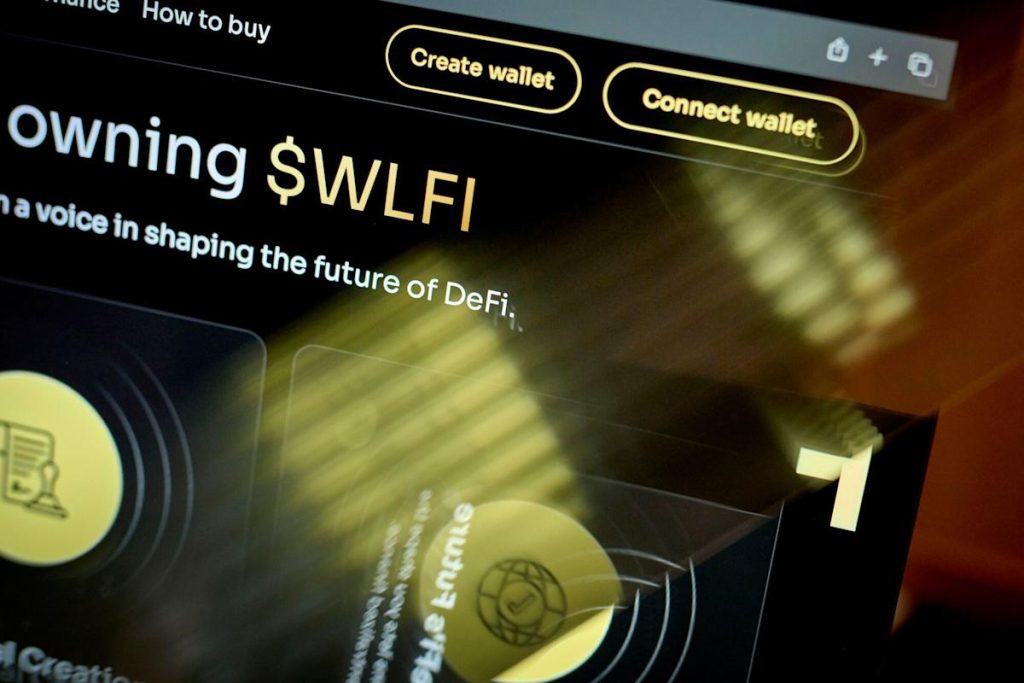
(Bloomberg) — The pitch is simple: Invest in Donald Trump and his family’s cryptocurrency ventures, back the industry’s most powerful allies at the height of their influence, and share in the spoils.
Most read from Bloomberg
Investors said yes, investing more than $550 million in two rounds of funding.
What happened next has not been publicly explained. Following the conclusion of these rounds, the project sold an additional 5.9 billion tokens to accredited private investors in transactions worth hundreds of millions of dollars, with the majority of the proceeds going to founder-affiliated entities.
The sale came to light when intelligence platform Tokenomist.ai examined World Liberty’s governance documents at the request of Bloomberg and found an increase in the number of tokens listed under founder, team, advisor and partner allocations with no apparent explanation and the project had not explained the discrepancy to its wider investor base.
World Liberty confirmed the deal to Bloomberg, describing it as a “white glove” deal with a private buyer but declined to say who the buyer was or where the money went.
What is happening has no precedent in American financial life. The family of a sitting president holds a financial stake in a real-time token project — one that sets governance rules, directs Treasury sales and collects proceeds — and those who signed up find themselves with limited exit options.
WLF was founded by members of the Trump family and the Witkoff family along with other business partners, with Zach Witkoff serving as CEO. Both Trump and Steve Witkoff, who serves as the president’s special envoy to the Middle East, are listed as honorary co-founders of the project’s website. The project recently removed a page listing its co-founders; a spokesperson said the company regularly updates its website.
According to information disclosed by the project on its website, DT Marks DEFI LLC, an entity affiliated with Donald Trump and certain family members, is entitled to 75% of the proceeds from the WLFI token sale, after deducting agreed reserves and fees. DT Marks and certain Trump family members also hold 22.5 billion WLFI tokens. World Liberty declined to say who received the funds from the additional sales.
Last year, early investors in the project had the opportunity to sell 20% of their holdings (the tokens were purchased for just 5 cents), but were unable to sell the rest. Unlike most token sales, World Liberty does not provide investors with an unlocking schedule in advance.
The White House said Trump had no role in managing the family’s cryptocurrency venture, instead handing control over to family and business partners.
“President Trump’s assets are managed by a trust managed by his children. There is no conflict of interest,” White House spokesperson Anna Kelly said.
White House counsel David Warrington said Witkoff has divested himself from World Liberty Financial and is not involved in official matters that could affect his financial interests.
Under a governance proposal currently before investors, no one (founders or early buyers) will be able to sell their token holdings for at least two years, after which the tokens will be gradually unlocked over the next few years. Investors who do not accept the new terms risk having their tokens locked up indefinitely. Insiders who accept the vesting plan will also be required to permanently destroy 10% of their token allocation, a structure the project says is designed to align the interests of founders and investors.
“We are confident in this vision and take a long-term view on everything we do, from our fundraising efforts to crafting governance proposals designed to benefit the entire ecosystem,” said World Liberty Financial spokesman David Wachsman.
The broader Trump family business has been reshaped by cryptocurrencies. The family built its fortune off licensing the Trump name — real estate, Bibles, sneakers — but digital assets have opened up new revenue streams.
For WLO investors, things turned out differently than many expected. Early buyers are still unable to hold 80% of their tokens and sell into an already volatile market. WLFI fell below 6 cents in public trading this week, setting a new low.
“It is surreal that the Trump family not only profited from this financial enterprise with a clear conflict of interest, but also profited in a way that prevented other investors from sharing in the profits,” said Eswar Prasad, a professor at Cornell University.
The project’s most high-profile outside backer has decided to step in.
Justin Sun, the billionaire founder of the Tron blockchain, sued the company in San Francisco federal court in April, accusing it of extortion and an illegal scheme to seize its tokens, charges the project’s co-founders have denied. Sun claimed he invested $45 million in WLFI but was not allowed to sell any tokens.
Syed Sameer, CEO of Sameer Group, a Dubai-based investment firm, said he has invested in the WLFI token along with UAE institutional partners. Sameer Group issued an offer for X to Sun and offered to help negotiate a solution.
“Sun can reach an amicable solution through a neutral intermediary rather than through a legal battle,” Saeed told Bloomberg. Sun told Bloomberg that he forwarded Saeed’s contact information to his lawyer.
In addition to the lawsuit, the project has deposited 5 billion of its WLFI tokens into Dolomite, a decentralized lending protocol, and its co-founders, who hold positions at World Liberty, have borrowed approximately $75 million in stablecoins with these tokens. Critics say the structure could allow insiders to convert their holdings into cash rather than wait for an unlock that could take years. World Liberty said the position was “nowhere near liquidation” and that a $25 million loan had been repaid, with $50 million outstanding as of mid-April.
As the token price falls, World Liberty’s broader corporate trajectory is showing stress. Alt5 Sigma, a Nasdaq-listed company that raised $1.5 billion to accumulate WLFI tokens in August 2025, announced its shift to artificial intelligence. A recent filing said it may “redeem or monetize a portion of its token holdings to fund operations, meet obligations or pursue strategic initiatives.” Alt5 CEO Tony Isaac told Bloomberg that the company has no plans to sell the token and may in fact continue to accumulate it.
World Liberty co-founder and CEO Zach Witkoff serves as chairman of Alt5’s board of directors. World Liberty co-founder Zak Folkman also serves on Alt5’s board of directors.
Problems arise that require a broader reckoning. Across the Trump family’s crypto empire — memecoin is down more than 40% this year and 93% from its post-inauguration peak; Bitcoin mining companies have seen their share prices plummet; and now Alt5, down about 90% since its shift to accumulating WLFI — the pattern is similar: Projects that thrived on the Trump brand are now pivoting or retooling as the political trading that fueled the initial enthusiasm collides with a cooling crypto market. Anyone who bought shares of Truth Social parent company Trump Media & Technology Group over Inauguration Weekend 2025 lost about three-quarters of their money.
There is little formal recourse for investors affected by market disruptions. Token projects operate beyond the regulatory requirements for public companies—no audited financials, no mandatory reporting of insider trading, and no independent board oversight.
“Foundation funds are at the project’s discretion, and there are no mandates to disclose or limit how they are used,” said Tanawat Chiewhawan of Tokenomist.ai. “Some projects also allocate Treasury tokens in rounds to private investors.”
—With help from Anne Massa and Jeff Mason.
Most read from Bloomberg Businessweek
©2026 Bloomberg