


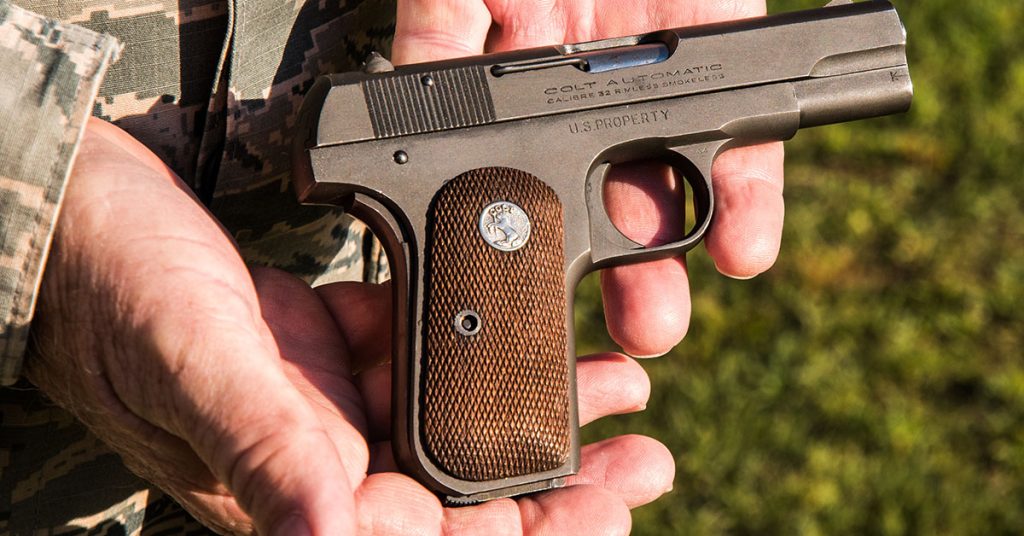
Today’s gun market is flooded with handguns designed and marketed for concealed carry.
However, when semi-automatic (then called automatic) self-loading pistols first appeared at the turn of the 20th century, one sidearm stood out and remained the Army-issued sidearm into the 1970s. Of course, it was designed by John Moses Browning.
RELATED: You Could Be the Next Owner of Darth Vader’s Revolver
Browning is best known for legendary firearms such as the 1911 pistol and the M2 .50 caliber machine gun, but he did not design the first commercial semi-automatic pistol. That honor goes to Hugo Borchardt’s 1893 C93. However, Browning’s simple recoil operating system and reciprocating slide design are still in use today. These groundbreaking features first appeared on the FN 1900 pistol, which quickly became popular in Europe and around the world.
In fact, the name “Browning” was once synonymous in Europe with any semi-automatic pistol with a slide.


John Moses Browning is considered the most famous and influential firearms designer in history. (National Museum of the United States Air Force)
Seeing the success of the FN, Colt wanted to enter the market and asked Browning to design a semi-automatic carry pistol for them.
An agreement existed at the time that allowed Colt to sell Browning designs in North America, the UK and Ireland, while FN could be sold in much of the rest of Europe. Other regions are also fair game. Targeting the civilian concealed carry market, Browning created the Colt Model M 1903 compact hammerless pistol.
Choosing both sides, Browning also designed a 1903 pistol for FN, which was basically an enlarged version of the Colt pistol for the European military market. At the same time, Browning also developed a military pistol for Colt called the 1903 Pocket Hammer; the 1903 Pocket Hammer was a compact version of the Colt 1902, derived from the Colt 1900, which was completely separate from the 1903 Pocket Hammerless, which later evolved into the famous Colt 1911.

So simple, a caveman could carry it. (public domain)
Despite the name, the 1903 Pocket Hammerless actually used a shrouded internal hammer to help make it portable.
To indicate whether the hammer is cocked, the thumb-operated safety lever is engaged only when the hammer returns. Additionally, the grip safety only protrudes when the hammer is cocked. Although associated with 1911, the term “cocked and locked” first appeared in a 1903 patent. In an era when true pocket carry was common, having the heel magazine release located above the side button also improved the pistol’s portability.
The release of the 1903 was a huge success for Colt. Equipped with a 4-inch barrel and eight rounds of .32 ACP ammunition, the Model I 1903 is a game changer in the concealed carry market. In the words of the iconic Eli Duckworth, the Colt 1903 was the SIG Sauer P365 of its time. In an America dominated by revolvers large and small, Colt’s semi-automatic pocket pistol is the only gun of its kind. Additionally, .32 ACP is as common as 9mm is today.
In 1908, Colt shortened the barrel of the 1903 Type II by a quarter inch and introduced a .380 ACP version in the Model M 1908, which had its own serial number range. Just two years later, the Type III’s bushing barrel was changed to a bushingless design. This version ran until 1926 and was the most common version in the 1903s.
Although the pistol saw limited adoption by the U.S. Navy and Belgian Army during World War I, it saw widespread use during both world wars.
When Bonnie Parker breaks Clyde Barrow out of prison, she has a piece of duct tape on her thigh. Al Capone reportedly kept a 1903 in his coat pocket as his personal weapon. When John Dillinger was shot and killed by federal agents in Chicago, he was reportedly reaching for a Colt Model M, purportedly a 1908 .380 ACP pistol, in his pants pocket. The Model 1908 Alert, on the other hand, was issued by the Shanghai Municipal Police under the command of William Fairbairn, the father of modern SWAT, who went on to train Allied commandos during World War II.

General George Patton has his issued M tank hanging from his hip. Note the star on the pistol grip. (public domain)
In 1926, Colt introduced the Type IV magazine safety and the Type V military sight. The Model 1903 pistol was changed from blue to phosphorized in 1941 and was purchased by the War Department and sent to intelligence officers, as well as to England. From there, the 1903 rifles were supplied to resistance fighters and carried behind enemy lines by SOE and OSS commandos. The popularity of the .32 ACP made it easy to keep handguns loaded in occupied Europe.
Notably, an SOE-trained Czech agent carried a 1903 when he assassinated Reinhard Heydrich, a key architect of the Holocaust, in Prague.
In 1944, the military began issuing Colt 1903 and 1908 pistols with belts and holsters to generals. This marked the beginning of the General’s pistol program that is still ongoing today. After retiring, the general has the opportunity to purchase a general pistol. As a result, Colt Model Ms with the “US Property” logo and serial numbers related to famous generals entered the civilian market. The Colt Model Ms continued to be issued as the General’s pistol until supplies were exhausted and the model was replaced in 1972 by the 1911 Improved M15.
Colt produced approximately 570,000 1903s and 138,000 1908s. As a result, these historic but often overlooked pistols can be found second-hand with relative ease. Of course, samples in better condition can fetch higher prices. New production MS Types are manufactured by US Armament under license from Colt, and replacement parts are readily available for Type III and newer models.
While .32 ACP and even .380 ACP are considered underpowered by today’s standards, there’s something special about carrying a Colt 1903 over a P365 or other polymer pistol. After all, Humphrey Bogart carried the 1903 product in classic films like “Casablanca” and “Key Largo.” Do you think you’re cooler than Bogie or any other legend carrying a Colt Model M?
Don’t miss the best we are strong
• The most orthodox military watch specially built for doomsday battles
• Marine Corps rejects Army’s SIG M7 rifle, opting to retain H&K M27
• The legendary HK416 rifle’s biggest rival may be its own descendant
Featured


First Battle of Bull Run
civil war
Why did the Union wear blue and the Confederacy wear gray during the Civil War?
go through strong team

New Dime Olive Branch Missing US Mint
feature
New dime design has no olive branch, and people are backlash
go through Blake Stillwell

Veteran Oscar Nominated Singer
Movie
An Army airborne veteran could win an Oscar for his wildly popular short film
go through Shannon Cobell

Old Dominion ROTC Army
army
Old Dominion ROTC cadet lunges at and stabs active shooter seconds after first shooting
go through Shannon Cobell

Military Family Support ResourcesDvids
powerful mir consort
A simple list of support resources for military children and families during difficult times
go through Sarah Jane Jean