


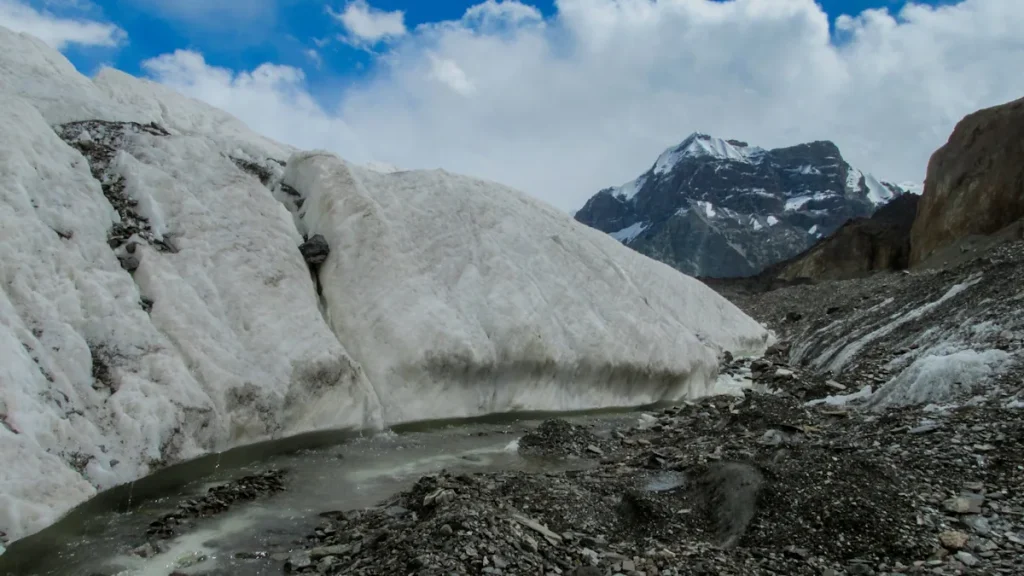
The rapid melting of glaciers in central and western Asia is causing a growing crisis for the 340 million people who depend on glaciers for drinking water, food and livelihoods.
What happened?
Floods, mudslides and drought threaten the region and its people, who rely on glaciers in the Pamir Plateau and Tianshan Mountains, Asia-Plus reported.
The risks are reportedly part of a “cascading crisis” in which rising temperatures cause ice to melt, “accelerate landslides and mudslides, increase the frequency of floods, and trigger droughts that lead to crop losses and depleted pastures.” It also noted a greater likelihood of glacial lake outbursts, heat-related illnesses and poor water quality.
The Asian Development Bank has earmarked $3.5 billion for the Glacier to Farm initiative, which aims to use science and risk management to save lives. Asia-Plus cited the example of the Swiss town of Bratten, which was devastated by melting glaciers in May. The warning system allowed hundreds of residents to evacuate a week ago.
Why is this important?
The nine countries under G2F are Armenia, Azerbaijan, Georgia, Kazakhstan, Kyrgyzstan, Pakistan, Tajikistan, Turkmenistan and Uzbekistan. This work is vital to 45.1 million people and will hopefully ensure water and food security, shore up infrastructure and build stronger social safety nets.
“G2F will support the creation of climate finance infrastructure, guidance for agribusiness and the design of cross-border pilot projects,” the program website states.
The report highlights that temperatures in Central and Western Asia are rising by 0.2-0.4 degrees Celsius (0.4-0.7 degrees Fahrenheit) per decade, and half of the region’s glaciers may melt by 2100. G2F will use climate science to plan adaptation measures and fund grants and loans for projects.
What is being done about melting glaciers in Central and West Asia?
The Green Climate Fund calls the G2F one of the world’s largest adaptation initiatives and says it hopes to avert disaster by linking science, governance and finance with community action. Asia-Plus explains that monitoring glacier conditions will protect agriculture, energy, water systems and healthcare.
Other aspects of the program include crop insurance, farmer support and water system upgrades. Locals will receive alerts on their mobile phones and be trained to respond to warning signs.
Asia-Plus said: “ADB emphasizes that glaciers are the starting point of the entire food system. As glaciers shrink, the amount of water in the valleys will inevitably decrease, resulting in less food.”
Get TCD’s free newsletter for simple tips to save more, reduce waste and make smarter choices, and earn up to $5,000 toward clean upgrades in TCD’s exclusive Rewards Club.