


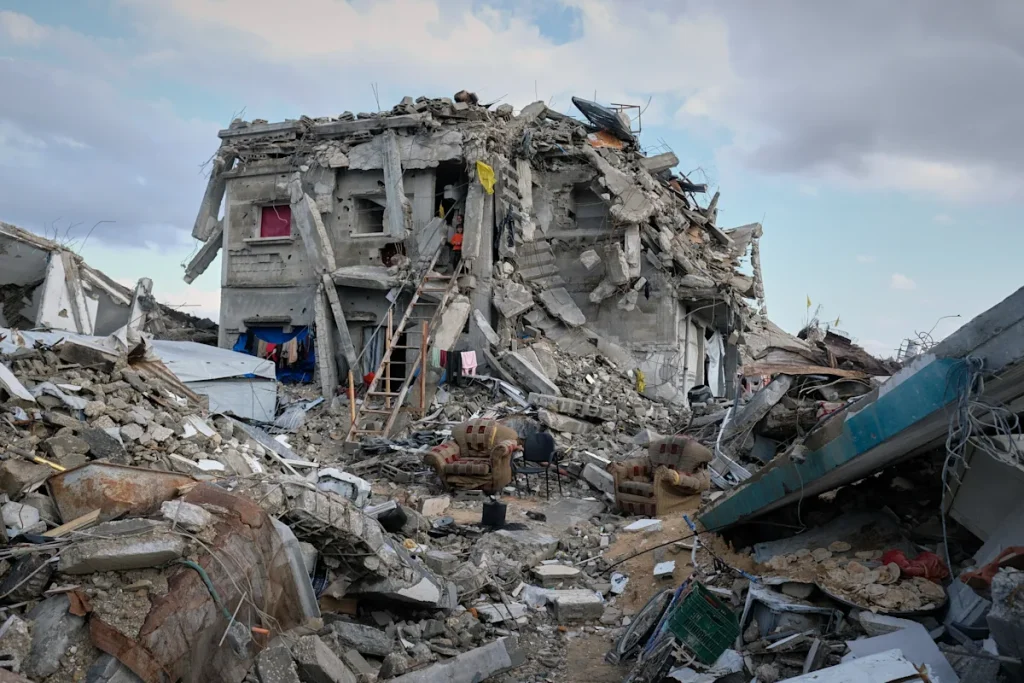
GAZA CITY, Gaza Strip (AP) — The Halawa family’s building remains two stories taller than the ruins of Gaza City, a minor miracle after two years of Israeli airstrikes have wreaked havoc on homes across the Palestinian territory.
Part of the building has collapsed, with bent metal poles protruding from where the roof once was. A narrow wooden staircase the family built to lead to their home creaked and was in danger of collapsing.
But even in ruins, it’s still home.
The war began with a Hamas attack on October 7, 2023, which killed approximately 1,200 Israelis and took more than 250 people hostage. Israel’s subsequent offensive in Gaza killed tens of thousands, caused widespread destruction and displaced most of the territory’s 2 million residents.
The situation eased at the end of the year as U.S. President Donald Trump brokered a ceasefire in October. But reconstruction work has not yet begun and is expected to take several years. Now, as the ceasefire moves into 2026, families like the Halawas are trying to rebuild their lives.
Three months after the war broke out, the family fled home. They returned in the faint calm that had prevailed during the truce. Like many people, the family of seven said it felt better to live in the ruins than in a tent, especially when it started to rain in the winter.
In a damaged room, Amani Halawa heats a small pot of coffee over a fire, thin rays of light filtering through the concrete blocks. Halawa, her husband, Mohammed, and their children repaired what they could with scraps of concrete, while hanging backpacks from exposed metal poles and filling the kitchen floor with pots and pans.
The walls of the home are decorated with a painted tree with messages written on it for loved ones separated by the war.
In damaged apartments across Gaza City, daily life continues, even as families lie awake at night fearing the walls might collapse on them. Health officials say at least 11 people were killed in building collapses in just one week in December.
In her home, Sahar Tarush swept dust from the carpet covering the ruins. As her daughter Bisang watches a movie next to the gaping hole in the wall, her face is illuminated by the glow of the computer screen.
On the cracked wall of another building, the family hung a torn photo of their grandfather on horseback from his days working in the Palestinian Authority security service in the 1990s. Not far away, a man lay on a rickety bed on the edge of a damaged balcony, scrolling over the shattered Alcalama neighborhood on his cell phone.
With so much uncertainty about the future, families are struggling to restore even the smallest sense of familiarity to homes that no longer exist.
This is a documentary photo story curated by AP photo editors.
___
Follow AP’s war coverage: https://apnews.com/hub/israel-hamas-war