


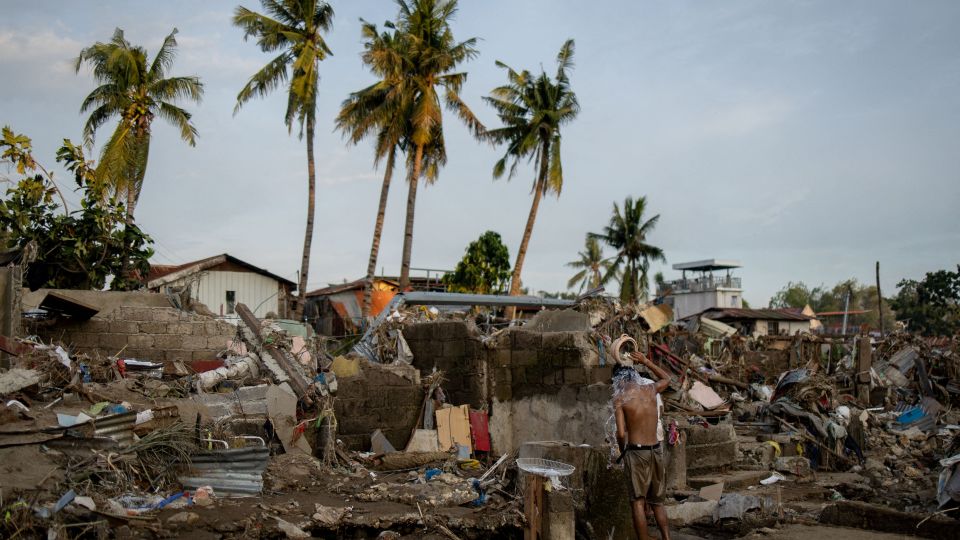
Ace Aguirre had just taken two bites of oatmeal on the morning of November 4 when he noticed something strange: dirt seeping into the living room floor of his bungalow in the village of Cotcot, Cebu province, Philippines.
The moments that followed will forever be etched in Aguirre’s memory. His living room furniture floated; those terrifying minutes when he wasn’t sure he could pry open the front door; his son praying to God as the water rose to their chests. His daughter, who couldn’t swim, sat high on a pillar with water and cars rushing inches from her feet.
“I don’t know how we survived. One detail didn’t go our way and many of us could have died,” Aguirre told CNN.
That morning, Typhoon Kalmaji brought more than a month of rain, causing rivers and waterways in Cebu to rise, triggering catastrophic flash floods that killed more than 230 people across the country.
One of the dead was Aguirre’s neighbor, a mother of two, who drowned after being trapped in her kitchen. He tried to save her but couldn’t get her out in time.
Heavy downpours and deadly floods are nothing new in the disaster-prone tropical Philippines. But in recent months, revelations that politicians, officials and contractors looted billions of dollars from national programs meant to mitigate its impact have sparked unrest across the country.
Before the deadly floods, a Cebu citizens group called for an audit of flood control projects along the Kokot River upstream of Aguirre’s residence, local media reported.
The scandal implicates dozens of senior lawmakers and officials who allegedly received kickbacks when awarding contracts. The revelations sparked massive youth-led anti-government protests against corruption and wealthy elites, similar to protests in Indonesia and Nepal this year.
Aguirre had been watching the political drama unfold for months in the faraway capital of Manila, but he didn’t expect it to arrive on his doorstep.
“All of a sudden you’re a direct victim,” he said. “It hits differently.”
The November floods prompted Cebu Governor Pamela Baricuatro to call for an investigation into the province’s 26 billion peso ($443 million) flood control projects, which Manila officials acknowledged “should have been operational” at the time of the disaster.
Philippine President Ferdinand Marcos Jr. subsequently visited the area and pledged to clean waterways and unblock drainage systems to prepare for next year’s rainy season.
In July last year, he revealed that government flood control plans worth more than 545 billion pesos ($9.2 billion) were plagued by corruption.
He said internal audits found that many of the 10,000 projects his administration has overseen since he took office in 2022 were built with substandard materials or were not used at all, which he called “ghost projects.”
CNN has contacted the Philippine government for comment.
Sol Iglesias, an associate professor of political science at the University of the Philippines, said that when Marcos Jr. exposed the fraud, he “opened a can of worms” and it was out of his control.


This aerial photo shows damaged houses after Typhoon Kalmaji in Talisay, Cebu Province on November 5, 2025. – Jam Sta Rosa/AFP/Getty Images
Iglesias said the testimony in the House and Senate exposed “an entire system of plunder and corruption that was facilitated by the agencies responsible for budgeting, planning, implementing, monitoring and inspecting the financial soundness of this infrastructure.”
In September, Finance Minister Raf Recto told a Senate hearing that as much as 118.5 billion pesos ($2 billion) in flood control funds may have been lost to corruption over the past two years, the Associated Press reported.
Marcos Jr. has vowed to jail at least 37 members of Congress and other officials responsible for the fraud before Christmas, and seven have been jailed so far. The government also froze about 12 billion pesos ($204 million) in assets of individuals linked to the scandal.
The scandal galvanized ordinary Filipinos, who took to the streets to protest decades of unchecked corruption.
“This is the last straw for the Filipino people,” said Tiffany Faith Brillante, the head of the Philippine Youth Anti-Corruption Organization, which participated in the protests.

Philippine activists protest near the Presidential Palace on Human Rights Day in Manila, Philippines, on December 10, 2025. – Eloisa Lopez/Reuters
“Corruption today is no longer just a symptom of weak governance,” she said. “It’s deeply rooted in how governments wield power, how they allocate budgets and how they continually evade responsibility.”
Marcos Jr. insists he was unaware of the fraud. He has positioned himself as a champion of corruption, shaming those responsible and egging on protesters.
But as more senior officials are implicated in the scandal, some are pointing the finger at the president.
One of them is Zaldy Co, a former Marcos ally and former House Appropriations Committee chairman who has emerged as one of the central charged figures in the scandal. He fled the country and is currently a fugitive.
While in hiding, he posted a series of explosive videos on his social media accounts accusing Marcos Jr. and his family of profiting from corruption — accusations the president denies.
Marcos’ family was also involved in the drama. Ferdinand Martin Romualdez, Marcos’ cousin, who resigned as House speaker in September over the controversy, has denied any involvement in the scandal.
Aries Arugay, a Filipino political scientist and visiting senior fellow at the Yusof Issa Institute of Southeast Asian Studies in Singapore, said beyond the scale of the alleged theft, what makes the scandal so devastating is that for many Filipinos, history is repeating itself.
“Corruption and the Marcoses are almost synonymous in Philippine politics,” Arugay said.
Marcos Jr.’s father, dictator Ferdinand Marcos Sr., ruled the Philippines with an iron fist from 1965 until he was ousted in 1986, with the country under martial law for about half of that time. His regime committed systemic human rights abuses and engaged in widespread corruption, stealing an estimated $10 billion from public coffers.
The flood control scandal has reminded Filipinos of the dark days that many experienced under Marcos Sr. One of the largest anti-corruption protests was held on an important day, September 21, when Marcos Sr. imposed martial law in 1972.
The younger Marcos’ landslide victory in 2022 marks an extraordinary comeback for the notorious political family, which critics claim was fueled in part by a disinformation campaign that whitewashed the history of the Marcos era.
While officials have warned that the looting of flood control plans may have begun under Marcos’s predecessor Rodrigo Duterte, lifestyle differences between elites and ordinary Filipinos have been a source of anger for the current president.

Philippine President Ferdinand Marcos Jr. speaks during a press conference at Malacañang Palace in Manila on November 13, 2025. – Jam Sta Rosa/AFP/Getty Images
Videos posted on social media by the children of wealthy politicians and contractors showing off their lavish lifestyles are adding salt to the wounds of angry citizens, Arugai said.
“While people are being flooded, politicians are flying in private jets in Paris,” he said.
The backlash against so-called “nepo kids” mirrors similar anti-corruption protests across Asia this year, including in Indonesia and Nepal, where Gen Z-led protests toppled governments.
As with these protests, young people are among the loudest voices calling for accountability in the Philippines.
“If the government continues to steal, oppress and ignore people, we will suffer the consequences of corruption and systemic abuse in our country,” Brillant said.
“We really want to hold every official involved in corruption accountable and jail them,” Brillant said.
“President Marcos is not immune because at the end of the day, he is the one who signs and approves the national budget every year.”
Although public confidence in Marcos Jr. has been shaken, he is unlikely to meet the same fate as his father, who was ousted from power in a public uprising.
Marcos Jr. is halfway through his six-year term, and the Philippine president has a single-term limit, so he is not eligible for re-election in 2028.
“We haven’t seen conclusive evidence,” Iglesias said.
“But if (we get) hard evidence, for example, that he benefited directly financially from this corruption, then I think that will push the government over a cliff. Right now, it’s teetering on the edge.”

Filipinos march with a portrait of Philippine President Ferdinand Marcos Jr. during an anti-corruption protest in Manila, Philippines, on November 30, 2025. -Lisa Marie David/Getty Images
A recent poll by WR Numero showed Marcos Jr.’s satisfaction rating at 21% in November, down 14% from August.
For a man who nearly lost everything, Aguirre feels optimistic and grateful. But he is not optimistic that the wave of public momentum will bring any meaningful change to the Philippines.
“With our resilience we can still move forward but the quality of life will remain the same.”
For more CNN news and newsletters, create an account at CNN.com