


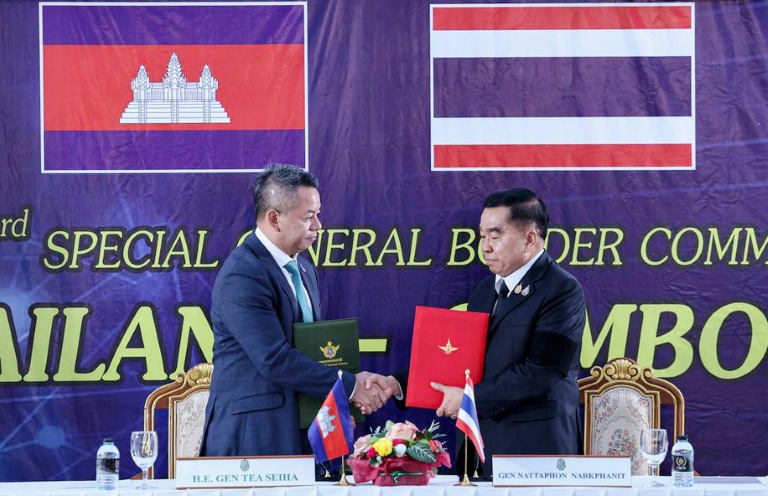
Thailand and Cambodia agreed on Saturday to an “immediate” ceasefire and pledged to end weeks of deadly border clashes, they said in a joint statement.
According to official statistics, at least 47 people have been killed and more than a million displaced in three weeks of fighting with artillery, tanks, drones and jets.
The conflict spread to nearly every border province between the two sides, breaking a truce previously agreed by U.S. President Donald Trump.
The statement signed by the defense ministers of the two countries said: “The two sides agreed to an immediate ceasefire after the signing of this joint statement, effective from 12 noon (local time) on December 27, 2025.”
The ceasefire agreement applies to “all types of weapons, including attacks against civilians, civilian objects and infrastructure, as well as military targets on both sides, in all circumstances and in all areas,” the statement said.
The statement also said that both sides agreed to freeze all troop movements and allow civilians in border areas to return home as soon as possible.
They also agreed to cooperate in demining efforts and combating cybercrime, while Thailand will return 18 captured Cambodian soldiers within 72 hours.
Thai Defense Minister Nataporn Nakpanit said the initial three-day window would be an “observation period to confirm whether the ceasefire is real.”
In a speech on Saturday morning, he called the truce “the door to a peaceful resolution of border issues.”
Oeum Raksmey, 22, who was evacuated with her family from their home near the border to a shelter in Cambodia’s Siem Reap province, said she was “very happy” to hear news of the ceasefire.
“If they stop fighting from now on, I’m happy that people can go home,” she told AFP by phone.
“But I don’t dare to go home yet. I’m still scared. I don’t trust Thailand yet.”
– The ceasefire was broken –
The ceasefire was announced after three days of border talks were announced following a crisis meeting by foreign ministers of the Association of Southeast Asian Nations (ASEAN), of which Cambodia and Thailand are both members.
The United States and China have also urged their neighbors to stop fighting.
The conflict stems from a colonial-era territorial dispute dividing the 800 kilometers (500 miles) border between the two countries, with both sides claiming ancient temples in the area.
Five days of fighting between the two countries in July left dozens dead before a truce was brokered by the United States, China and Malaysia.
Trump oversaw the signing of an expanded deal between Thailand and Cambodia in October, only for it to be broken just months later.
Each side blames the other for inciting new fighting this month and accuses the other of attacks on civilians.
Officials said at least 25 Thai soldiers and one Thai civilian were killed in the latest round of clashes.
Cambodia, which lags behind Bangkok’s military in both weaponry and spending, said 21 civilians were killed but no military deaths were reported, although the wife of leader Hun Manai attended the funerals of soldiers killed in the fighting, according to an official Facebook post.
-“Final Signature”-
Fighting continued to rage on Friday, with Cambodia accusing Thailand of stepping up bombing of the disputed border area and Thai media reporting nighttime attacks in Cambodia.
Both countries claim sovereignty over the disputed temples due to a vague demarcation drawn up by Cambodia’s French colonial rulers in 1907.
These demarcation issues still need to be resolved after the ceasefire.
But Thai Prime Minister Anutin Charnvirakul sounded an optimistic note on Friday night, announcing that the defense ministers of the two countries would meet the next day and possibly sign a truce.
“You can trust Thailand. We have always adhered to our agreements and commitments. Let this be the final signature so that peace can be restored and our people can go home,” he said.
Thailand is scheduled to hold a general election on February 8.
Burtim/MTP