


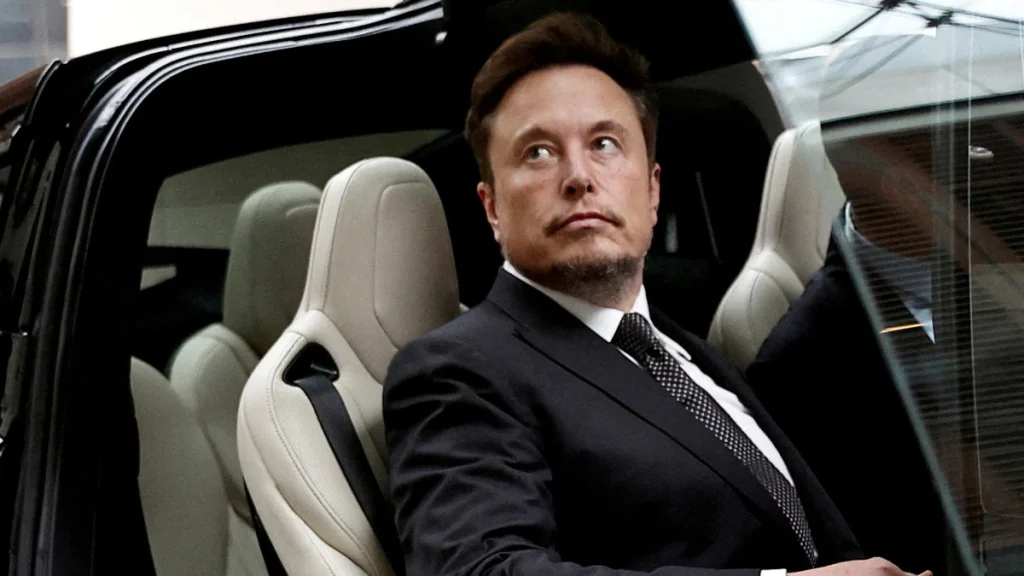
Tesla has cleared some key regulatory hurdles that have long hampered its rollout of self-driving software in China, paving the way for Elon Musk to make a surprise visit to the U.S. automaker’s second-largest market with promising results.
Tesla Chief Executive Elon Musk arrived in the Chinese capital on Sunday and is expected to discuss the rollout of Full Self-Driving (FSD) software and allowing driving data to be transmitted overseas, according to people familiar with the matter.
The billionaire met with Chinese Prime Minister Li Qiang during his whirlwind visit, just over a week after he canceled a planned trip to India to meet Prime Minister Narendra Modi, citing “Tesla’s very heavy obligations.”
Tesla has reached a deal with Baidu to use the Chinese tech giant’s mapping license to collect data on China’s public roads, two sources told Reuters on Monday, in what they said was a key step towards introducing FSD in the country.
One of China’s top automobile associations said on Sunday that Tesla’s Model 3 and Y cars were among the models tested and found to comply with China’s data security requirements.
Data security and compliance are concerns the US electric car maker has not launched FSD in China, its second-largest market globally, despite customer demand. Four years ago, the company launched the most autonomous version of its Autopilot software.
Since 2021, Chinese regulators have required Tesla to store all data collected by its Chinese fleet in Shanghai, preventing the company from transferring any data back to the United States.
Musk is seeking approval to transfer data collected at home abroad to train algorithms for his self-driving technology, the person said.
Musk’s trip to China was first reported by Reuters but not reported publicly, the person said on condition of anonymity because they were not authorized to speak to the media.
Musk’s arriving plane took off from Beijing Capital Airport at 0517 GMT, bound for Anchorage, Alaska, according to data from Chinese flight tracking app Flight Manager.
Tesla did not immediately respond to a request for comment on Musk’s departure.
Wedbush stock analysts called the unexpected visit “a big moment for Tesla.”
Chinese rivals such as Xpeng Motors and Huawei Technologies Co. have been seeking to gain an advantage over Tesla by rolling out similar software.
Retired commentator Hu Xijin said on Weibo that Tesla was the only foreign automaker to meet China’s data compliance requirements, adding that this would pave the way for Tesla cars to enter the premises of Chinese government agencies and state-owned enterprises.
“This is not only a breakthrough for China, but also a major demonstration for the world to solve data security problems.”
Li Keqiang on Sunday praised Tesla’s development in China as a successful example of U.S.-China economic and trade cooperation.
China data
Tesla vehicles have been banned from Chinese military installations for years because of security issues with cameras installed on its vehicles. Its cars are also banned from venues hosting important political events, such as the ruling Communist Party’s annual summer leadership conclave in 2022.
He Xiaopeng, CEO of Xpeng Motors, said on Weibo that Tesla technology is welcome to enter China and its XNGP advanced driver assistance system is similar to FSD.
“Only when more good products and technologies enter can the entire market and customer experience be improved, and the market develop healthily and accelerate,” he said.
“Let a hundred flowers bloom,” he said, echoing a famous quote from Chairman Mao Zedong, the founder of modern China.
The improved prospects for FSD’s entry into China come as Tesla shares have fallen by nearly a third since the start of the year amid growing concerns about the electric car maker’s growth trajectory. Last week, Tesla reported its first quarterly revenue decline since 2020, when the COVID-19 pandemic slowed production and deliveries.
Musk said last week that Tesla would use its existing electric vehicle platforms and production lines to launch new, cheaper models and would offer new “robotaxis” with self-driving technology. He said on X this month that he will launch robot taxis on August 8.
Industry experts say China’s complex traffic conditions, with more pedestrians and cyclists than many other markets, provide more scenarios that are critical for training self-driving algorithms more quickly.
“If Musk can get approval from Beijing to transfer data collected in China abroad, it would be a ‘game changer’ in accelerating algorithm training for self-driving technology around the world,” Wedbush analyst Dan Ives said in a report.
Musk said this month in response to a query from X that Tesla may offer FSD to Chinese customers “soon.”
In addition to meeting Li Keqiang during his brief trip to Beijing, Musk also met with organizers of the ongoing Beijing Auto Show. Zeng Yanhong, chairman of Tesla’s main battery supplier and Chinese battery giant CATL, also visited Musk’s hotel on Monday, according to Reuters witnesses. Reuters could not immediately confirm to CATL whether Zeng met Musk.
Musk had planned to cancel his trip to India and announced $2 billion to $3 billion in new investments, including a car factory, after India lowered import taxes on electric vehicles in return for new policies.
© Thomson Reuters 2024