


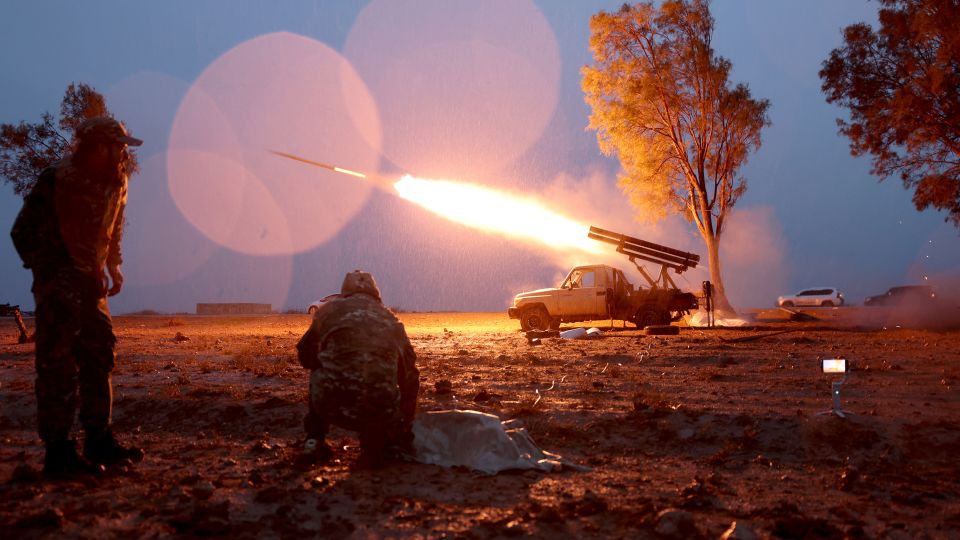
Within two days, the Syrian army, aided by tribal militias, drove Kurdish forces from a large swath of northern Syria they had controlled for more than a decade.
Raqqa, once the notorious capital of the Islamic State’s (ISIS) so-called caliphate, was reportedly one of the captured towns.
Geolocation video showed tribal militias in the city center on Sunday and a military presence in other neighborhoods.
Much of Syria’s oil wealth is also now controlled by the government, for the first time in more than a decade.
Here’s what we know about the rapid changes on the ground.
What led to this confrontation?
Clashes broke out in the city of Aleppo and surrounding countryside earlier this month, the latest episode in a tense standoff between the central government and the SDF, followed by a sudden push into Kurdish-controlled areas.
The SDF is a U.S.-backed group that is not part of the rebel alliance that ousted Syrian dictator Bashar al-Assad in 2024.
On Friday, the SDF agreed to withdraw from the Aleppo region to the east bank of the Euphrates River, its first territorial concession to the new government.
But since Saturday, Syrian troops have moved into areas not covered by the deal and Kurdish forces appear to have retreated in disarray.
The Syrian army has advanced into several areas, causing the SDF to lose control of mineral wealth and fertile farmland.


On January 18, 2026, members of the Syrian Army were deployed in the town of Tabqa after the withdrawal of the SDF. – Karam al-Masri/Reuters
What did the Syrian army seize?
The army and allied tribes have seized large parts of Aleppo, Raqqa and Deir ez-Zor provinces bordering Iraq, and Arab militias have also invaded the Kurdish-controlled Hasakah province.
In the process, the army has taken control of two hydropower stations on the Euphrates River, according to the Syrian Energy Ministry. The larger of the two, which provides most of the country’s drinking water, will be able to produce about 900 megawatts of electricity when renovated.
The Syrian military also controls oil and gas fields in Deir ez-Zor province, including the largest Omar field, as well as the Tanak and Konnok fields, officials said.

A Syrian government soldier uses a sniper rifle to scan the area around the Euphrates River dam after government forces recaptured the town of Tabqa from the Self-Defense Forces on January 18. – Omar Albam/AP
Why did the negotiations fail?
Over the years, the SDF have controlled many areas populated mainly by Arab tribes, many of whom have now joined the fight against them. The SDF, working with a U.S.-led coalition to fight the Islamic State as it controls much of northeastern Syria, continues to expand its control.
After the overthrow of Assad’s regime, the government of interim President Ahmed Sala rejected the idea of a Syrian federation, demanding that Damascus’s writ be implemented nationwide.
There have been numerous negotiations between the government and SDF leader Mazloum Abdi. For a while, it seemed possible to reach an agreement on integrating Kurdish forces into Syria’s security forces and extending the political control of the Damascus government into northern and eastern Syrian territories.
Last March, Sala and Abdi signed an agreement that the Syrian president said aimed to “ensure the representation and participation of all Syrians in the political process and in all state institutions, regardless of their religious and ethnic background.”
But the Kurds remain unwilling to give up areas they control and there is no agreement on integrating Kurdish forces into the national army.
Damascus promised the Kurds broad cultural autonomy, such as the use of Kurdish languages in schools. Indeed, Sala signed a decree on Friday promising cultural and linguistic rights to Kurds and granting Syrian citizenship to people who have been denied Syrian nationality for thousands of years.
The SDF leadership said the concessions were not enough.
Meanwhile, many Arabs living in Kurdish-controlled areas of Syria are losing patience.
The town of Tabqa was seized by government forces on Saturday, according to multiple videos and eyewitness accounts, with resident Mohamed Karusi telling Reuters that residents had been waiting for the troops to arrive to “eliminate this (Kurdish) gang that everyone is complaining about and tired of”.

On January 18, the town of Tabqa in the countryside of Raqqa was captured by the Syrian army. – Moawia Atrash/Photo Alliance/dpa/AP
What happened in Raqqa?
Local activists said clashes broke out in the nearby city of Raqqa on Sunday. The city was controlled by Islamic State for several years until it was driven out of the area in 2017. The city has witnessed some of the worst atrocities committed by the terrorist group.
Geolocation video showed explosions and snipers on rooftops in the city, as well as tribal militiamen celebrating in the streets.
A mostly Kurdish government has governed the city since its liberation from Islamic State.
Raqqa resident Ahmed Haji Mulla told CNN on Sunday that he had joined the fight against the SDF.
“Currently, the clashes are taking place in the city’s neighborhoods. The SDF have snipers on many buildings and a heavy presence in the north of the city, but we are dealing with them,” he told CNN by phone.
“The Syrian army is located in the south of the city. The liberation of Raqqa will only take hours, not days,” he claimed.

After Syrian government forces captured the town of Tabqa, residents toppled a statue of a female Kurdish fighter. – Qais Alsayed/AP
“Anyone who opposes the (SDF) self-government will end up in jail,” Mulla claimed. “They should never have been here in the first place.”
Syrian state television reported that Raqqa residents “rose up against the SDF amid mass defections from the city’s residents” and said the group’s militants had been driven out of the city.
“Raqqa’s community will fully hand over the city to the Syrian government to manage and maintain its institutions, security and stability,” the report said.
Will this affect the fight against ISIS?
The United States has expressed concern that the unrest will undermine coalition efforts to fight the remnants of the Islamic State in rural Syria.
On Saturday, Adm. Brad Cooper, commander of U.S. Central Command, urged the Syrian government to “cease any offensive operations between Aleppo and Tabqa” to ensure a common front against the Islamic State.
The Syrian military appears to have ignored the call.
Central Command said Saturday that in its latest strike against extremists in Syria, it killed an Al Qaeda operative directly linked to the ISIS attackers who killed three Americans in early December.
It was unclear whether Kurdish security forces still guard the largest detention camp in al-Hol, near the Iraqi border, where relatives of Islamic State fighters are held. But geolocation video showed Arab militiamen had captured the town of Shadadi, about 50 kilometers (30 miles) to the south.
For more CNN news and newsletters, create an account at CNN.com