


About 90 minutes after the shooting at Brown University began at 4:05 p.m., I drove past the police cordon that had been put up on the entire street near the Barus & Holley building where the shooting took place. Shortly after I parked my car nearby, I saw four young men running from the building with their hands raised. Police officers stood beside the car with their lights flashing.
The four exited through the Brook Street entrance on the side of the building. Visibly panicked, they continued to run with their hands up, half a block north along Brook Street, and then a full block to the intersection of Waterman and Thayer streets.
They stopped in front of an unreal scene. A dozen police officers, many in SWAT gear and holding guns, stood at the usually vibrant Thayer Street intersection. But now it has become a refuge and gathering place, and at 5:40 p.m., the gunman was still on the loose and dozens of students and others walked past law enforcement vehicles and police cordons.
I approached three students I saw while a fourth student was being interviewed by another reporter. We were standing outside In The Pink Acai & Smoothies store, opposite Pokeworks.


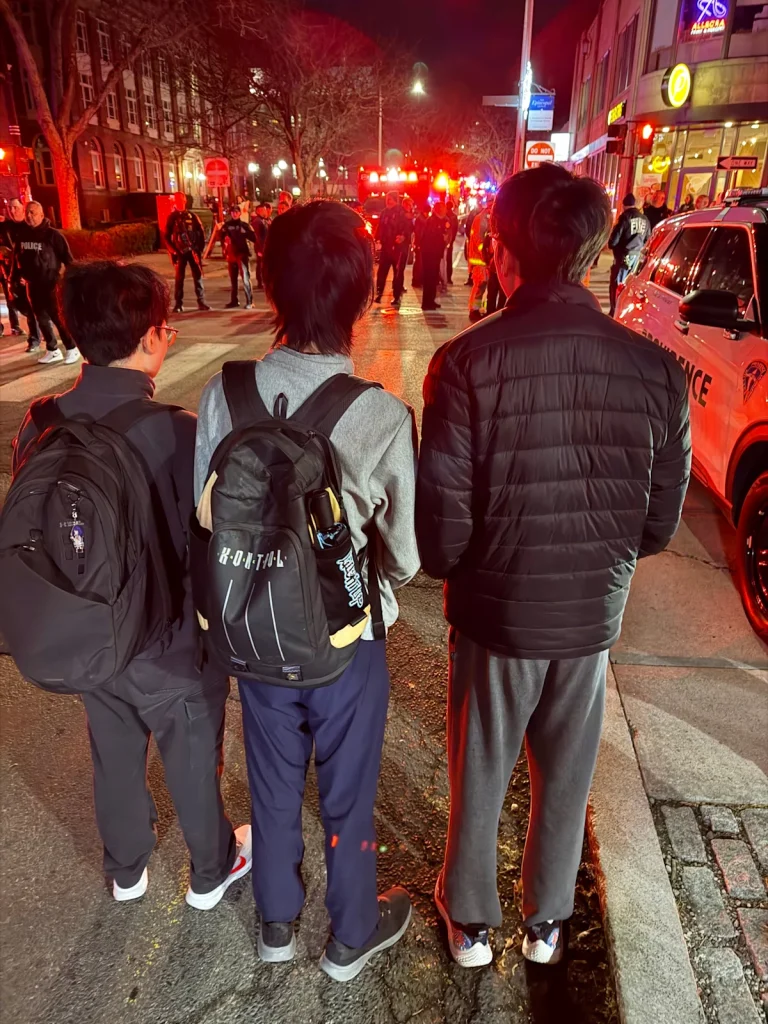
Three Brown University engineering students from China watch on the street after being evacuated from the Barus & Holley Building where a deadly school shooting occurred on December 13.
All three were shocked and did not want to reveal their full names, but all said they were engineering graduate students from China.
They were studying for finals in a small office lab on the third floor of Barus & Holley when their phones went off with text alerts about the shooting. The alarm tells them to take cover, silence their phones, stay hidden, and “stay away from Barus & Holley,” but as far as they’re concerned, they’re trapped inside.
They kept getting alerts – the first text message said the suspect had been arrested, but then another text message shortly after said the opposite – “Police have no suspect in custody.”
The tallest of the three gave me his nickname “Evans” and said he was an engineering PhD student. It was cold outside and he was wearing only a thin shirt as we spoke. Apparently, his coat was not left in the study, and the police rushed out before he could get it.
He told me that as soon as they received the first alarm they locked the office lab door and all four people – the only people in the room – ducked under the desk.
They had no idea they would be in this situation for about 90 minutes. They were among the last to be evacuated as police searched room by room. It is a large engineering and science building with seven floors containing classrooms, faculty offices, research laboratories, and student project and study spaces.
Shortly after the alarm went off, Evans thought he heard gunshots but couldn’t be sure, saying it could have been other sounds like a door slamming.
“It sounded like a shooting,” Evans said, “but I’d never heard of a shooting before.”
The four agreed they needed to stay put.
“We were panicking,” Evans said.
They continued to lie on the floor under the table, thinking it would be safer lower down from the bullets. But it seemed like an endless ordeal, as the minutes turned into half an hour, then an hour or more.
As we stood in the cold, crowded crowd at the Thayer-Watman intersection, I turned to the student next to him—he called himself Bock. He is 25 years old and a computer engineering student.
He described the room they took refuge in as small, with only a computer station. He also thought he heard gunshots but couldn’t be sure.
I turned to the third student, also an engineering student from China. He asked me to use his nickname, RC.
This made me stop and ask them why they didn’t want their full name used.
They said they were still afraid.
“Maybe he’ll come back,” RC said of the Gunner.
This is an insight into the mindset of having just survived a mass shooting in a building.
RC showed me the alerts on their phones as police lights reflected off the Thayer Street storefronts.
“Urgent. Report of shots fired near Governor Street,” one said.
Another said: “If you can’t evacuate, hide.”
Then: “Fighting is a last resort.”
RC told me that they locked the door and turned off the lights, so they had been lying in near darkness.
As time passed, the four began texting friends and family to say they were safe so far. But they’re still worried about what might happen. What if a gunman breaks in?
RC texted his parents, “I love you.” So did others.
Finally, around 5:30 p.m., there was a loud knock on the door and they heard someone yell “police.”
But the four of them did not speak immediately.
“We’re trying to be cautious,” Evans said, “just to double check.”
Bock said they feared it might have been a ploy by the shooter.
But with several voices shouting “police” through the locked door, and the sound of security force radios blaring, it became clear this was law enforcement.
The four opened the door and saw three police officers in regular uniforms and a fourth officer in SWAT gear.
But at first, while the students were grateful to have been rescued, the atmosphere was tense. The policeman shouted: “Don’t move, put your hands up.”
“I said, ‘We’re students, we’re students,'” Bock recalled.
Despite this, the police asked them to face the wall while they were searched to make sure. Once they did, police were still busy escorting the four people down three flights of stairs to the Brook Street exit.
When the students finally walked out, police officers sternly told them to run toward Waterman Street and keep their hands raised. That’s because their side of the street has been cordoned off with yellow tape and no one is allowed to enter now.
That’s when I saw them.
I watched these four men run for a block on the sidewalk while I followed them on the other side of the street. Police and squad cars lined a block-long route, flashing lights reflecting off the four students as they ran.
I was a little surprised to see four students running out of the building. When I first arrived at the scene about 90 minutes after the report of the shooter, I thought things were safe. But obviously, the evacuation is not over yet.
The foursome are still a little nervous as we talk at the intersection of Waterman and Thayer, usually an upbeat spot for students entering and exiting restaurants and shops.
But this time is different — a mass shooting has disrupted security on Brown University’s campus and the city’s quiet East Side.
By now this was global news, and as I was interviewing the four, my phone was buzzing with texts from my own friends and family asking if I was okay, as I’m sure was happening to people across Providence.


At 6:20 p.m., police were still clearing the Brown University shooting scene near the entrance to the Barus and Holley buildings on Brook Street.
Evans asked me if they were safe here with the shooter still at large. I pointed to the police around us, but maybe that’s why Evans was nervous—the cops were nervous, too, because they were openly holding automatic weapons.
The three students I interviewed were kind enough to pose for a photo with their backs to the camera, but soon after, the police announced they were pushing everyone away from the intersection and extended the cordon, so we had to move on.
As I returned to my car, I passed the Barus & Holley entrance where I saw four students running away with their hands raised.
Now, just inside, a half-dozen police officers, many in SWAT gear, were at the same glass door, continuing to ensure the building was clear.
I stopped to take a picture of them from the street, and a nearby Channel 10 team took a picture, but one of the police officers opened the door and shouted at us to keep going.
He was rude about it and I didn’t blame him.
It was 6:20 pm – almost 2.5 hours after the event started – and they had a job to do that would last into the evening and beyond.
The area remains an active shooting scene as the suspect remains uncaptured and the horrific incident has made headlines around the world.
mpatinki@providencejournal.com
This article originally appeared in The Providence Journal: Brown University students weather tense lockdown after campus shooting