


WASHINGTON (AP) — The Senate advanced legislation on Tuesday aimed at forcing President Donald Trump to withdraw from the war with Iran, as a growing number of Republicans defy the president’s directives during the more than two months of conflict.
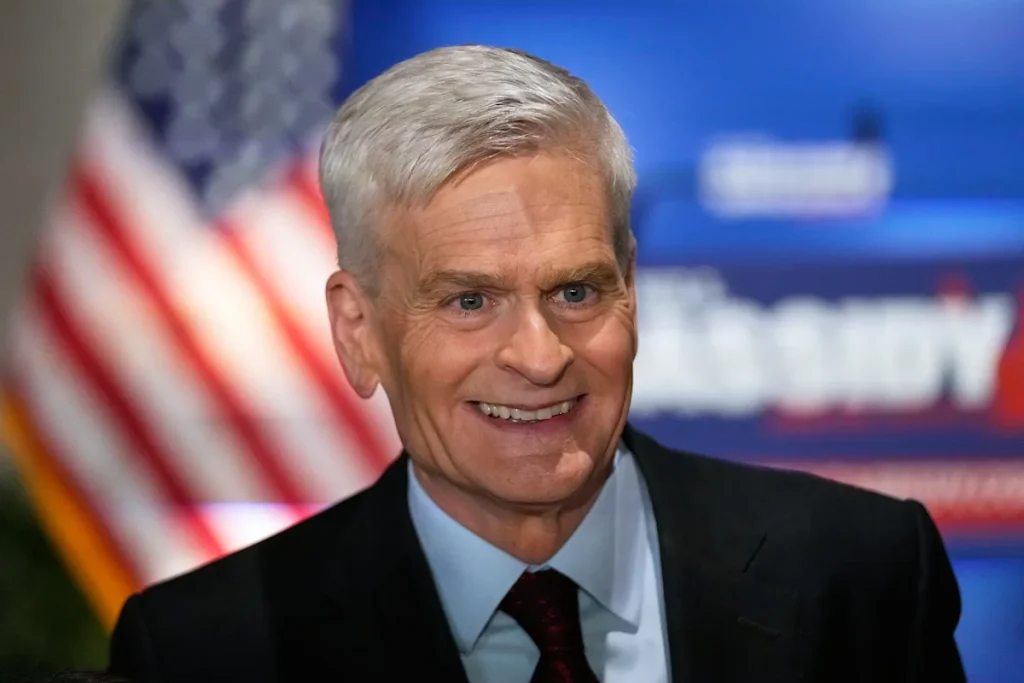
Since Trump ordered an attack on Iran in late February, Democrats have forced him to take multiple votes on war powers resolutions that require him to either get congressional approval or withdraw troops. Republicans would have been able to muster the votes to reject the proposals, but Louisiana Sen. Bill Cassidy — fresh off a primary defeat in which Trump endorsed his opponent — changed his position.
The 50-47 vote showed that a small but growing number of Republicans are willing to challenge Trump on the Iran war, although that effort may not go far. Three Republicans were absent Tuesday, and their votes would have been enough to defeat the bill if they maintained their stance on the war.
Still, the vote showed growing unease among Republicans over a conflict that shows no sign of ending, is stuck in a fragile ceasefire and is causing U.S. gasoline prices to rise.
“Republicans are starting to crumble and momentum is building to contain him,” Senate Democratic leader Chuck Schumer said in a statement after the vote. “We will not let up.”
Republican Sens. Rand Paul of Kentucky, Susan Collins of Maine and Lisa Murkowski of Alaska have all previously voted for similar war powers resolutions and voted again on Tuesday. Cassidy supported the bill for the first time, while Pennsylvania Sen. John Fetterman was once again the only Democrat to vote against it.
After losing last week’s primary, Cassidy returned to Washington defiant. He said he was proud of his work upholding the Constitution and would carefully consider how to vote on several future priorities for the Trump administration.
Trump’s control of the Senate Republican conference may be slipping after Cassidy’s primary defeat and the president’s decision on Tuesday to endorse his primary opponent, Republican Sen. John Cornyn.
“While I support the administration’s efforts to dismantle Iran’s nuclear program, the White House and Pentagon have kept Congress in the dark about an epic act of outrage,” Cassidy said on social media.
“Until the administration clarifies, no congressional authorization or extension is warranted.”
House will also vote on war powers
At the Capitol, the House of Representatives is expected to vote on a similar war powers resolution on Wednesday, with Democrats optimistic about its chances of passing it. Last week, another war powers resolution narrowly passed the House in a tie vote.
Even if Congress eventually passes legislation forcing Trump to withdraw from the conflict, it’s unclear whether he will comply. In order to circumvent the requirements of the 1973 War Powers Resolution, the White House claimed that it had technically ceased “hostilities” with Iran because of the ceasefire.
Trump said this week he ordered preparations for an attack on Iran on Tuesday but later called off the action to give Gulf allies more time to reach a deal with Iran.
“Peace talks are at an impasse, grocery prices are rising day after day, and gas prices are rising,” Sen. Chris Murphy, D-Conn., said in a speech.
Lawmakers want more information on Iran war
On Capitol Hill, Trump is clearly losing patience with the war he is waging without congressional approval.
Republican Sen. Mike Rounds of South Dakota said he supports Trump’s decision to go to war, but a growing number of Republicans are growing concerned about the long-term plan. Rounds said the government may need to provide more detail on this.
The 1973 War Powers Resolution “really provided an avenue for that discussion and debate,” Lowndes said.
He said he believed now was not the right time to do so and that he would rather “stand with the president” at this time. “But I think some of our members may just feel it’s time to have a debate.”
Earlier this year, Republican senators voted to pass a war powers resolution on the conflict with Venezuela and forced the Trump administration to present its case for military action to Congress.
A handful of Republican senators forced a final vote on the legislation to exit the conflict. Two Republicans, Sens. Todd Young of Indiana and Josh Hawley of Missouri, ultimately reversed course after Secretary of State Marco Rubio agreed to hold public hearings on the administration’s Venezuela strategy.
__
Associated Press writer Mary Claire Jalonick contributed to this report.