


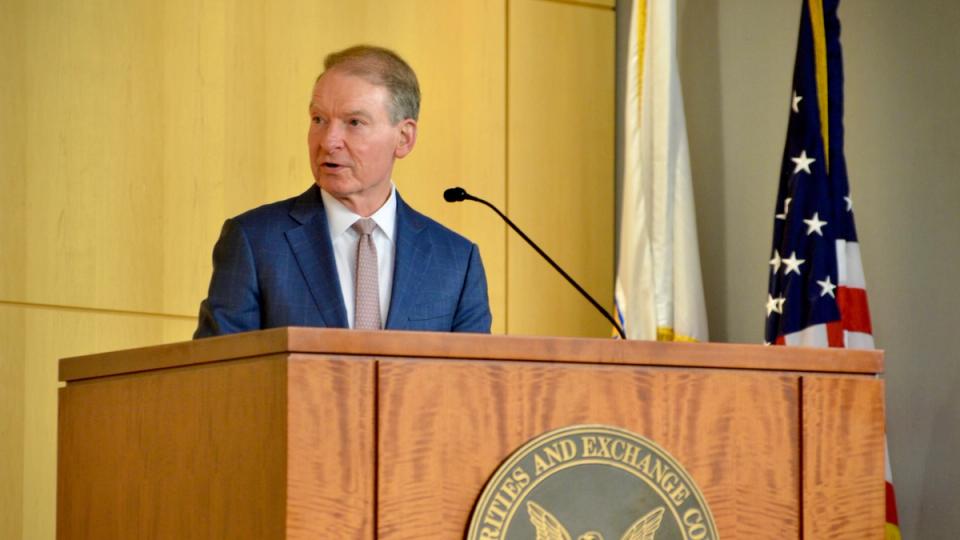
U.S. Securities and Exchange Commission Chairman Paul Atkins said on Friday that the agency is considering changes to how securities regulations apply to blockchain-based financial markets and artificial intelligence-driven financial applications as digital asset companies increasingly move trading and settlement activities on-chain.
Speaking at the AI+ Expo in Washington, Atkins said the SEC is considering formal rules around on-chain trading systems, blockchain settlement infrastructure, automated financial applications and crypto vaults that are increasingly blurring the lines between traditional players.
He believes that existing securities rules are designed around traditional market intermediaries such as brokers, exchanges and clearing houses, while newer blockchain systems often combine these functions into a single software protocol. Atkins’ predecessor, Gary Gensler, held a similar view, although he focused more on centralized exchanges, which the SEC argued at the time offered these disparate functions under one roof, largely through litigation.
“A single protocol can execute trades, manage collateral, route liquidity, execute trading strategies through the vault structure and settle trades,” Atkins said.
“We should remember that today’s on-chain market structures are often hybrid in nature, combining elements of what is often referred to as ‘traditional’ and ‘decentralized’ finance,” he said. “We should use notice and comment rulemaking to clarify how the Commission views the range of models that may implicate our regulations and use our exemption authority where necessary and prudent.”
Atkins’ comments underscore the regulator’s latest move away from an enforcement-focused approach under former Chairman Gary Gensler. Under President Donald Trump, the SEC has issued cryptocurrency-related employee guidance, no-action relief and public statements aimed at reducing legal uncertainty for digital asset companies.
The chairman sees the potential changes as part of a broader shift towards artificial intelligence-driven and automated financial infrastructure. He believes that artificial intelligence agents will increasingly participate in market and financial decisions at machine speed, while blockchain rails allow these systems to transfer value instantly.
He said the SEC should avoid locking emerging technologies into outdated rules.
“Our job is to set the rules and referee the games, not to pick the winning team,” Atkins said.
He also reiterated his support for congressional efforts to pass crypto market structure legislation, including the Clarity Act, which would establish a regulatory framework for digital assets shared between the SEC and the Commodity Futures Trading Commission (CFTC).