


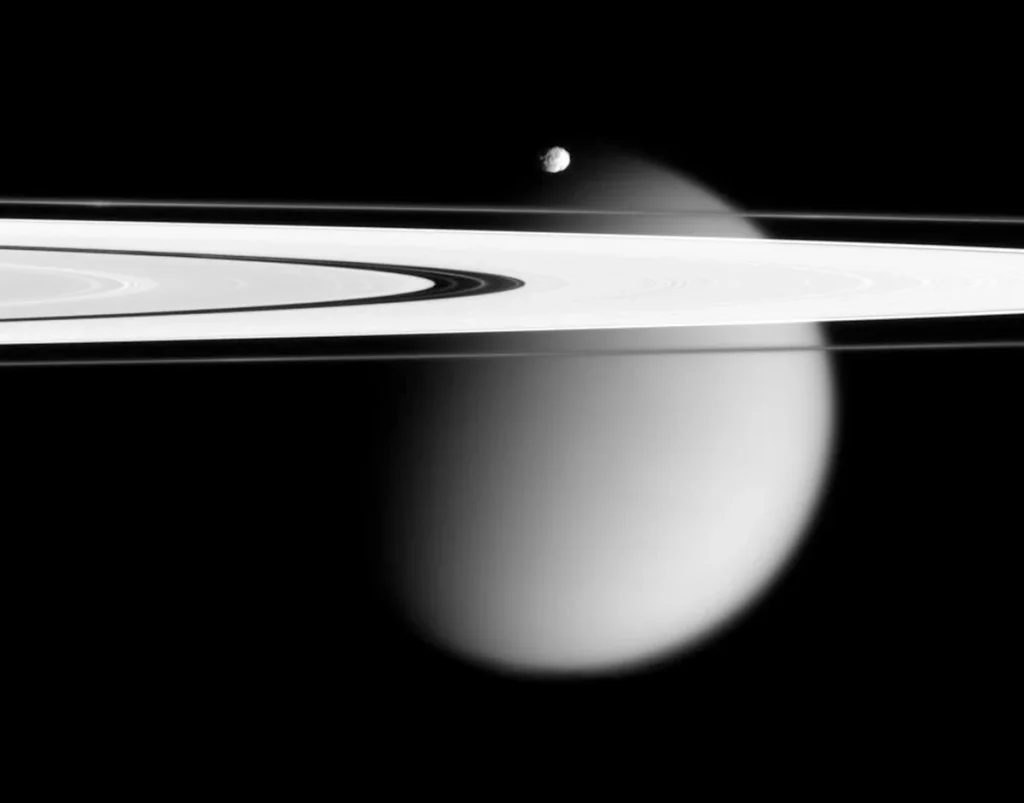
CAPE CANAVERAL, Fla. (AP) — Saturn’s giant moon Titan may not have a vast underground ocean at all.
Titan may have deep ice and mud more similar to Earth’s polar oceans, with some melted water where life could survive and even thrive, scientists reported Wednesday.
A team led by researchers at NASA’s Jet Propulsion Laboratory has challenged the decade-long hypothesis that Titan buries a global ocean after revisiting observations made years ago by NASA’s Cassini spacecraft around Saturn.
They stress that no one has found any signs of life on Titan, the solar system’s second-largest moon that spans 3,200 miles (5,150 kilometers) and whose frosty surface is filled with lakes of liquid methane.
But the latest findings show a muddy, nearly molten environment, and “we have good reason to remain optimistic about the potential for alien life,” said Baptiste Journaux of the University of Washington, who co-authored the study published in Nature.
As for what form of life this might be, which might be strictly microscopic, “Nature has repeatedly shown greater creativity than the most imaginative scientists,” he said in an email.
Lead author Flavio Petricca of the Jet Propulsion Laboratory said Titan’s oceans may have frozen in the past and are currently melting, or its hydrosphere may be heading toward complete freezing.
Computer models suggest these layers of ice, slush and water are more than 340 miles (550 kilometers) deep. The outer ice shell is thought to be about 100 miles (170 kilometers) deep, covered in a layer of slush and pools of water, and may extend down another 250 miles (400 kilometers). The temperature of this water can be as high as 68 degrees Fahrenheit (20 degrees Celsius).
Because Titan is tidally locked, the same side of the moon always faces Saturn, just like our moon and Earth. Saturn’s gravity is so strong that it deforms the moon’s surface, creating bulges as high as 30 feet (10 meters) when the two bodies are closest.
Through improved data processing, Petrica and his team succeeded in measuring the time between peak gravitational drag and the rise of Titan’s surface. If there were a moist ocean on the moon, the effect would be immediate, Petlica said, but a 15-hour gap was detected, indicating slushy ice and liquid water inside. Computer models of Titan’s orientation in space support their theory.
Luciano Iess of Sapienza University in Rome, whose previous research using Cassini data suggested a hidden ocean on Titan, is not convinced by the latest findings.
While “certainly interesting and will inspire new discussion…at this time, the available evidence certainly does not look strong enough to exclude Titan from the SeaWorld family,” Eese said in an email.
NASA’s planned Dragonfly mission – which will launch a helicopter-type vehicle to Titan later this decade – is expected to provide a clearer picture of the moon’s interior structure. Journaux is part of the team.
Saturn leads the solar system with 274 moons. Jupiter’s moon Ganymede, which is only slightly larger than Titan, may have an underground ocean. Other suspected water worlds include Saturn’s Enceladus and Jupiter’s Europa, both of which are believed to have geysers spewing from the frozen crust.
Cassini was launched in 1997 and arrived at Saturn in 2004, orbiting the planet and flying past its moons until it deliberately plunged into the planet’s atmosphere in 2017.
___
The Associated Press Health & Science Department receives support from the Howard Hughes Medical Institute’s Department of Science Education and the Robert Wood Johnson Foundation. The Associated Press is solely responsible for all content.