


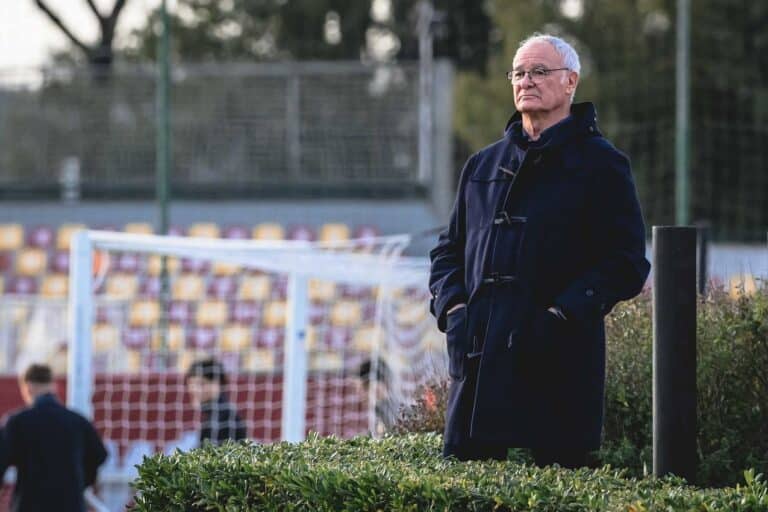
Claudio Ranieri has traveled the world as a manager and is now a senior adviser to Friedkins.
Interview with the former manager, who was born in Testaccio messenger About his early days around the neighborhood and the wonders he created at Leicester City.
advertise
The former manager spoke first of all about Testaccio: “My parents’ butcher’s shop no longer exists, so I come back a lot less than before. I still have a very clear memory: we lived in the market square and it was packed with people.”
Ranieri then spoke about how he started his football journey: “It was a classic childhood dream. I never went to a football school; they didn’t exist then. There were youth clubs and I started at San Saba. At 16, I had a trial with Roma but they rejected me. Herrera took me back.”
The current senior advisor then recalled his debut in a Roma shirt: “Scorpinho was on the bench. Then Liedholm took over: I definitely had great teachers, there’s no doubt about it. Herrera didn’t make you think; he wanted me to pass the ball directly. That’s the way football is now, you play with your heart. Scorpinho, on the other hand, was very thoughtful, but when he scored five minutes, it was troublesome. Fortunately, I was happy. “Very hard-working, and they didn’t scold me either. “
The former footballer then commented on his career: “I was an ordinary player and I have no regrets. I spent eight wonderful years at Catanzaro. I became captain and now I hold the record for the most Serie A appearances for them.”
advertise
Ranieri also spoke of his early experiences as a coach: “I thought, why not give it a try? In Italy, not everyone understands football: playing football is one thing, watching the game from the stands is another. Sitting on the bench was another world: you had to know how to talk to the manager, the players and the reporters. When When Cagliari called, they advised me to refuse. ‘Just think, you might get burned out’, but I wanted to take a chance and my contact with the players had an impact on my career, and the coach needs everyone to follow an idea, right or wrong, in order for him to be successful.”
The former coach has no doubts about the methods he uses to get inside his players’ heads: “Fans think they are robots. That’s not the case: they have their ups and downs, and you have to be there for them in difficult moments. I have always considered myself a balancer. There is a poem by Kipling that describes this: Treat victory and defeat like impostors. It’s absolutely true.”
Regarding the lonely nature of the role, the coach himself said: “Coaching is lonely. It’s about the team, the outside world and the management. I tend to take responsibility. That’s why I went through the dismissal like an abyss: I didn’t understand certain dynamics. I never thought, nor said, that it was the player’s fault.”
Ranieri has no doubts about the most painful parting: “My second year at Valencia. I made it clear to the management: we have achieved more than we could have achieved and we will have to bear the pain. They fired me at a difficult moment; I feel betrayed.”
advertise
The former coach then spoke of the call that surprised him the most: “The call from Juventus. I had already committed to Taxi Shinawatra, who was buying Manchester City. I was supposed to sign ten days later, but twenty days passed. When Turin called, I flew to London to tell him I couldn’t wait.”
The “Miracle Man” then spoke about his title-winning campaign with Leicester City: “I haven’t changed, I’m still the same person in Kipling’s poem. The public perception of me has changed since then. I almost won the title in an under-equipped team and was a permanent runner-up. But I accepted everything and you can’t go against the mainstream. At Leicester City, I was right It was the right place at the right time. They call it a Yo-Yo team because of its ups and downs. The president asked me to get the team out of relegation as soon as possible, and then in February we had back-to-back games against Manchester and home games against Arsenal, and after that the lads always wanted to have a day off and one day Vardy came to me and said: “Sir, what if we get nine points?” “I replied that I would give him a week. We beat Liverpool and Manchester and only lost to Arsenal in the 95th minute with ten men, but for me it was as good as a victory. So I kept my promise. When Mahrez mentioned the team, he said to me: “What do you think we can achieve? You know very well…” I smiled, but I never thought about victory.”
Ranieri, who had many encounters with Mourinho during his career, said of this: “We clashed at the beginning and then we became friends. When I came to Inter Milan, he was the first person to call me. Obviously, they have explained to him what kind of person I am.”
Senior advisor Friedkin then talked about the current situation of Italian football: “I see two problems. The first is the lack of money, so we cannot compete with the English teams, who spent 60 million euros on players under the age of 20. The second is related to the cycle. Before Cliff, the Dutch team was useless, just like other leagues. We have championships and “Italian style” competition, even today, no one will use it when needed, but here a war broke out between gamblers and pragmatists.”
advertise
Ranieri then talked about saying “no” to the national team: “What coach doesn’t want to coach his own national team? But I can say that it is not difficult because I have a contract with Roma. This may create a conflict of interest. For example: I am a reference point for Friedkins and the national team is playing, but at the same time Roma has an important game. So I will not call up Roma players, or I will not call them and send other players.” For the players of the team, this certainly seems to be the most honest choice, knowing what will happen in Italy. “
Later, the man himself spoke about his relationship with the Friedkins family: “At the time, they told me that I could make any choice I wanted and that they would support me. They were fair to me. We now communicate regularly via video calls and text messages. They are not a problem in the United States; in England they are almost never in the teams I coach. Only in Italy they cause problems. The president is important because he pays at the end of the month.”
Ranieri then spoke about his future: “I think I will eventually stay at Roma, but never say never. I said I would stop coaching, but when Roma called me, I accepted it. The capital is my mother and Cagliari is my wife. I had enough of the bench. I quit because I realized that the joy of victory is short-lived and defeat eats me up. Now, if I were to change teams, I would only change to a managerial position.”