


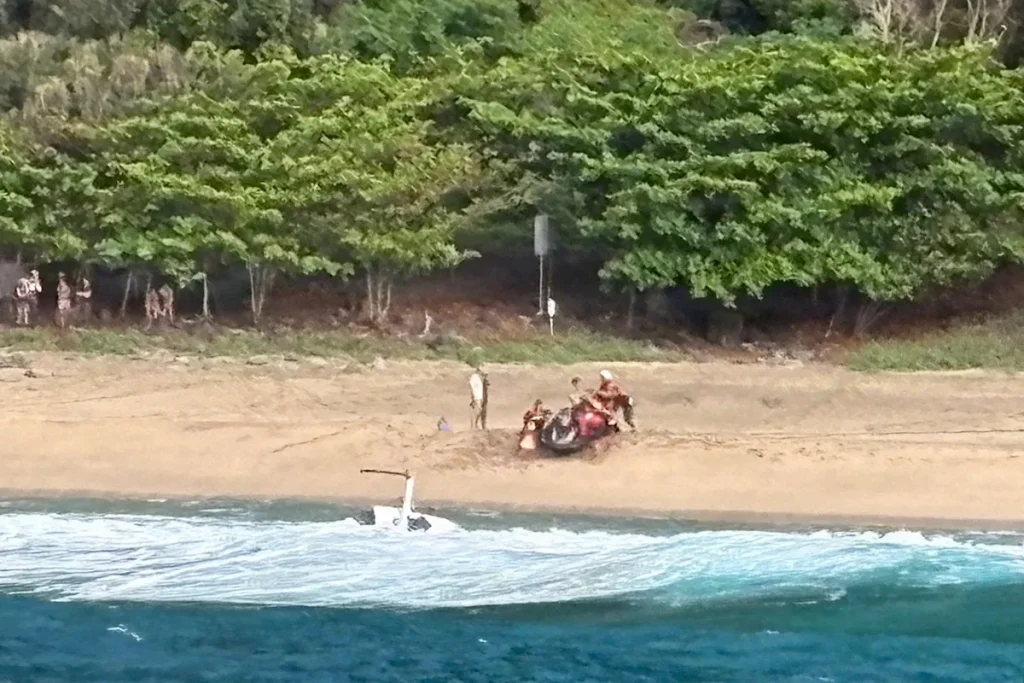
The pilot of a helicopter that crashed on a sightseeing flight last month near the Hawaiian island of Kauai, killing three passengers, told investigators the plane vibrated and spun before plunging into the water, according to a report released Friday.
The National Transportation Safety Board’s preliminary report did not identify a suspected cause of the March 26 crash, but said the pilot reported he experienced “high-frequency vibrations throughout the helicopter in a wave-like pattern that became stronger each time.” The reasons won’t be known until a final report is released, likely sometime next year.
The helicopter was carrying the pilot and four passengers when it crashed near remote Kalalau Beach on the Na Pali Coast on Kauai’s north shore, an area only accessible by an 11-mile (18-kilometer) hike or boat. The area’s tall seaside cliffs and steep ridges can cause air turbulence and rapid weather changes that can be hazardous to aviation.
The pilot and surviving passengers were seriously injured.
The pilot reportedly said the vibrations started when he turned left away from the coastline as part of a normal flight pattern. The helicopter then began to spin rapidly clockwise. He put the plane into autorotation—a maneuver that allows the rotor to spin with the force of the air rather than the power of the engine—and stopped the rotation. He sent a distress signal before falling into the water about 75 yards (69 meters) off the beach.
“It sounds like a catastrophic mechanical failure, likely involving the tail rotor,” said former National Transportation Safety Board investigator Alan Diehl.
The helicopter rolled to its right and was partially submerged. The report did not say how the pilot and one passenger survived the crash or where the surviving passengers were sitting.
A witness flying near the accident site witnessed the crash and reported that the helicopter appeared to be intact before it hit the water and broke apart.
Authorities identified the three people killed as Margaret Rimmler, 65, and Patrick Haskell, 59, of Massachusetts, as well as Oksana Pihol, 40, of Ukraine.
The helicopter was operated by Airborne Aviation, which provides sightseeing tours of Kauai’s canyons, coastline and waterfalls. Airborne is advertised as a “thrill-seeking adventure right outside your door” and can accommodate up to four people. Helicopter tours are a popular way to explore the cliffs, beaches, and waterfalls of the Na Pali Coast.
Aviation safety expert Jeff Guzzetti agreed with Diehl that the helicopter had some kind of mechanical problem — most likely with the tail rotor. He said that’s what the helicopter’s vibrations and sudden rotation indicated, although it was too early to determine what the specific problem was.
“Certainly it appears that this would have caused a mechanical failure in the helicopter, which would shift the investigation to maintenance and design issues,” said Guzzetti, who has investigated crashes for the National Transportation Safety Board and the Federal Aviation Administration.
Guzzetti said it appeared the pilot did the right thing because he was able to stop the spin, but the helicopter didn’t have enough time or altitude to reach the beach.
Investigators will learn more about what caused the crash as they examine the wreckage, its maintenance history and interview everyone involved.
The accident is the latest in a series of fatal accidents that have plagued the industry for decades. At least 16 people have died in helicopter crashes in Hawaii over the past seven years, including two in 2019.
Tourism companies in other parts of the country, including New York, are also facing collapse. An incident last year in New York’s Hudson River killed a pilot and a family of five Spanish tourists. In 2018, a charter helicopter providing “open door” flights crashed into the East River, killing five people. In 2009, a plane collided with a tourist helicopter over the Hudson River, killing nine people.
___
Johnson reported from Seattle. Fink reported from Omaha, Nebraska.