


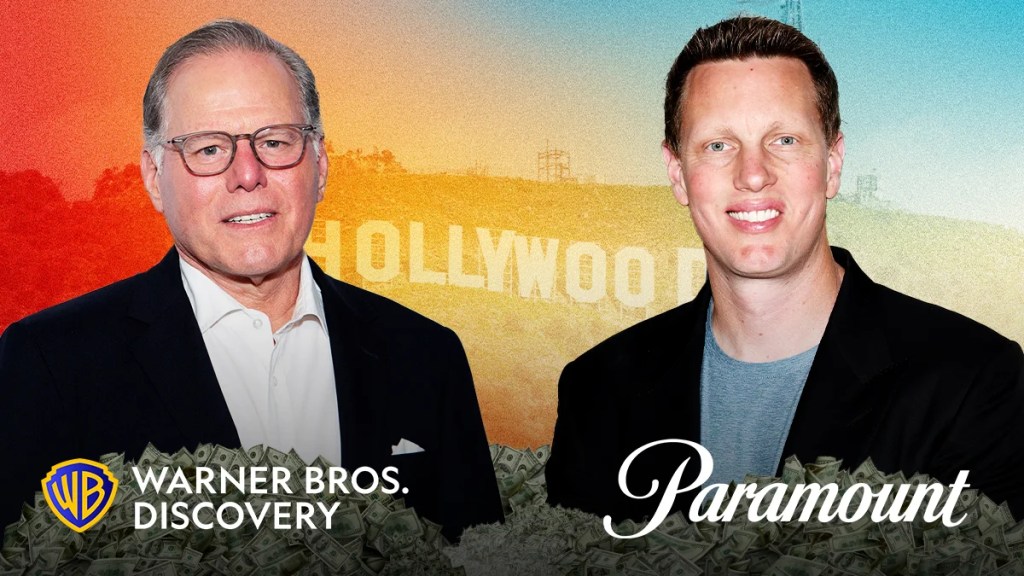


Over the years, Paramount has made a comeback.
The months-long Warner Bros. Discovery Channel merger saga ended in a matter of hours Thursday, in a day that began as a trickle of news and quickly escalated into a tsunami. Warner Bros. declared Paramount’s revised bid a “better offer,” prompting Netflix to throw in the towel shortly after.
For Paramount, it marks an impressive turnaround for a company that was essentially written off after slamming Warner Bros. for what it called an unfair bidding process and then launching a hostile bid that seemed unappealing. Netflix has been in the driver’s seat on the deal for months, courting WBD CEO David Zaslav. But Paramount CEO David Ellison, with the help of Warner Bros. shareholders, overcame the feud and finally got the board’s attention.
“We are pleased that the WBD board of directors has unanimously affirmed the superior value of our offer, which delivers superior value, certainty and speed to closing for WBD shareholders,” Ellison said in a statement issued before Netflix’s exit.
This also marked Zaslav’s victory. Since the Wall Street Journal first reported Paramount’s unsolicited bid in September, he found that WBD stock has risen 129%, from $12.59 to currently trading just below $29. Paramount’s bid increases the amount to $31 per share and includes a breakup fee.
“Once our board of directors votes to approve the Paramount merger agreement, it will create tremendous value for our shareholders,” Zaslav said in a statement. “We are excited about the potential of the combined Paramount Skydance and Warner Bros. Discovery Channel and can’t wait to start telling the stories that move the world together.”
The regulatory pressure ended up being too much for Netflix. President Trump has wavered back and forth on his own involvement, and over the weekend he appeared to be weighing the pros and cons, calling on Netflix to fire board member Susan Rice, a Democrat and former U.N. ambassador, or face “consequences.”
The Justice Department is also launching an antitrust investigation into the Netflix deal, talking to theater owners, filmmakers and producers across Hollywood to gather their input for review. Netflix co-CEO Ted Sarandos met with Attorney General Pam Bondi and White House Chief of Staff Susan Wiles in Washington today.
Presumably, these meetings did not go well.

“If they lose confidence in the deal and their ability to overcome the regulatory/political/business challenges, this is the best way for them to save face and avoid shareholder questions about whether the deal was worth it in the first place,” Paul Nary, professor of M&A and strategy at the University of Pennsylvania’s Wharton School, told TheWrap.
Less than 20 minutes later, Netflix issued a statement.
“The deal we negotiated will create shareholder value and provide a clear path to regulatory approval,” Netflix said in a statement. “However, we have been disciplined and the deal is no longer financially attractive at the price required by Paramount Skydance’s latest offer, so we declined to match Paramount Skydance’s bid.”
As the streaming giant has done in countless production deals, it raised the price and backed out. Netflix shareholders will probably be happy.
“Netflix has concluded that this is simply not worth the headache,” Third Bridge senior analyst John Conca told TheWrap. “Ultimately, this could be a positive for Netflix; they need to focus on delivering growth businesses, especially advertising, and the large and lengthy complex approval process that would follow could severely impact this, especially given that the business is still in its infancy.”
Two big pluses for Netflix: Shares up 9% since exit and It no longer has to appear at a second Senate hearing to discuss the deal – the scheduled deadline for Netflix to match Paramount’s offer.
Now it’s Ellison’s turn to face lawmakers’ skepticism about more media consolidation.
Apparently, Paramount wanted it more. But as Paramount and WBD’s quarterly results showed, the merger of the two media giants doesn’t necessarily spell the end of their respective woes.
On Wednesday, Paramount reported a fourth-quarter loss of $573 million, more than double its loss in the same period last year before it acquired Skydance. This morning, Warner Bros. reported a fourth-quarter loss of $252 million — at least an improvement from the $494 million loss in the same period last year, suggesting that a turnaround effort is finally taking hold — but it may be too late.
The two companies’ losses were huge – totaling $825 million in the last three months of the year.
Paramount’s growing losses are concerning. As Conca noted, its results were significantly lower than operating income due to restructuring charges, while its legacy businesses showed no improvement, especially its disappointing film division.
“Is Paramount management currently equipped to handle the messier, more arduous integration of assets?” he asked.
Paramount’s massive losses illustrate why it’s so desperate to acquire WBD’s treasure trove of valuable intellectual property and studio business, which it aims to inject into what it envisions as a larger (hopefully) profit machine.
But scale won’t solve all of Paramount’s problems, and taking on the debt needed to complete the WBD acquisition would mean Paramount is at a financial disadvantage from the start.
Meanwhile, Netflix released quarterly results last month showing net profit of US$2.42 billion, a year-on-year increase of 29%. It’s in a much healthier financial position, and even if it misses out on franchises like Game of Thrones or Harry Potter, it still gets $2.8 billion in fees for its troubles.
So who has the last laugh?
The post Paramount taking Warner Bros away from Netflix, analysis, appeared first on TheWrap.