


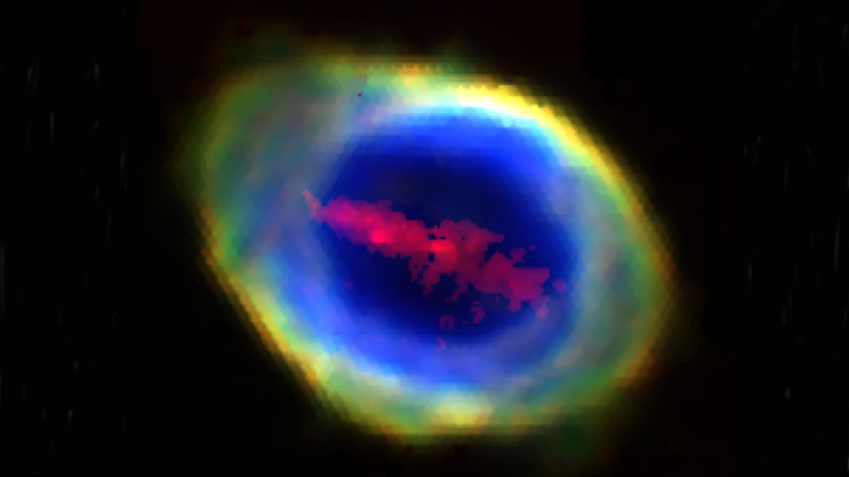
Scientists have discovered a giant bar-shaped cloud of iron atoms in space that could provide clues to Earth’s future.
The structure was discovered inside the Ring Nebula, the famous colorful cloud that forms when a dying Sun-like star releases its outer layers, about 500 times wider than Pluto’s orbit and 2,283 light-years away.
Astronomers from Cardiff University and University College London detected the iron bar using a new telescope instrument called the WHT Enhanced Surface Velocity Explorer (Weave).
Scientists observing it say its origin is unclear, but their theories about how it formed suggest it could hint at Earth’s future.
The first theory is that the nebula may have formed as the parent star collapsed during the formation of the nebula.
Alternatively, experts believe it could be space plasma left behind when a rocky planet was destroyed as the star expanded. If true, it could provide a preview of Earth’s future, as the Sun – Earth’s parent star – will similarly expel its outer layers and engulf the Earth within billions of years.
The team said they are planning further observations to figure out exactly what the iron rod is, where it came from, and what it can tell them.
Lead author Dr Roger Wesson, from Cardiff University and University College London, said that although the Ring Nebula has been studied using many different telescopes and instruments, Weaver allowed them to “observe it in a new way, providing more detail than before”.
“By continuously acquiring spectra of the entire nebula, we can create an image of the nebula at any wavelength and determine its chemical composition at any location,” he said.
“As we processed the data and scrolled through the images, one thing popped out as clear as anything—this previously unknown ‘strip’ of ionized iron atoms in the middle of the familiar, iconic ring.”


Cardiff University scientists were involved in the research [Colin Smith/Geograph]
Co-author Professor Janet Drew added: “We definitely need to know more, particularly whether any other chemical elements co-exist with the newly detected iron, as this might tell us the right class of models to pursue.”
Weaver plans to conduct eight surveys over the next five years, with targets ranging from nearby white dwarfs (a type of dead star) to very distant galaxies.
Wesson added: “It would be very surprising if the iron rod in the ring was unique.
“So hopefully as we observe and analyze more nebulae produced in the same way, we will find more examples of this phenomenon, which will help us understand where the iron comes from.”