


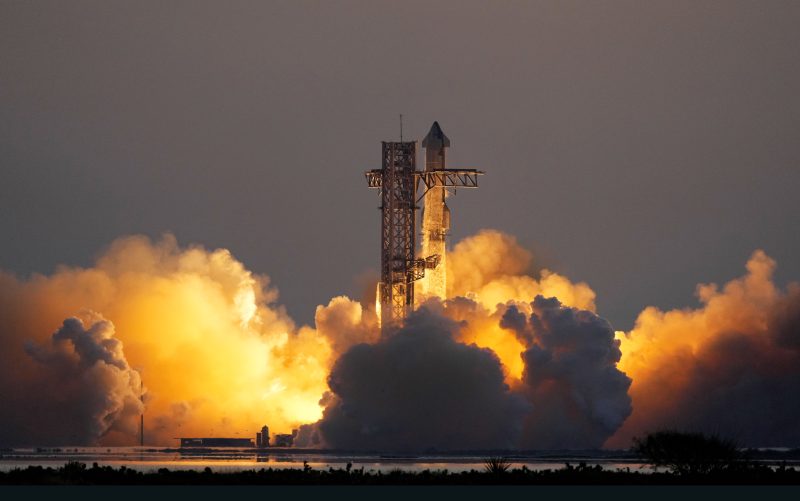
WASHINGTON (Reuters) – Development of SpaceX’s Starship has been delayed for at least two years since the agency selected the rocket as a lunar lander for astronauts in 2021, with more time expected to clear remaining hurdles before landing on the moon while the agency examines plans to speed up the program, the agency’s inspector general said on Tuesday.
NASA has been working with a range of companies, most notably Elon Musk’s SpaceX and Jeff Bezos’ Blue Origin, to launch routine astronaut missions to the moon as part of its multibillion-dollar Artemis program, which it requires before China sends its own astronauts to the lunar surface around 2030.
But increasing delays in the development of SpaceX’s Starship, the program used to carry NASA astronauts to the lunar surface, have gradually pushed back the original goal of landing on the moon in 2024 – although officials at the time were skeptical of 2024.
Retired Air Force general still missing despite massive search
One of the most challenging steps in Starship’s journey to becoming an astronaut-class lunar lander is that the rocket will need to refuel itself in space before completing the remainder of its journey to the moon, a dangerous and delicate process that has never been attempted on this scale, the inspector general said in a report Tuesday.
In order for one Starship to send astronauts to the moon, SpaceX first needs to launch more than 11 Starships into Earth orbit, which will act as tankers. One of the Starships will serve as a propellant storage depot, requiring more than 10 Starships to fill with enough fuel that will be transferred to the moon-landing Starship.
Starship is taller than a 15-story building and is fueled by approximately 1,200 metric tons of liquid methane and liquid oxygen, two highly explosive propellants that must be kept at cryogenic temperatures, or below -238 °F (-150 °C).
Docking Starships together and carefully transferring ultracold propellant at least 10 times in low-Earth orbit, a politically and commercially crucial region of space where satellite traffic continues to surge, will be one of the most dangerous challenges for a company that already lands orbiting rockets and launches astronauts to the International Space Station.
NASA officials overseeing the development of SpaceX’s Starship “consider demonstrating cryogenic propellant transfer to be one of the most significant technical challenges facing SpaceX,” the report said.
“NASA is tracking the biggest risk that some of the cryogenic technologies and capabilities being developed by SpaceX will not be fully mature before a lunar landing in 2028,” the report said.
Erica Kirk appointed to Air Force Academy Board of Trustees
SpaceX has launched the Starship system 11 times since 2023 in a series of test flights closely watched by NASA officials.
NASA last month added an additional Artemis test mission and acknowledged the technical challenges its contractors face in the Artemis moon program, which will see SpaceX put humans on the moon in two missions starting in 2028, followed by a similar crewed landing by Jeff Bezos’ Blue Origin.
The agency has set 2028 as Starship’s target moon landing date.
(Reporting by Joey Roulette; Editing by Franklin Paul and Chizu Nomiyama)
Copyright 2026 Nexstar Media, Inc. All rights reserved. This material may not be published, broadcast, rewritten or redistributed.
For the latest news, weather, sports and streaming video, head to NewsNation.