


Diego O’Re
MEXICO CITY, Dec 8 (Reuters) – Mexican lawmakers are set to start debating a bill to increase tariffs on goods from China and other Asian countries this week, but have faced strong opposition from Chinese and Mexican business groups, three ruling party lawmakers told Reuters.
The proposal would increase import tariffs by up to 50% on cars, textiles, clothing, plastics, steel and other products from China and other Asian countries that do not currently have trade agreements with Mexico, including India, South Korea, Thailand and Indonesia.
Mexico’s Economy Ministry first outlined the proposed tariffs in September, but the initiative has struggled to gain broad support in Congress despite the overwhelming majority held by the ruling Morena party and its allies.
President Claudia Scheinbaum’s government said the measure was aimed at boosting production capacity, protecting national jobs and ensuring Mexico competes fairly in global markets and addressing the trade imbalance with China.
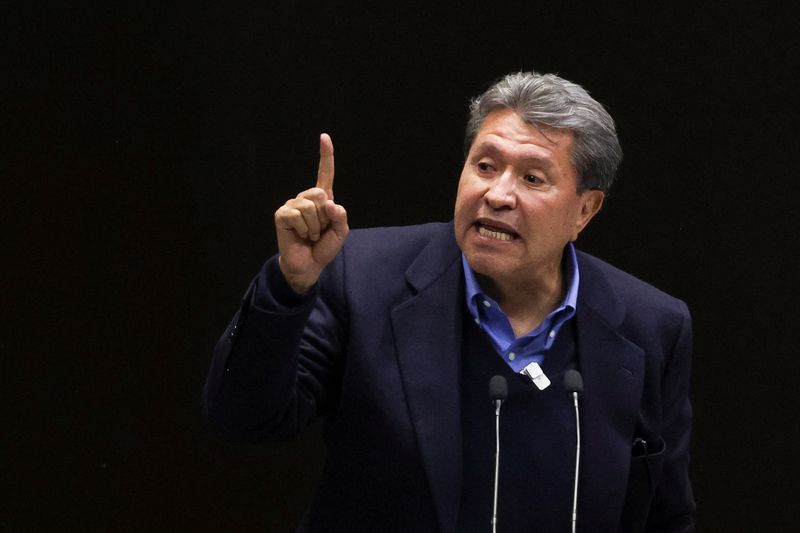
“In the past few years, our country has faced trade distortions, unfair practices and a growing dependence on imported inputs that have affected the country’s productive sectors,” lower house leader Ricardo Monreal of the ruling Morena party said on social media on Friday.
The proposal would also bring an additional 70 billion pesos ($3.76 billion) to the state coffers, Tax Undersecretary Carlos Lerma said in September as the government prepared the measure.
Neither Scheinbaum’s office nor the Economic Ministry responded to requests for comment.
Four sources familiar with the meeting told Reuters that Scheinbaum met privately with Morena party allies and lawmakers at the National Palace in late November to urge them to approve the bill before the end of the year.
“The directive is to pass the bill before the end of the parliamentary session on December 15,” a source said.
Like other sources, the person spoke on condition of anonymity to discuss sensitive political issues and private meetings that have not been previously reported.
“There is a sense of urgency within the government to get this done before the end of the year,” the source added.
Two sources said the proposal to be considered by lawmakers this week is likely to be more modest than the original bill, which stalled in the lower house of Congress last fall in the face of strong opposition from China and business groups.
Industry associations have warned that the proposed tariffs will significantly increase production costs, given its heavy reliance on Chinese imports of machinery, parts and raw materials.
In particular, the government’s proposal could scale back tariff increases on auto parts and steel products, two sources said. Reuters could not confirm the specific changes.
Mexico’s auto assembly industry, one of the world’s largest, has warned that proposed tariffs could cut off supplies of key electronic components such as touch screens for digital dashboards because they are not produced locally.
Next year’s USMCA review will center on Mexico’s sweeping tariff proposal. Mexico had already raised tariffs on Chinese goods earlier this year in what analysts said was an effort to appease Washington. But U.S. officials continue to raise concerns.
On Thursday, U.S. Trade Representative Jamieson Greer said Canada and Mexico should not be used as export hubs for China, Vietnam, Indonesia and other countries, saying that was already happening in some cases in Mexico.
Experts warn that the proposed tariffs could disrupt critical supply chains at a time when Mexico, Latin America’s second-largest economy, has nearly ground to a halt. Mexico’s National Automotive Parts Industry Organization said that those facing the greatest risk are the electronics and automotive industries that rely heavily on Chinese parts.
“The impact could be brutal,” said Amapola Grijalva, president of the China-Mexico Chamber of Commerce in Mexico, which represents Chinese companies operating in Mexico and Mexican companies operating in China.
“These tariff levels will prevent domestic manufacturers from accessing certain technologies and products that would allow them to remain competitive at home and abroad.”
The proposal would also affect India, one of Mexico’s growing trading partners. India supplies pharmaceuticals, textiles, chemicals and auto parts, while Mexico exports oil, copper and agricultural products to India.
In recent months, business leaders have strongly lobbied Mexico’s finance and economy ministries to repeal the measure, or at least eliminate some tariff categories and gradually reduce the tax burden.
Initially, government officials refused to budge, four sources said. But they have shown greater flexibility since November, four sources said, suggesting they may be open to smaller tariff increases than originally proposed or removing sensitive products from a list of more than 1,400 categories.
(Reporting by Diego Oré; Additional reporting by Ana Isabel Martínez and Emily Green; Editing by Laura Gottesdiener and Aurora Ellis)