


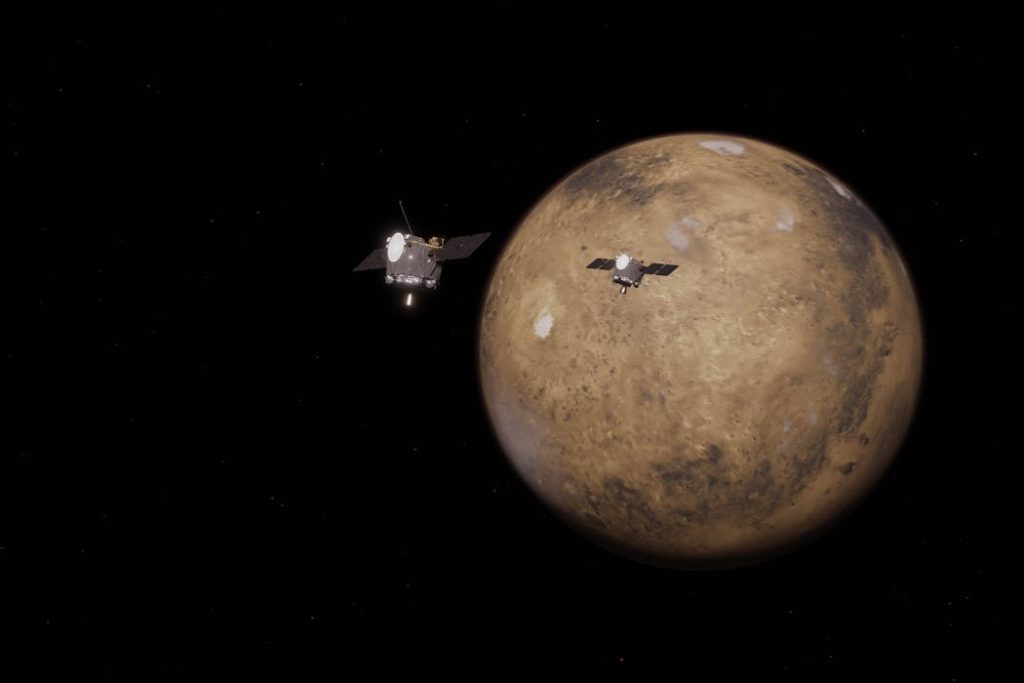
After a year of setbacks, NASA’s Escape and Plasma Acceleration and Dynamics Explorer (ESCAPADE) mission has finally begun its journey around Mars.
ESCAPADE’s twin probes, launching on November 13, 2025 aboard Blue Origin’s New Glenn rocket, will map the Martian magnetic field and study how the solar wind (a stream of charged particles released by the sun) strips away the Martian atmosphere over billions of years.
When I was a PhD student, I helped develop the VISIONS camera system on each of ESCAPADE’s spacecraft, so I’m particularly excited about the successful launch.
But this low-cost mission is just getting started, and it carries greater risks than typical big-budget NASA missions.
ESCAPADE is part of NASA’s Small Innovative Missions for Planetary Exploration (SIMPLEx) program, which funds low-cost, high-risk projects. Of the five SIMPLEx missions selected to date, three have failed after launch due to equipment problems that might have been encountered in more traditional, tightly managed projects. The fourth is in indefinite storage.
ESCAPADE won’t start returning scientific data for about 30 months, and the project’s history suggests the odds aren’t entirely in its favor. Still, if enough of these missions succeed, NASA can achieve valuable science at a lower cost—even if it incurs some damage along the way.


Lower costs, higher risks
NASA divides payloads into four risk levels, from A to D.
Class A missions are the most expensive and highest priority, such as the James Webb Space Telescope, Europa Clipper, and the Nancy Grace Roman Space Telescope. They use thoroughly proven hardware and undergo exhaustive testing.
ESCAPADE is at the other end. This is a Class D mission, defined as having “high risk tolerance” and “low to moderate complexity.”
NASA has launched 21 D-class missions since the name was first used in 2009, but to date, none have been launched as planned. Only four remain under budget. Four of them were canceled outright before launch.
ESCAPADE’s cost is estimated at $94.2 million by the end of science operations in 2029, and has been kept below $100 million through a series of cost-saving options. It features a small set of key instruments, lower spacecraft mass to reduce launch costs, and extensive use of common commercial components rather than custom hardware.
NASA also outsources to private companies: most spacecraft development goes to Rocket Lab and orbital design goes to Advanced Space LLC, with strict contract restrictions to ensure contractors don’t go over budget.
Additional savings came from creative arrangements, including university-funded VISIONS camera packages and discounted rides on New Glenn, which Blue Origin wanted to fly anyway to meet its own testing goals.
commercial space
The launch of ESCAPADE comes at a transformative moment for space science.
NASA and other science agencies are facing their most severe budget pressures in more than 60 years as political winds shift funding toward human spaceflight. Meanwhile, the commercial space sector is booming, with long-awaited technologies finally making cheap space travel available.
This boom has led in part to a resurgence of NASA’s “faster, better, cheaper” drive that originated in the 1980s and 1990s but largely disappeared after the 2003 Columbia disaster.
In theory, NASA’s leaner oversight, greater use of off-the-shelf hardware, and narrowed science goals could reduce costs while launching more missions and increasing total science return. If ESCAPADE succeeds in delivering important scientific results, it will be seen as evidence that this more commercial, risk-tolerant template can be achieved.
trade off
One concept promoted by Jared Isaacman, the Trump administration’s nominee for NASA administrator, is that 10 $100 million missions are better than one $1 billion flagship (or top-level) mission. This approach could encourage faster mission development and diversify the types of missions entering the solar system.
But this restructuring comes with trade-offs. For example, low-cost missions rarely match flagship missions in scope, and they often do less to advance the technologies needed to advance innovative science.
Because of their narrow scope, missions like ESCAPADE are unlikely to yield the most transformative discoveries, such as the origin of life or the nature of dark matter, or the first chemical analysis of new world oceans. Instead, they focus on more specific issues.
Early in the development of ESCAPADE, my role was to help create a planning document for the VISIONS camera called the “Scientific Traceability Matrix,” which defined the scientific objectives of the instrument and translated them into specific measurement requirements.
My colleagues and I systematically asked: What do we want to learn? What observations would prove this? And, crucially, how accurately does the tool need to work to be “good enough” given the budget? Higher targets often require more complex instrumentation and operations, which increases costs.
The broader goal of ESCAPADE is to gain a clearer understanding of the Martian magnetic field, how the solar wind interacts with it, and to figure out the impact of this process on the Martian atmosphere. This is valuable science. But it is a broader and more instrumented mission than its $583 million predecessor, MAVEN. It’s MAVEN that determines how and when Mars loses its once-dense atmosphere.
ESCAPADE and MAVEN again pale in comparison to the open potential of the James Webb Space Telescope, which observes an infinite number of astronomical objects in the infrared spectrum with greater resolution than any existing combination of small telescopes.
Flagship missions such as the James Webb Space Telescope drive the development of new technologies and materials. These innovations will then permeate future tasks and daily life. For example, the Webb telescope improved medical tools used in eye exams. Smaller tasks rely more heavily on existing mature technologies.
When systems are built by private companies rather than NASA, those companies tightly control patents rather than openly disseminating the technology to the scientific community.
A tense road to launch
Rob Lillis, ESCAPADE’s principal investigator, joked that it was an 11-life mission that survived 11 near misses. Problems include a failure to reach a level of technical readiness in time that would help ensure the probe does not malfunction after launch, and the loss of the original hitchhiking function of NASA’s Psyche mission.
In 2024, ESCAPADE received support from NASA for its first flight aboard New Glenn, but faced delays as Blue Origin overcame technical hurdles. In October 2025, ESCAPADE finally arrived at the launch pad.
I traveled to Cape Canaveral for the launch and felt the tension firsthand. The first window was scratched due to bad weather and ground equipment issues. Then, a powerful solar storm—ironically a key driver of the process ESCAPADE will study—closed the second window.
Meanwhile, the Federal Aviation Administration has imposed new launch restrictions due to the government shutdown, and if not for a last-minute exemption, the launch would have been further delayed.
On November 13, after repeated setbacks, the New Glenn finally took off amid cheers from across the country. ESCAPADE reached orbit, and after several tense hours of receiver misalignment, mission controllers established communications with the spacecraft.
what’s next
While in Florida, I also watched another commercial spaceflight milestone: the record-breaking 94th launch from Cape Canaveral in 2025, the most launches in a single year in Florida. This is the SpaceX Falcon 9 rocket carrying Starlink satellites.
Like New Glenn, SpaceX’s Falcon 9 saves money by landing and reusing the rocket. The economics of small science missions will only improve if multiple providers like SpaceX and Blue Origin compete to keep launch prices low.


If ESCAPADE’s twin spacecraft reach Mars and deliver new insights as planned, they will demonstrate how a minimalist, commercial, forward-thinking approach can expand the planetary knowledge base.
But even so, a future series of SIMPLEx successes may not replace technologically advanced flagship missions with unique capabilities that can answer the most profound questions. Instead, ESCAPADE could help test whether a broader portfolio of smaller missions—relying on commercial partners and a few ambitious large flagships—can collectively sustain planetary science in an era of tight budgets.
For now, this balance remains an open experiment, and only time will tell whether escape is a lonely highlight or the beginning of true transformation.
This article is republished from The Conversation, a nonprofit, independent news organization that provides you with facts and trustworthy analysis to help you understand our complex world. Author: Ari Koeppel, Dartmouth College
Read more:
Ari Koeppel is a team member on the ESCAPADE VISIONS camera and has previously received funding from a NASA research grant. He currently works at the Planetary Society.