


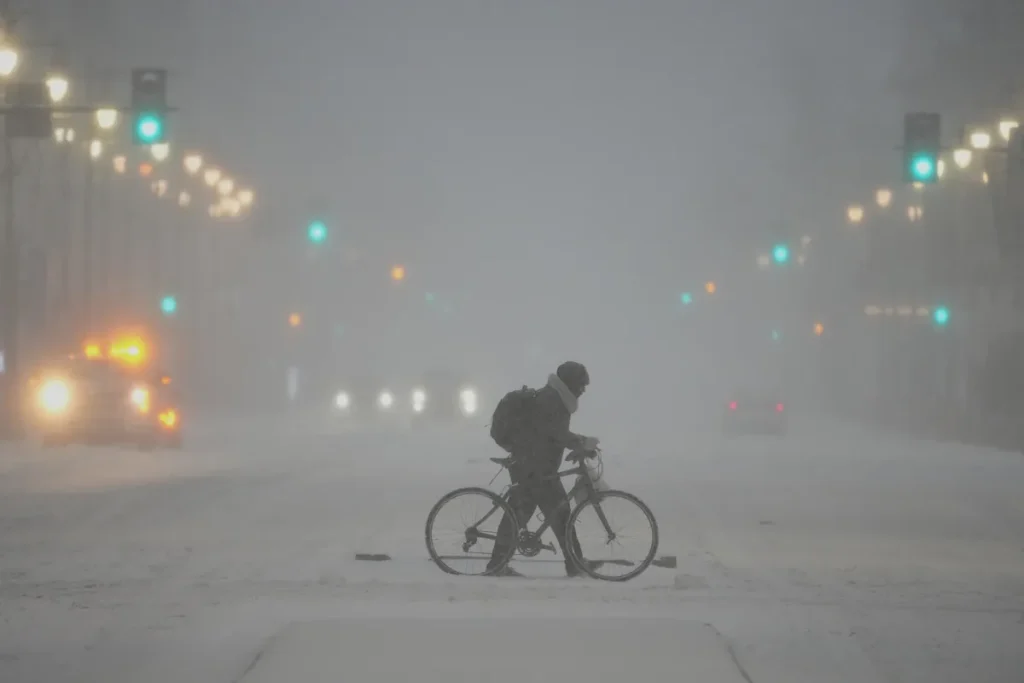
HOUSTON (AP) — Winter’s harsh grip on the eastern U.S. shows no sign of letting up, with the balmy Florida peninsula plunging into subfreezing temperatures in the coming days and the possibility of powerful snowstorms expected along the Atlantic coast.
The severe cold is expected to continue through at least the first week of February. Meteorologists are also watching a “bomb cyclone” — a rapidly intensifying storm that is the winter version of a hurricane — form in the Carolinas Friday night into Saturday.
“A major winter storm appears to be about to hit the Carolinas,” said meteorologist Peter Mullinax of the National Oceanic and Atmospheric Administration’s Weather Prediction Center.
The storm could bring at least 6 inches (15 centimeters) of snow to the Carolinas, northern Georgia and southern Virginia. After that, it could turn and move across the Interstate 95 corridor Saturday night into Sunday, dumping more snow from Washington to Boston and further paralyzing much of the country. Or it could cause a brief hit, mainly hitting places like Cape Cod.
Alternatively, it could turn harmlessly out to sea. Meteorologists and forecast models have yet to settle on a single outcome.
“Confidence that we’re going to see heavy snow this weekend is much higher than in the coastal Carolinas and Virginia,” said James Belanger, vice president of meteorology for The Weather Channel and its parent company. “The real question is going to be the trajectory of it.”
Ryan Maue, a private meteorologist and former chief scientist at the National Oceanic and Atmospheric Administration (NOAA), said it’s a “boom or bust” situation for the mid-Atlantic and northern Atlantic. “If it happens (along the coast), it’s going to be a big deal.”
Models remain divided on storm track
Forecast models were all over the place Tuesday, from out to sea and inward toward Philadelphia. By Wednesday morning, they were beginning to agree that “we’re probably going to see some form of strong coastal storm somewhere off the coast of Delmarva in eastern North Carolina, but they’re still divided on where,” Mullinax said.
Malinax said the chances of the storm leaving the East Coast entirely had diminished but were not gone by Wednesday morning.
Of all the options, “Washington to New York is probably the least clear,” Mullinax said. He said a difference of just 50 miles (80 kilometers) in the center of the storm was critical. AccuWeather senior meteorologist Dan Pydynowski said it may be difficult to avoid some kind of snow, whether it’s light or heavy, in the southern mid-Atlantic.
This storm will be stronger than the last one
Meteorologists say this weekend’s storm will be different from the last one, which started with moist air from the Pacific, combined with deep Arctic air from the elongated polar vortex, plus more moisture from the south and east. The winds in the last storm were light. Even if snow doesn’t blanket the Washington area, Mullinax said, the storm will produce strong winds that could still reach gusts of 40 mph (65 kph) and send wind chills plunging to below zero Fahrenheit (minus 18 Celsius).
“This looks like a very strong and explosive storm, so everyone is going to see gusty winds, even inland areas like Pittsburgh where it won’t get snow,” Pidinowski said. Strong winds could push daytime temperatures below zero in teens there, he said.
“We think this is more like a typical nor’easter,” Belanger said, describing a storm that formed along the U.S. Gulf Coast, crossed the Atlantic and rose up that coast.
Cold air and warm water combine to form powerful storms
Bernadette Woods Placky, chief meteorologist at the nonprofit Climate Center, said one of the keys in this scenario is warmer-than-normal water temperatures in the Gulf of Mexico (due in part to human-caused climate change) and the always-warm Atlantic Gulf Stream.
When that happens, the storm “draws in more moisture and gives it more strength,” she said.
Mauer and Belanger said once the storm’s core approaches the Carolinas, its pressure will drop significantly enough to reach what meteorologists call a “bomb cyclone,” or “bomb cyclone,” which would give it the effects of a moderate-severity hurricane, including high winds, but in the winter.
If the storm does make landfall, Mauer said, those winds and additional snowfall could result in massive snowdrifts big enough to bury cars.
Arctic chill continues and spreads further south
What’s more certain, meteorologists say, is that arctic cold in the Midwest and East will continue into mid-February, with only slight warming but still below normal levels.
The new weekend storm “is going to bring so much cold that it’s going to spread right into the heart of the Florida peninsula,” Pidinowski said. Temperatures in Orlando are expected to be well below freezing, with a high of just 48 degrees Fahrenheit (9 degrees Celsius), breaking temperature records, while Miami and Key West will also experience record cold temperatures on Sunday and Monday, meteorologists said.
The outlook for Florida is cold enough to raise concerns about damage to citrus and strawberries in the state.
“We’re entering a period of severe cold,” Moir said.
The storm keeps coming
Mauer said after this weekend’s storm, long-range models will see another storm toward the end of the first week of February. Meteorologists believe the eastern region is mired in freezing temperatures and blizzards due to a sharp drop in Arctic air and seawater.
East Coast snowstorms don’t happen often, but “when they do, they happen in clusters,” said Louis Uccellini, a former National Weather Service administrator who has written a weather textbook on winter storms.
___
AP’s climate and environment coverage receives financial support from multiple private foundations. The Associated Press is solely responsible for all content. Find AP’s criteria for working with charities, supporter lists and grant coverage at AP.org.