


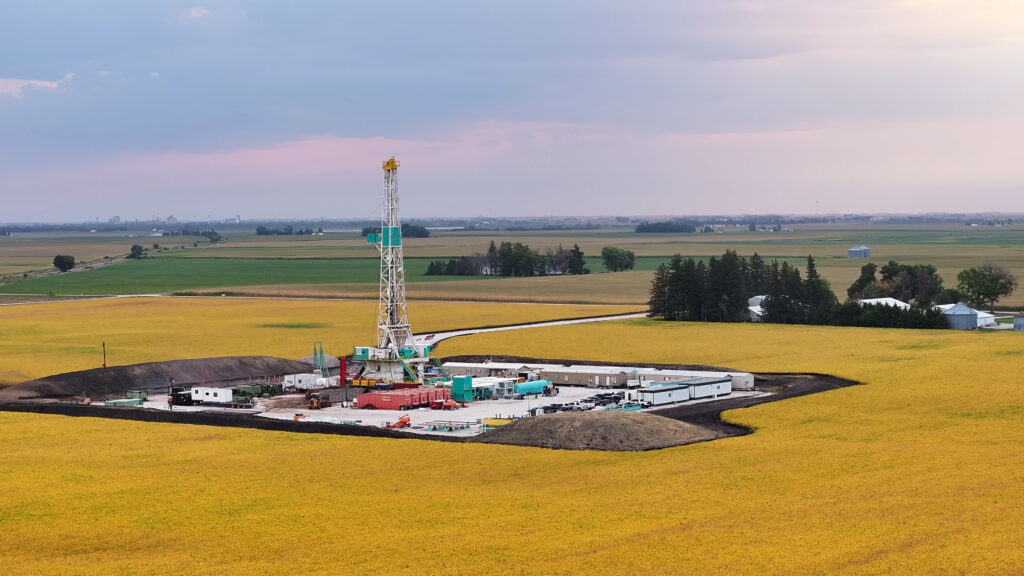
One company is exploring the potential of extracting hydrogen in Iowa. Pictured here is a temporary drilling rig used to establish a hydrogen well, but the production well has a lower profile and a similar height to a water well. (Photo courtesy of Coloma)
It’s no secret that Iowa has large geological formations rich in hydrogen-producing rocks, but in recent years the question has turned to whether hydrogen can be extracted in large quantities.
If the answer is yes, Iowa could have a new natural resource commodity that could be used as a domestic source of fertilizer and clean fuel.
As exploration continues in the state, Iowa lawmakers are looking to update state laws to help regulate the industry going forward.
Pete Johnson, CEO of Koloma, a hydrogen exploration company currently operating in Iowa, said the company is still seeking to answer some “very core technical questions” about hydrogen in the state.
“What we can say is that the potential for underground hydrogen in Iowa is very high,” Johnson said.
SUBSCRIBE: Get morning headlines delivered to your inbox
What is geological hydrogen?
this U.S. Geological Survey Defining hydrogen as a “key feedstock” for petroleum upgrading, steel manufacturing and fertilizer production. It also noted that global demand for hydrogen is expected to increase with decarbonization goals, as hydrogen can also be used as an energy source. The U.S. Geological Survey says hydrogen for most industrial uses is made through the high-temperature reaction of water and coal or methane.
Certain rock formations also produce hydrogen, but until recently, scientists didn’t believe there was an economic accumulation of natural gas at depths where it could be extracted.
Ryan Clark, deputy state geologist with the Iowa Geological Survey, said parts of Iowa’s geology are “extremely promising” for hydrogen, key minerals and carbon sequestration.
Clark said geological hydrogen is formed when iron-rich rocks containing the mineral olivine interact with groundwater, a process known as “serpentinization.” On February 11, he submitted his report to the House Environmental Protection Committee.
These geological formations are abundant in parts of top Iowa mid-continent rift — an event that occurred more than a billion years ago when North America attempted to break apart and massive amounts of lava oozed from the Earth. The spilled lava solidified into basalt that became buried under thousands of feet of sediment in Iowa and much of the country.
Clark said Iowa has the “largest intact” portion of the rift-induced basalt structures that stretch from the Great Lakes through Minnesota, Iowa, Nebraska and into northern Kansas.
Although the Midcontinent Rift runs through Iowa, Clark said the state Geological Survey at the University of Iowa has only 24 drill samples that were drilled deep enough and in the right locations to intersect the basalts of the Midcontinent Rift.
These samples, along with 1,300 other geological core samples from across the state, are housed at the university and can be analyzed by scientists and companies interested in understanding what’s beneath Iowa.
Clark said he knows of about a half-dozen companies interested in hydrogen drilling prospects in Iowa, most of which require basalt cores.
Clark said 11 of the 24 samples were located in a geological area known as “Vincent Dome” in northeastern Webster County. Clark said that in the 1970s and 1980s, the U.S. Geological Survey surveyed wells across the country and found that wells in the Vincent Dome area showed very high concentrations of hydrogen.
Recently, the U.S. Geological Survey released a map of the U.S. geological hydrogen landscape, which shows areas where geological hydrogen exploration is “possible,” according to a report. Press release From the USGS. A dark blue crack is visible in the center of the map.
“Iowa, especially the midcontinent rift, looks very promising in the eyes of the USGS,” Clark said. “So I think that also helps bring some attention to hydrogen exploration in Iowa.”


A map from the U.S. Geological Survey shows areas where geological hydrogen might be extracted. (Map provided by U.S. Geological Survey)
Iowa’s hydrogen exploration to date
Johnson and Coloma said the company, which was founded in 2021, was drawn to Iowa “from the beginning” as a region to explore for geological hydrogen because the mid-continent rift and demand for fertilizer would be near-term markets for hydrogen.
“From a market perspective, there’s probably no better place on Earth to find more hydrogen than the U.S. Corn Belt, where there’s a lot of demand for fertilizer,” Johnson said.
If the infrastructure and demand are in place, the hydrogen extracted in Iowa could have other uses, such as generating electricity or fueling vehicles. But Johnson said the current need, especially in Iowa, is for domestically produced anhydrous ammonia.
The company began exploration in Iowa in 2022 and has since drilled three wells and is currently drilling a fourth well, Johnson said.
Most of those wells are located around the Vincent Dome area, Clark said. When lawmakers asked how deep the well was, he said he couldn’t reveal it because most exploration information is proprietary.
In the 1980s, Amoco drilled the deepest well ever drilled in Iowa, at 17,850 feet, Clark said.
“The wells (hydrogen exploration companies) are drilling right now are basically the second-deepest wells in the state,” Clark said. “So, we’re talking about very deep wells and a lot of information.”
Johnson explained that the discovery process included verifying whether the sites contained high proportions of hydrogen, as shown in early rock samples. The next step is to see if the rock formations contain “traps” where commercial hydrogen could be stored.
“The big question about the rock in Iowa’s subsurface is not whether it is a good source of hydrogen — at this point, no one is debating that,” Johnson said. “The big question is whether Iowa has the right geology to create recoverable reservoirs that can accumulate natural gas in large quantities.”
Geological hydrogen can also be “stimulated” by drilling into the right rock in the right place and injecting water, the National Geological Survey’s Clark noted in a presentation to lawmakers. This process will stimulate the serpentinization process and allow the company to extract hydrogen without having to find naturally occurring gas traps.
Johnson said the stimulus process was still in “early stages of development” and Coloma was looking for “natural accumulation”.
Coloma is a discovery company, so Johnson explained that once the company finds hydrogen storage sites, it will work with another company to drill production wells in those areas and then sell the hydrogen to anhydrous ammonia producers.
While the concept of finding naturally occurring hydrogen storage underground is relatively new, Johnson said the process of drilling and producing hydrogen wells is established science and uses the same rigs used to drill for natural gas.
From Johnson’s perspective, the commodity is untapped because the value or demand for carbon-free natural gas is relatively new and there is “little overlap” between areas with the most viable hydrogen source rocks and those producing oil and gas.
“These are areas that are largely unexplored, people haven’t drilled a lot of holes in these areas, they haven’t drilled a lot of wells,” Johnson said. “You’re going into places where there’s almost no data, there’s almost no wells, and you have to build from scratch.”
That’s the case in Iowa, where Clark said oil has never been “discovered in any economic quantities.”
Set guidelines
That means Iowa’s laws on oil and gas drilling “could be stress-tested for the first time” if hydrogen drilling is as successful as exploration companies hope, Clark said.
Lawmakers will introduce companion bills in the House and Senate in 2025 to update state laws on oil and gas production. new version of the bill, Senate File 546 Presented by the Subcommittee on February 5, 2026.
The bill was supported by Koloma and advanced the previous version in 2025.
Johnson said that while “not being regulated seems great,” lessons from the oil and gas boom showed that extracting minerals without established regulations could spark conflict.
“A small amount of regulation here could eliminate a lot of conflict and pain down the road,” Johnson said. “… Let’s create a reasonable set of laws based on the well-established laws of other reasonable surrounding states and work to incorporate those laws.”
Brittany Lumley, who lobbies on behalf of Coloma, said during a subcommittee hearing that the bill would let companies know what they need to pay to operate in Iowa and submit paperwork to the Iowa Department of Natural Resources. She said the bill would also create a more “robust” pooling process.
The amalgamation process is where a company enters into a deal with all landowners who own resources such as oil, gas or hydrogen.
A well does not respect property lines when extracting a resource, so the bill states that when a company reaches an agreement to drill for a resource on a property, it must talk to other landowners in the identified pool area and offer royalties on the resource.
Under the bill, non-consenting landowners or those who do not agree to enter into a royalty contract with the company will automatically receive a 12.5% royalty rate. Existing law does not require the payment of royalties to non-consenting landowners.
Lumley said progress on the bill was halted in 2025 due to conflicts with some farm groups in the state. Lobbyists for the Iowa Farm Bureau Federation and the Iowa Soybean Association said on the subcommittee that they have worked with Coloma outside the Capitol to reach a better deal, although neither group has so far Registered Support this bill.
SF 546 provides that companies can keep information submitted to the DNR confidential for up to five years, which Lumley said protects the company’s proprietary information obtained from exploratory drilling.
Sen. Janet Peterson, D-Des Moines, said she was concerned about the secrecy portion of the bill and was “not happy” with the bill.
The Sierra Club’s Iowa chapter does not have an official position on hydrogen drilling in Iowa, but has registered against SF 546.
Pam McKee-Taylor, director of the branch, singled out a section of the bill that allows the DNR director to issue changes to “any rule, regulation or order of the department” without holding a hearing.
“This is a big issue,” McKee-Taylor said during a conference call with Iowa Capital Scheduling. “We want to make sure the public interest is protected and we don’t want hydrogen to be produced at the expense of the environment.”
Sen. Annette Sweeney, R-Iowa Falls, said she wanted to study some elements of the bill further but was enthusiastic about a potential hydrogen industry in Iowa.
“Iowa could be the next Oklahoma and Texas,” Sweeney said. “We’re on the cusp of becoming an energy producer in the United States because we have ethanol, we have hydrogen. I think we need to make sure we continue to move forward, but make sure our questions are answered.”
The bill is eligible for discussion in the Senate Commerce Committee.
Support: You make our work possible