


00:00 Jared
Another popular stock is Rivian. Shares of the maker of electric vehicles rebounded from losses on Thursday after a series of announcements focused on autonomous driving and chips. Senior Reporter Pras Subramanian Here’s more, Pras, you just sat down with the Rivian CEO and today we got this huge hit. I don’t know if there is a correlation.
00:20 Prath Subramanian
Yes, some Wall Street commentary, you know, maybe it’s me, certainly it’s me, but there’s also some bullish Wall Street commentary. But yes, Rivian’s Autonomy and Artificial Intelligence Day is a big deal. The company has outlined its self-driving strategy, an iterative process that will start with a universal hands-free feature, similar to General Motors’ Super Cruise. It will travel 3.5 million miles in the United States before evolving into an eyes-free, hands-free self-driving product, with the ultimate goal of personal level 4, which means it will drive you around like a robot taxi and even perform tasks like picking up your kids. I spoke with CEO RJ Scorange, and like you mentioned Jared at the event, we started by talking about why custom chips, meaning in-house designed chips, is the way to go and why it makes sense for their AI-centric approach.
01:13 RJ Scaringer
We decided years ago to build our entire vertical software platform in-house, with all the computers in-house and not relying on Tier 1 vendors for anything. It’s not like we said we were going to do that and then didn’t put in the work and then we built a team of thousands of people to put it all together. You know, many, many, many billions of dollars are spent developing these systems, and as we get closer to autonomy and our overall artificial intelligence roadmap,
01:54 RJ Scaringer
We have a very similar view that this will be the most important technological shift in transportation. The bottom line I would say is that since the advent of the automobile, we have wanted to be in control of our own destiny. So back in 2022, when we started the process of redesigning and cleaning up the platform, we said to do this, we wanted to control the perception platform. We want to build a very powerful data flywheel. We want to build it around a very high level of reasoning. This is a very, very smart brain.
02:37 RJ Scaringer
We need to fit this into a cost-effective package, so in order to do that, one of the main drivers of our cost is that inference is compute. So we ultimately decided to bring it in-house. Then again, if you do that, that means you’re spending hundreds of millions of dollars on the chip. You need a very large team to do that, and you need to recruit a team with incredible chip development capabilities. You will need a partnership with TSMC or equivalent, but most likely TMC TSMC, in our case our partner.
03:22 RJ Scaringer
Well, we’re going to get better performance that’s unique to vision-based robotics. The example here is a vehicle. You can imagine other instances in our business that might benefit from a vision-based robotic inference platform. And then, um, we need to build this data flywheel. A lot of offline training means a lot of GPUs. But from an R&D perspective, this is our company’s largest investment category to date.
04:10 Prath Subramanian
You know, we hear a lot about data centers and how people are investing heavily in chips and how making your own chips cuts your profits in half, right? That’s the power it can have once an investment is made. So, uh, you know, I wanted to mention Tesla because they’re doing the same thing in terms of completely verticalizing. They have their own chips, they’re doing their own data centers. Do you think different sensors will play different roles in your autonomy? Do you think you can reach and surpass where they are now in the next few years?
04:52 RJ Scaringer
I mean, of course, our goal is to be world-class. Well, I mean, just to be clear, Tesla is a great product. Well, they’ve built a very impressive platform. We very much agree with them and believe it needs to be a neural network-based approach, you know, building an end-to-end training model using a fleet of vehicles, building a data flywheel, training the model through reinforcement learning. So we really agree with that. We do have different views on the benefits
05:32 RJ Scaringer
A range of different ways of perceiving. Um, you know, in our case, the camera is still heavy, calling it the primary camera, but by including radar and lidar, it allows us to turn the entire fleet into a ground truth fleet. Therefore, every vehicle on the road is very helpful in training our model. So, we think, it’s going to allow us to build models very quickly, and then these sensors, in addition to helping us build models, can also do a good job of covering some pretty extreme edge cases.
06:12 RJ Scaringer
Of course, the advantage of radar is that it’s not affected by low visibility conditions, so things like fog or, uh, you know, rain, it performs very, very well. The advantage of lidar is that it can really, uh, accurately perceive the three-dimensional world, and it can be used to train, you know, cameras on two-dimensional images. So you can really use this to speed up how quickly a neural network understands the world. so
06:50 RJ Scaringer
That’s our approach, but our perspective is reaching level four. So, I think that’s the end state that everyone needs to think about. This is no longer science fiction 10 or 15 years from now. It’s like in a fairly short period of time, the next couple of years, we think vehicles, personally owned vehicles should be offering level four. Well, it will change the way you think about cars. Your car suddenly
07:29 RJ Scaringer
Um, if you have a nanny, your car almost becomes like do something like you can have your car pick up your kids from school. I have three children, they are nine, eight and seven years old. So they play sports, lots of different sports, constant practices and withdrawals, and it’s like pure chaos trying to get everyone in the right spot. So I know in my own life it would be very helpful to have a vehicle that can transport them to the different places they go to, to different exercises and activities.
08:12 Prath Subramanian
You know, we’re hearing that 2026 could be an inflection point. So we’ll keep an eye on that. Well, I know your time is limited, but I just want to ask you about the overall situation of the electric vehicle industry in the United States. Well, you know, the tax credit disappeared in Q, sorry, Q4. How are you doing? I know we can’t talk about indicators, but what is the market saying about you right now?
08:39 Prath Subramanian
I’ve heard people talk about how BEV manufacturers would really benefit from this because they would have fewer competitors in the market. I’ve heard of it. I’m not sure if this is true, but what are your overall thoughts on what’s going on in the United States?
09:00 RJ Scaringer
Well, I don’t think it’s going to change materially in the long run. Does not change the final state. I do think dynamics, like system dynamics, and the cause and effect of what other people are going to do, are interesting to think about. Well, I think your assumption in your question is probably correct. I think you’re going to see a lot of manufacturers pull back. I think this is unfortunate. I think the auto industry would be healthier if everyone did this
09:59 RJ Scaringer
Focus on electrification. I think the pullback means there will be less choice, which is bad for customers. But I do think that because there’s less choice, that means the competitive environment is going to be weaker. Well, so we can’t control what other people do. Uh, we can, we can control our own things. So what we can do to help drive the adoption of electrification is make incredible products and give customers more choices. You know, if you were to look at the segment of vehicles starting under $50,000,
10:49 RJ Scaringer
There are few very compelling choices. As a result, Tesla alone has accumulated about 50% of the market share. You know, it changes every quarter, but half of the market under $50,000 is one company. This is not a reflection of the health industry. This reflects an underserved market. So if we want to see electrification adoption increase from the current 8% in the U.S. to 25% or 30%, or eventually 100%,
11:39 RJ Scaringer
We need to have more than one good choice. I think Tesla will continue to be a good choice, but I think there need to be other options. Of course, I think Rivian is one of the companies that has R2. I think it’s going to be phenomenal. Well, the car itself is awesome. Well, but I hope there are others and, you know, we’re excited to have a partnership with Volkswagen where we’re helping them take some of our technology and put it into their vehicles. I know the vehicles we develop with them are going to be great vehicles as well, so there will be some options.
12:15 RJ Scaringer
But, um, but I think there’s not enough choice in the market today.
12:18 Prath Subramanian
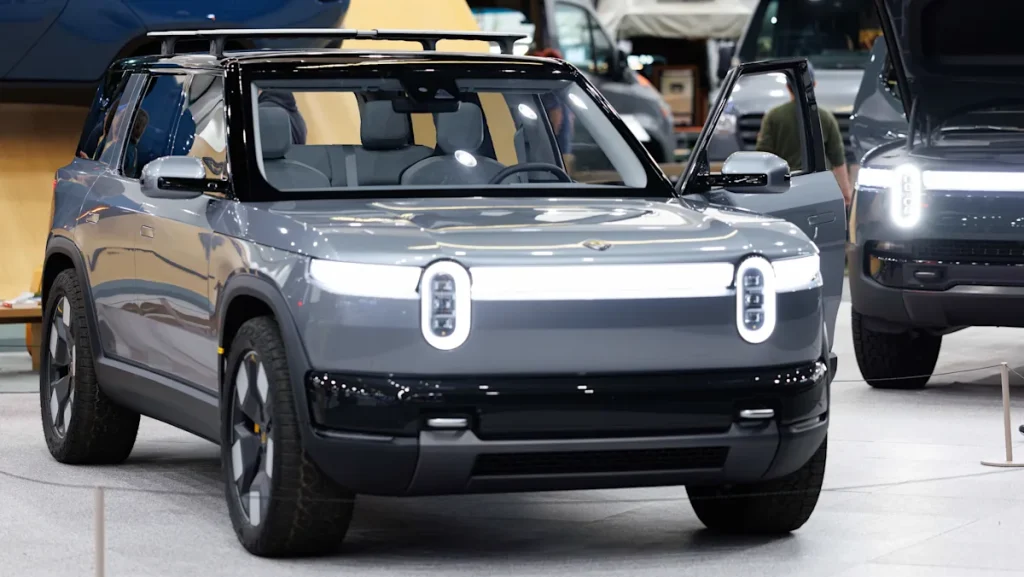
So, yeah, you know, the Rivian R2, which is their midsize car, is going to be a big deal when it launches next year and it’s going to grow throughout the year because, as RJ mentioned, you know, Tesla has half, half of the sub-$50,000 EV market and they really need that to cannibalize that market and really make a difference from a mainstream perspective on EVs.
12:44 Jared
Making your own chips is no joke. We’ll leave it there because of time constraints, but thanks for being here, Plath, for a great interview.