


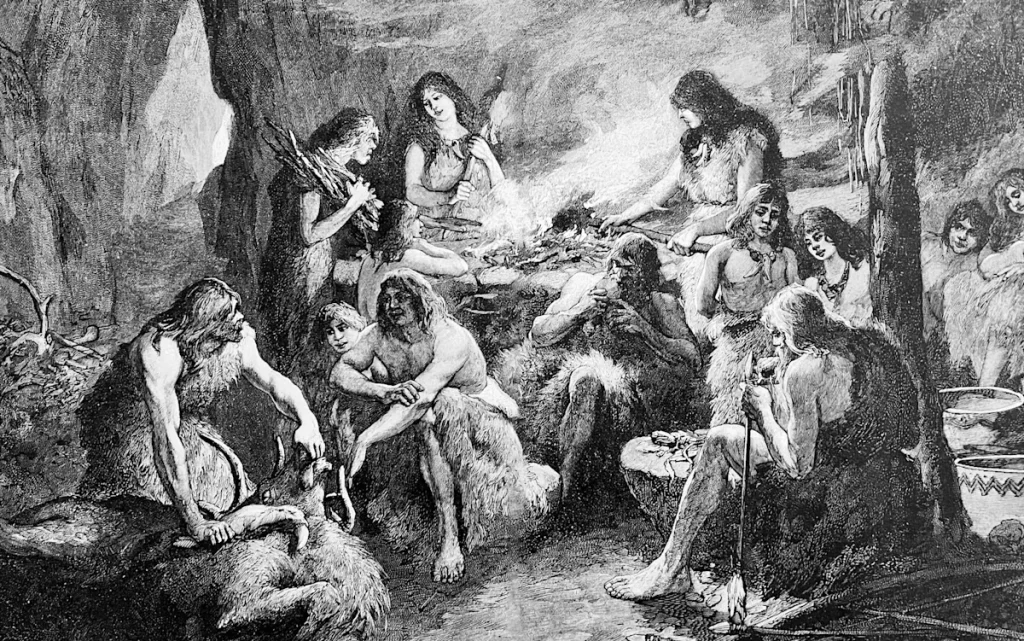
A new study suggests that humans may have eaten Neanderthal babies.
Analysis of bones found in a cave in Belgium has revealed that cannibalism took place there, with the victims being children and young women.
Scientists say the cannibals, whose identities are unclear, may have been early Homo sapiens that preyed on rival Neanderthals or another group of Neanderthals.
Neanderthals and Homo sapiens are two cousin species, descended from the same ancestor. The two species have coexisted for thousands of years and often interbreed.


Nuclear DNA shows that the two children, an infant and a child aged between 6.5 and 12.5 years, were boys – Belgian Institute of Natural Sciences
Discovered in 2016, Goyet Cave in central Belgium contains Neanderthal bones from around 45,000 years ago, some of which have cut marks on them, a sign of cannibalism.
Researchers say the women and children who were eaten may have been abducted during cannibal attacks, or the body parts may have been chopped off and taken back to the attackers’ home cave for easier transport.
Scientists believe it is also possible that the body parts, including those of a Neanderthal baby and a six-year-old child, were cooked before being eaten.
Dr Isabelle Crevecoeur, research director at France’s National Center for Scientific Research (CNRS) and lead author of the study, told The Telegraph: “Based on the archaeological and behavioral data we obtained through our research and presented in our paper, Neanderthals eating other Neanderthals is the most parsimonious hypothesis.”


Goyer Cave contains the most important Neanderthal remains found in Northern Europe – Belgian Institute of Natural Sciences
“However, we cannot completely rule out the hypothesis that Goyet Neanderthals were killed and massacred by early groups of Homo sapiens.”
DNA and structural analysis of the Goyer Cave finds revealed that of the six people who may have been eaten, four were young women and two were boys.
One of the children had knife marks on his collarbone, indicating someone had cut his flesh with a knife.
Further analysis revealed that the adults were mature female Neanderthals, described as slender and short in stature.
The study also found that the victims were not related to their kidnappers and lived in a different area from Goyer Cave.

Researchers combine genetics, isotope analysis and morphology to create a picture of the victims – Belgian Institute of Natural Sciences
Scientists say it’s possible that one tribe attacked a rival tribe, kidnapped six women and children, and took them back to the cave to eat.
But they say it’s also possible that cannibals killed their victims and then slaughtered them where they fell, taking only the edible body parts back to base.
The identity of these cannibals remains unknown, with scientists saying they are most likely another group of Neanderthals.
At the time of the massacre, Homo sapiens had not been found living in modern-day Belgium, but Homo sapiens had been found in Lanis, 370 miles east of Germany, and were likely present in the area.

A third of the bones – mostly from the lower limbs – show signs of cannibalism, including cuts – Belgian Institute of Natural Sciences
However, experts are skeptical of these suggestions and point to Neanderthals as the culprit.
Professor Chris Stringer, a human evolutionary anthropologist at the Natural History Museum, said it was “certainly possible” that a group of Homo sapiens were living in Western Europe at the time of the Goyer Cave cannibalism incident.
“But based on the current evidence we can’t place them anywhere near this location in Belgium at that exact time, so I think it’s possible,” he told The Telegraph.
Second’


‘
Dr. Quentin Cosnefroy, co-author of the study and a postdoctoral researcher at France’s National Center for Scientific Research, added that it was possible but unlikely that the culprit was Homo sapiens.
“There is no archaeological evidence that Homo sapiens existed in the Goyer area at this time,” he said.
“Another important point is that the processing of Neanderthal remains at Goyet is consistent with other sites of Neanderthal cannibalism and differs from patterns seen later in environments where Homo sapiens practiced cannibalism.”


Researchers have not ruled out Homo sapiens being cannibals, but think the most likely culprits are other Neanderthals – Belgian Institute of Natural Sciences
The remains date to roughly the same period as the earliest recently discovered evidence of intentional fire-making by humans, found in Suffolk 40,000 years ago, a skill that may have come from Europe.
The researchers said Goyet’s remains showed no signs of burning, but that was not enough to rule out the possibility that human flesh had been butchered and cooked.
In a previous study, the scientists wrote: “While the Neanderthal remains show no signs of burning, the possibility that they may have been baked or boiled cannot be ruled out.
“However, the large number of cleavage traces and the fact that DNA could be successfully extracted are inconsistent with this possibility.”
The CNRS study was published in the journal Scientific Reports.
Try full access to The Telegraph for free now. Unlock their award-winning website and essential news app, plus helpful tools and expert guidance on your money, health and holidays.