


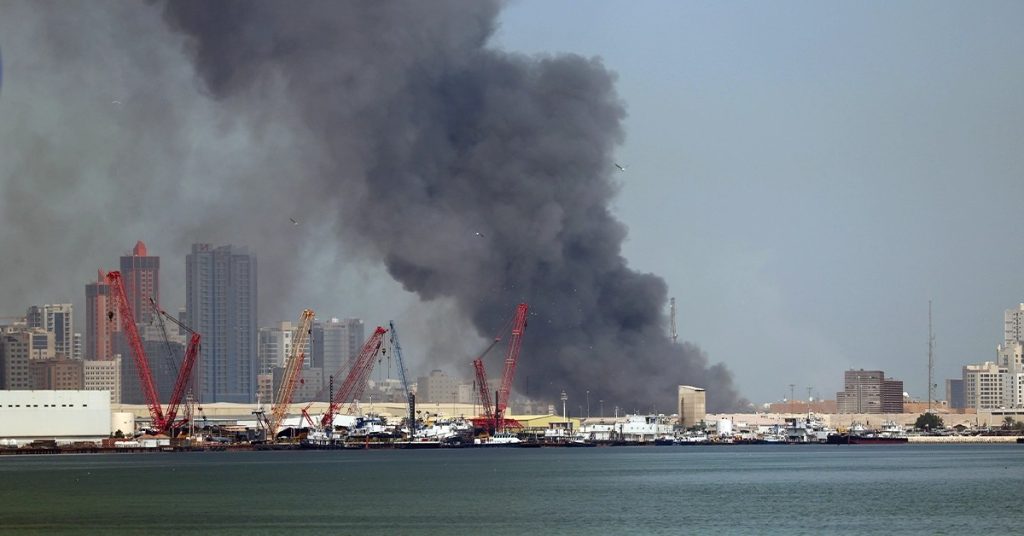
Welcome to 2026. The sky in Bahrain’s Al Juffair district isn’t that blue; it’s very blue. Instead, it’s a mosaic of gray-black feathers and white-hot interceptor stripes. For years, armchair generals on social media have been salivating over Operation Real Commitment 4, a so-called doomsday scenario in which a rain of Iranian missiles ultimately swamps the U.S. Fifth Fleet on its own home turf.
Also read: God Switch: What Elon Musk’s Starlink could actually be used for
They tell us the Persian Gulf is a killing field. They tell us that the Naval Support Activity (NSA) headquarters in Bahrain is a duck for the slaughter. When the first Shahed-136 lightweight drone flew slowly over the Mina Salman port area over the weekend, it looked like they might finally be right.
Yet while the world watched smoke billowing from service centers, our Fifth Fleet remained unscathed; however, the base where it was located was harmed by the turmoil.
Here’s an after-action report on how we turned Pearl Harbor into a dramatic episode in Iran, and why the future of modern defense will be a bloodbath for our budgets.
calm down
Before you start mourning the Fifth Fleet, check out the docks. Acting on intelligence foresight, or perhaps a well-timed leak, the Navy took its most valuable card off the table before the first alarm sounded.
The USS Abraham Lincoln and the USS Gerald R. Ford Carrier Strike Group disappeared into the “blue water” like the Homer Simpson disappeared into the brush, disappearing into the Arabian Sea and the Mediterranean Sea, safely outside the immediate “kill zone” of Iran’s coastal batteries.
For all intents and purposes, what Iran attacked this weekend was a ghost port (if you know it, you know it). Millions of dollars worth of munitions are being poured into static infrastructure, fuel depots, radomes and logistics centers. There is no sugarcoating this, and it will do our military no favors in future conflicts.
On the other hand, it’s like blowing up an empty garage after the owner drove his Rolls-Royce to another county. Don’t let the bitter victory of the carrier retreat fool you; the infrastructure left behind is a technological marvel, and it was used for target practice.
Mopeds and million-dollar missiles
When 71% of the earth is covered with high-quality water, whoever can rule it can rule the world. So when this walking “FAFO” symbol of our Navy no longer poses a threat, things need to change quickly. The Shahed-136 loitering munition was the one that led to a revolutionary change in U.S. naval power…otherwise.
This little nugget is a $35,000 lawn mower engine with a slug attached. It’s slow, loud, and arguably the most annoying weapon in modern history. But in a dense urban community like Juffair, annoyance becomes deadly.
The problem isn’t that we can’t hit them, spoiler alert: we can, it just costs a lot of money. The Patriot PAC-3 and THAAD anti-missile systems protecting the base screamed today, slamming dozens of incoming threats into the sky.
Unfortunately, that’s the power of consumption: We’re firing a $4 million death stick at a $35,000 drone. Iran is counting on us to “win” every engagement until we run out of ammunition or money. They want to exhaust our magazine depth with junk drones before sending real hardware.
Hypersonic “Fatah” and Radar Horizon
Once the Shahd swarm softened the electronic bubble, the IRGC (Islamic Revolutionary Guard Corps) launched its bombshell: the Fattah-1 hypersonic missile. Iran calls it a “conqueror,” and while Western analysts like to dismiss its Mach 13-15 speed claims as dubious at best, the pictures on the ground today tell a different story.
Unlike conventional ballistic missiles, which have more predictable high-arc paths (making them easy targets for systems like THAAD), the Fattah-1 is designed to maneuver within the atmosphere.
Today, that calculation revealed at least one confirmed attack on a service center near the base’s command and control center. We didn’t lose a ship, but we lost the aura of untouchability our static bases once radiated.
Defending in a crowded room
Bahrain’s National Security Agency is not in the desert like al-Udeid; it is in the heart of Manama’s Juffair district, surrounded by 20-story luxury apartments. It’s a tactical nightmare. Whenever C-RAM opens with its signature lead walls, thousands of 20mm high-explosive bombs take to the sky.
What goes up must also go down.
There are already reports of civilian high-rise buildings being shattered by “friendly” shrapnel and falling interceptor fragments, thus posing a major dilemma: the enemy does not have to hit the base to win; the enemy only needs to hit the base to win. They had to force us to defend it so aggressively that we triggered a diplomatic crisis with our hosts, Bahrain. The point is simple: if the remains of American weapons cause too much damage to civilian infrastructure, people will blame the United States.


On February 28, 2026, Iran attacked several buildings in Manama, the capital of Bahrain, and a fire broke out in a building targeted by an Iranian drone. (Stringer/Anadolu via Getty Images)
“Lucas” joins the fight
Perhaps the grimmest part of today’s after-action report is the irony of the epic Fury operation. When Iran attacked us with “Shahid”, the US military also launched our new good helper LUCAS (Low-Cost Unmanned Combat Attack System).
What is Lucas? It’s a US-made Iranian Shahed-136 clone worth $35,000. We reverse-engineered their “moped” and began mass production through SpektreWorks in Arizona. Today we saw a classic “Spider-Man pointing at Spider-Man” moment in 21st century warfare: two powerful nations using the exact same cheap technology to try to destroy each other’s air defense systems.
We spent a trillion dollars buying the airspace over the Persian Gulf, but today, Iran showed they can rent it for an afternoon for pennies on the dollar. Operation Honest Commitment 4 never even sniffed the 5th Fleet because we were smart enough to move the ships, but it did make the Iron Dome of the Gulf look more like a pair of worn sweatpants.
Russia’s S-300s in Venezuela are little more than paperweights due to corruption; U.S. shields in Bahrain are under pressure from attrition. We can win sniper duels, but what happens when the enemy stops carrying rifles and starts carrying ten thousand rocks?
The smoke is still clearing over Manama, and America’s global naval dominance may be significantly diminished unless serious attention is paid to preventing kids from destroying our bases with toy helicopters. Welcome to an era where a handful of missiles worth $4 million are the only thing standing between a $30,000 drone and your buddy.
Don’t miss the best we are strong
• Operation Eagle Claw: The story behind Iran’s failed hostage rescue
• Swedish Sledgehammer: Tribute to Carl Gustaf, long live the reign of “The Goose”
• Veteran with Gulf War illness wins recognition for 30 years of war


Smoke rises after Iran launched a missile attack on the main headquarters of the U.S. Navy’s 5th Fleet in Manama on February 28, 2026, in retaliation for U.S. and Israeli attacks in Bahrain. (Photo by Stringer/Anadolu via Getty Images)
military news
Lessons Learned: How Iran Wrecked the U.S. Navy’s 5th Fleet
go through Adam Gramegna

Operation Eagle Claw Desert One socom
special operations
Operation Eagle Claw: The story behind the failed Iranian hostage rescue
go through Blake Stillwell

Armed members of Iran’s police special forces stand behind a flag hoisted on an armored military vehicle during a pro-government rally in downtown Tehran, Iran, on January 12, 2026. The rally was held in Tehran to oppose recent anti-government unrest, activities against the United States and Israel in Iran, and in support of Supreme Leader Ayatollah Ali Khamenei. No Iran Deal News Getty
military news
Iran ‘unlikely to give in’ to Trump’s demand for deal to avoid military action
Kian Sharifi, Radio Free Europe/Radio Liberty

Options iranian special forces dvids
military news
The military options the United States must take against Iran
Ray Furlong, Radio Free Europe/Radio Liberty

U.S. troops in Persian Gulf, Iran protest Getty
military news
Why U.S. military action in the Persian Gulf may be about deterrence, not D-Day
go through Adam Gramegna