


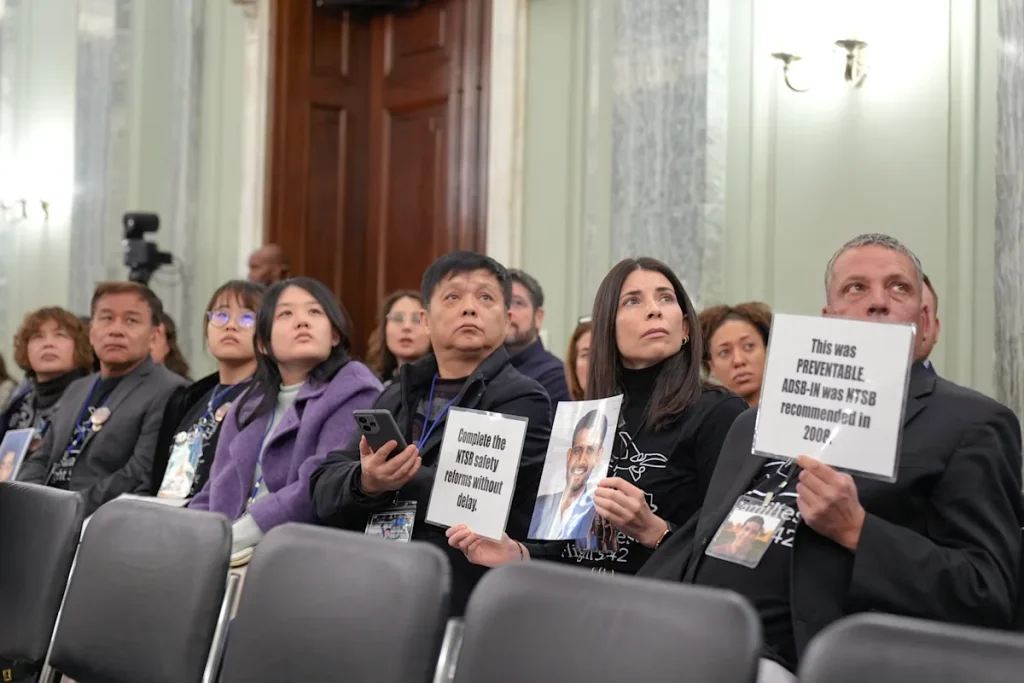
A House vote Tuesday is expected to likely decide whether to require jets and all other aircraft flying at busy airports to install positioning technology that the head of the National Transportation Safety Board says could have prevented last year’s tragic mid-air collision near Washington, D.C., that killed 67 people.
The bill, which the Senate passed unanimously, would require all aircraft to be equipped with a system that can broadcast their location and another system to receive data about the location of other aircraft. Currently only systems that need to broadcast their location are needed.
The family of the victim who died when an American Airlines jet collided with an Army Black Hawk helicopter strongly supports the measure, which would implement a reform the NTSB has been recommending since 2008. Leading pilot, flight attendant and aerospace workers unions have also backed the bill, known as the ROTOR Act. But leaders of two major House committees quickly drafted a replacement bill last month that sought to address all 50 of the NTSB’s recommendations, not just location technology.
Victims’ families support Senate bill, but industry does the opposite
The main group for the families of Flight 5342 said that while the House bill contains some good reforms worth considering, they cannot support the bill as written. Everyone aboard the helicopter and American Airlines plane taking off from Wichita, Kansas, including the parents of Olympic figure skater Maxim Naumov and 26 other members of the figure skating community, were killed when the planes collided and plunged into the icy Potomac River.
“The measure of legislation is not how many items it addresses, but how well it addresses the most critical issues. The two bills are materially different on the core issue of how quickly and efficiently aircraft need to carry collision mitigation technology,” the family group said Friday.
The American Airlines trade group and major general aviation groups representing owners of business jets and small aircraft — including the National Business Aviation Association and the Aircraft Owners and Pilots Association — supported the House bill. But American does support the Senate bill.
On Monday, the Department of Defense dropped its support for the ROTOR Act, which was approved in December, because the bill would “create significant unresolved budget burdens and operational security risks affecting defense activities.” Leaders of the House Transportation and Armed Services Committee also urged colleagues during the debate to veto the bill because it was incomplete and lacked any input from the House.
Competing bills take different approaches to targeting systems
The main difference between the bills is that the House version does not require the installation of two proven automatic dependent surveillance broadcast systems. Instead, the House bill would require the FAA to investigate which technology might be best during a lengthy rulemaking process before requiring a solution. The House bill also covers more aspects of what the NTSB identified as systemic failures that led to last year’s Jan. 29 crash.
Bipartisan Senate leaders behind the ROTOR bill, led by Republican Sen. Ted Cruz and Democratic Sen. Maria Cantwell, say their bill would be a good first step before more legislation is drafted.
The ROTOR bill will need more than two-thirds support to pass the House on Tuesday under a special process used to fast-track the bill. The bill introduced by House members is not yet ready for a floor vote.
Rachel Feres, who grieved the loss of her cousin, wife and two young daughters in the crash, said the two bills should not be a focus of debate because both are necessary, but ROTOR is now ready to pass to address critical crash-avoidance technology while lawmakers refine a more comprehensive bill.
“The risk of taking the lives of our families still exists today. So we must address this as quickly as possible,” Ferres said.
Improved collision warning system
Any aircraft flying at a major airport must be equipped with an ADS-B Out system, which continuously broadcasts the aircraft’s position and speed. The ADS-B system, which can receive these signals and create a display that shows pilots the location of all surrounding air traffic, is not standard on airliners, although many general aviation pilots already use portable receivers to display that information on iPads.
An investigation by the National Transportation Safety Board showed the system could have provided more warning to the pilots involved in the crash and allowed them to avoid a collision. Aircraft equipped with ADS-B In can give pilots a detailed description of the location of other aircraft, whereas current technology can only warn of traffic in the area.
“The question is: How many more people do we need to die before action is taken?” NTSB Chairman Jennifer Homendy asked in a post on X shortly before the House bill was released last week.
“We have an obligation to address what happened on January 29th. We have to do it not just for the 67 people who died, but for all the people who lost their lives in the accidents we investigate. We have to do it for their families. We have to do it for future generations… We can still save lives.”