


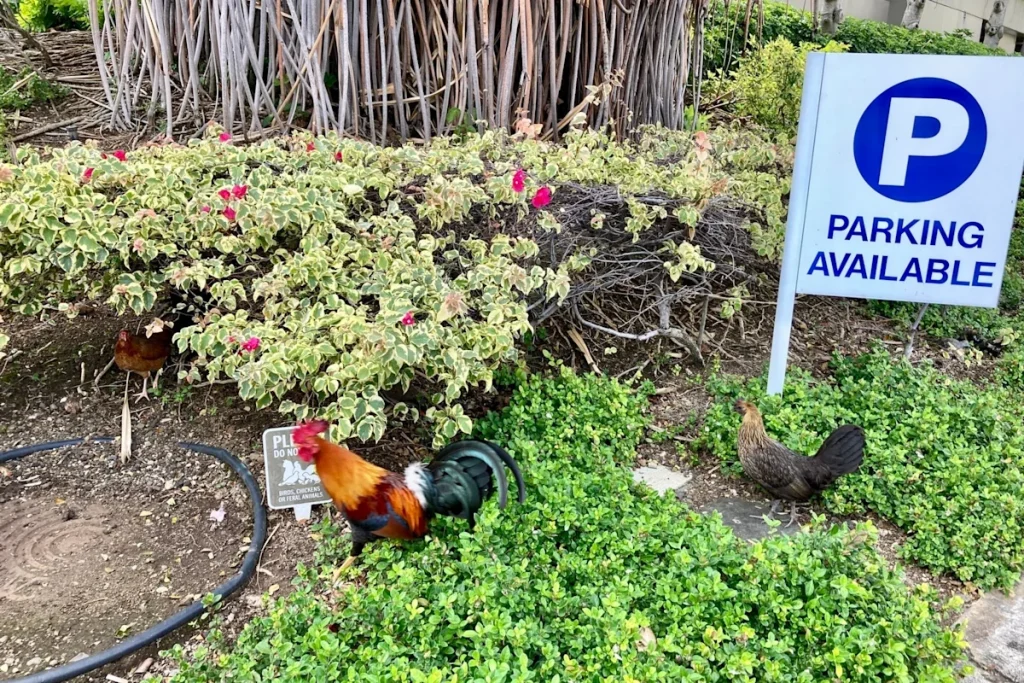
HONOLULU (AP) — The roosters crow begins before the sun rises over Mason’s Iona, Hawaii, home.
But the 3 a.m. rooster alarm isn’t what worries retirees the most. He spent much of the day chasing away pheasants burrowing in his yard, listening to the constant squawking and ruffling of feathers, and scolding people who fed the birds in the park just steps from his home.
“It’s a big problem,” he said of the roosters, hens and chicks that teeter on the narrow road between his Honolulu house and a city park. “And they’re multiplying.”
Communities across the state have been dealing with widespread poultry problems for years. Honolulu spent thousands of dollars trapping them, with little success. Now, state lawmakers are considering possible solutions, including letting residents kill the pheasants, treating them as a “controllable pest” on Honolulu’s public lands and fining people who feed the pheasants or release them in parks.
Chicken’s Cultural Connections
But one person’s nuisance is another person’s cultural symbol, a dynamic that also plays out in Miami and other cities with pheasants.
Kealoha Pisciotta, a Hawaiian cultural practitioner and animal advocate, disagrees with killing pheasants simply because they are a nuisance. Some of today’s chickens are descendants of chickens brought to the islands by early Polynesian voyagers, she said.
“Moa are very important,” she said, using the Hawaiian word for chicken. “They are on our voyage, coming with us.”
The Humane Society of Hawaii opposes letting residents kill chickens “as a means of population control unless all other strategies have been exhausted.”
aggressive birds
Democratic Rep. Scot Matayoshi, who represents the Honolulu suburb of Kaneohe, said he began working on chicken control legislation after he heard from an elementary school teacher in his district that chickens were harassing students.
“Children are afraid of them and they will chase children more aggressively for food,” Matayoshi said.
Rep. Jackson Sayama said he introduced the chicken-kill bill because there are currently limited ways to get rid of chickens. Lethal methods will be left to the discretion of residents.
“If you want to go the old fashioned way, just break the chicken’s neck,” said the Democrat who represents part of Honolulu. “There are a lot of different ways to do this.”
Poultry problems are growing
Matayoshi said bills to eliminate chickens have failed for years. Chicken sterilization was an idea he discussed while serving on a community board.
“I think there are people taking this more seriously now,” he said.
For more than 30 years, Aiona, 74, has lived in the house where his wife, Leona, grew up in the valley near downtown Honolulu. They say pheasants didn’t appear in their neighborhood until about a decade ago. These bird populations have exploded during the COVID-19 pandemic.
He said he once saw a man take a chicken out of his car, leave it in the park and drive away.
When the chickens first appeared outside his home, he caught one with his bare hands, put it in a plastic trash can and drove it to a park near the airport. “I took the lid off, turned it over, and the chicken came out,” he said. “I said…’Don’t come back.'”
But he soon realized that his time-consuming efforts were in vain.
He personally has no interest in killing chickens, preferring someone to scoop them up and take them to rural farms. Urban trapping programs are too expensive, he said.
The city contracted with a pest control company to capture the chickens. The weekly service fee for a private owner is $375, plus a $50 cage rental fee and a $10 handling fee per chicken.
More than 1,300 chickens were caught through the program last year, said Harold Nedd, spokesman for the Honolulu Department of Customer Service, who added that the department also saw a 51% increase in complaints about pheasants in 2025.
Chicken for dinner?
Pheasants don’t make a cheap dinner. The meat is tougher than poultry raised for harvest, and wild birds can be vectors of disease.
One of Iona’s neighbors shot them with a leaf blower. “I also have a blower, but mine is electric,” Iona said. “You can only go so far with a rope.”
Iona is tired of telling park visitors to stop feeding the chickens after she retires. While he doesn’t recommend anyone eat them, he welcomes anyone who wants to.
“There’s no charge,” he said.