


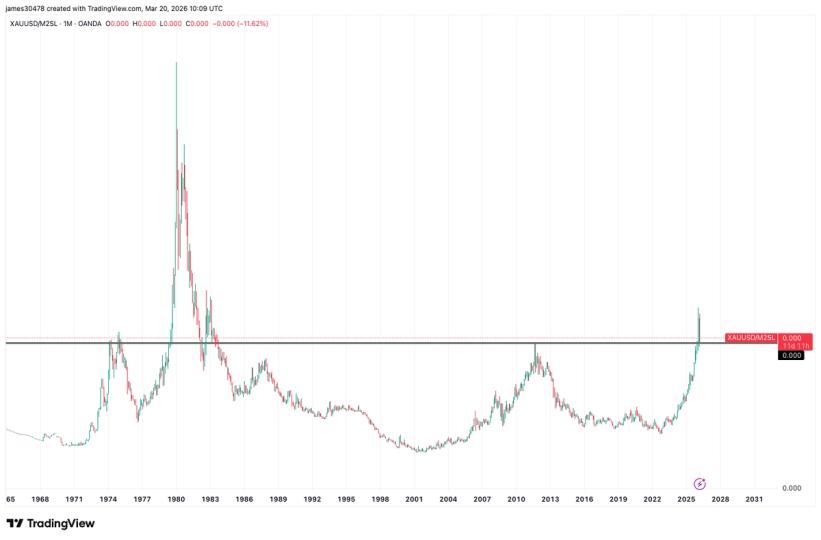
Gold is approaching a technical bear market, down nearly 20% from January’s all-time high. Gold has traditionally been viewed as a store of value and a hedge against geopolitical uncertainty, but gold’s recent performance challenges this narrative. Despite rising tensions in the Middle East, prices have fallen around 10% since the war broke out in late February.
The market has also repriced the outlook for interest rates, with rate cuts now largely postponed and policy expected to remain restrictive until December 2026. At the same time, rising oil prices, driven by geopolitical risks, are adding to upward pressure on inflation and reinforcing a higher long-term interest rate environment, which is the main headwind for gold.
When adjusted for M2 money supply (which includes cash, deposits and other liquid forms of money), gold trades close to the levels of its major historical peaks in 1974 and 2011, when gold prices were $200 and $1,800 per ounce, respectively. On this basis, gold appears to be consolidating higher and may form a cyclical bottom relative to global liquidity.
In contrast, Bitcoin remains in a 2024-like consolidation phase relative to M2 while retesting 2021 highs on a liquidity correction basis. Historically, each cycle has seen Bitcoin break out of its previous peak after adjusting for the money supply. With Bitcoin still trading around 40% below its October highs, this could represent a typical consolidation range before further gains.
Gold has been trading alongside Bitcoin since it fell below $5,000 on Wednesday, showing a positive correlation after previously diverging from the cryptocurrency market.