


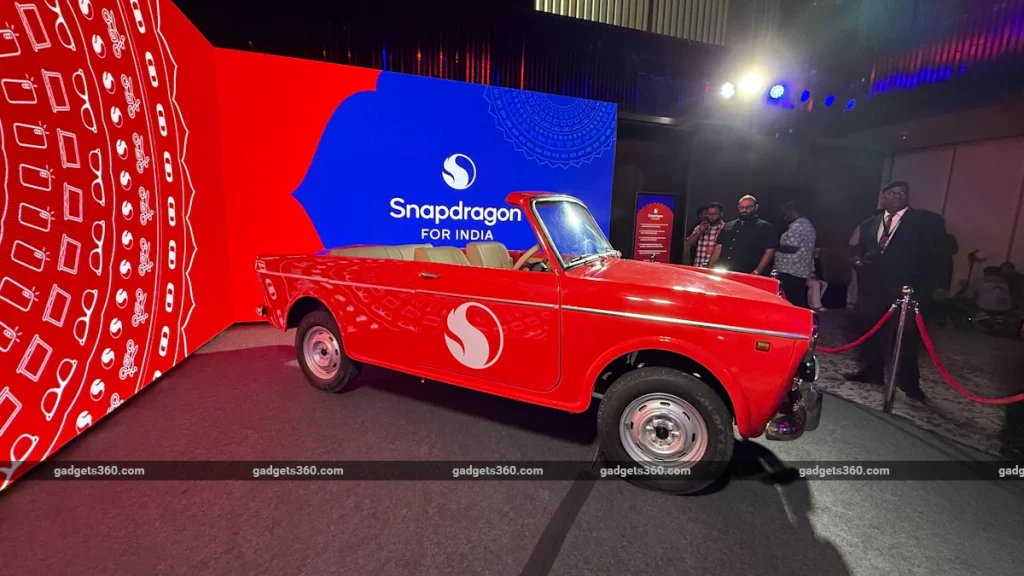
Qualcomm hosted the first Snapdragon: Automotive Day in India on Wednesday, showcasing multiple strategic collaborations in the automotive sector. Imagine if I told you that you might be driving a car equipped with a Qualcomm chipset? This was news to me when I spoke to Qualcomm executives on the sidelines of India’s Snapdragon Car Day event in New Delhi. At the event, the chipmaker showcased various strategic collaborations with partners such as KPIT, an AI-powered smart chassis platform with integrated vehicle motion control (IVMC) capabilities. Of course, this is powered by Qualcomm, the driving force behind this type of technology stack.
Nakul Duggal, general manager of Qualcomm’s Automotive, Industrial and Embedded IoT Group, spoke about the company’s strategic focus in India, highlighting its significant engineering business and innovation efforts. During his keynote address, Duggal spoke about India’s shift from low-end to high-end experiences, focusing on artificial intelligence enabled through digital chassis. The event also highlighted Qualcomm’s partnerships with major automakers such as Maruti Suzuki India Ltd. and Mahindra & Mahindra, showcasing advanced technologies such as autonomous braking and cybersecurity features.
Nakul Duggal, general manager of Qualcomm Automotive, Industrial and Embedded IoT Group, during the keynote speech
Hisashi Takeuchi, Managing Director and CEO of Maruti Suzuki India Limited, discusses how the collaboration with Qualcomm began five years ago. He also revealed that the second-generation Baleno is the company’s first car to feature Qualcomm connected car features, adding that the upcoming e-Vitara EV will use Qualcomm technology. Velusamy R, President, Automotive Business, M&M Limited and Managing Director, Mahindra Electric Automobile Limited, was also present at the event.
Qualcomm is driving premium in-cabin experience
Qualcomm’s Duggal discussed how the company is enhancing various aspects of a premium in-vehicle experience, such as multiple high-resolution displays front and rear with enhanced graphics support, natural language understanding for intuitive voice control of vehicle interactions, multi-modal interfaces for multiple vehicle interaction mechanisms, facial recognition that adds an extra layer of safety and a highly personalized experience for all occupants. He also discussed key aspects such as driver monitoring, which keeps the driver alert and aware of their surroundings to improve safety, and surveillance systems with surround-view cameras, which increase situational awareness to further improve safety.
Qualcomm says more than 350 million cars worldwide are equipped with Snapdragon digital chassis
The premium in-cabin experience also includes a premium sound experience, including zoned audio with active noise and echo cancellation, machine learning and edge artificial intelligence, and contextual data for higher levels of personalization.
Duggal gave the example of Qualcomm’s more than 20 years in the automotive industry, “We started the OnStar journey back in 2002 with General Motors, when the U.S. was moving from analog to digital, and we worked with General Motors to get them to use CDMA, which is a technology we innovated. The history of the company is really trucking telematics. Back in the late ’80s, we actually created a system called Omni Tracks that was specifically designed for long-haul trucking in the U.S. and Mexico and ultimately into Europe.”
Qualcomm also continues to focus on two-wheelers through services such as 4G/5G/GPS, Wi-Fi, Bluetooth Low Energy, nearby charging station notifications, vehicle service alerts, etc.
V2X is a critical component and adoption in India is key
Dougall also spoke about the global call for action on road accidents. He claimed that by adopting advanced vehicle-to-everything (V2X) technology, approximately 1.2 million deaths could be avoided globally every year. During his keynote address, he explained that V2X technology enables direct, low-latency communication between vehicles (V2V), roadside infrastructure (V2I) and vulnerable road users (V2VRU). The technology can aid collision avoidance safety systems, as well as safety alerts for cyclists and pedestrians, forward collision avoidance and road safety hazard warnings.
Qualcomm’s focus in India includes driving digital cockpit and smart mobility
Duggal also talked about how Qualcomm’s acquisition of Autotalks will bring global, production-ready V2X solutions.
He also mentioned that India has been Qualcomm’s engineering hub for over a decade and the teams here support the entire chipset and software roadmap, test engineering, telematics, cockpit, ADAS, two-wheelers, connected services, global customer engineering and Indian customers are supported locally. There are centers in Hyderabad, Delhi-NCR, Chennai and Bengaluru.
Qualcomm wants to make India a global leader in internet security
The most important part of the event was Qualcomm’s Nakul Duggal highlighting the need for government and industry to come together to accelerate the large-scale deployment of V2X with the aim of significantly reducing road accidents and fatalities in the country.
Qualcomm offers telematics, digital cockpit, ADAS, connected two-wheelers and connected services
This will involve near-term government regulatory certainty and supportive policies, such as the free introduction of life-saving safety spectrum through the early de-licensing of the 5875-5925MHz band for V2X deployment, and the inclusion of V2X in the planned implementation of Bharat NCAP 2.0 in 2027. Qualcomm is also working to incentivize two-wheelers to add V2X, enable four-wheelers and trucks, and deploy V2X roadside units in collision hotspots such as highways.
He also discussed how AI-driven automated crash response can be efficient, such as integrating infotainment and telematics to enhance safety.