


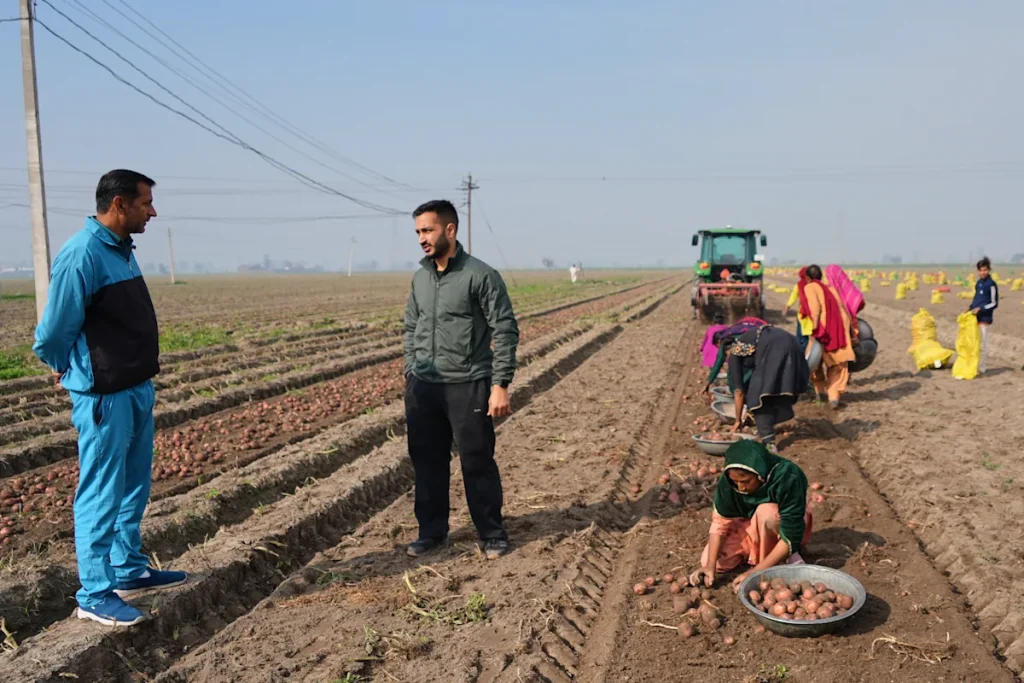
KARNAL, India (AP) — Farmer Bir Virk taps an iPad mounted next to his tractor’s steering wheel to switch the vehicle into autonomous mode. The machine moves forward and begins harvesting potatoes on its own in a field in the northern Indian city of Karnal.
About 145 kilometers (90 miles) from the country’s capital, New Delhi, educator Swetank Pandey uses similar automated technology at his coaching academy. He uses algorithms to scan and score handwritten test papers for candidates in India’s highly competitive civil service.
In both cases, the same invisible hand is at work: artificial intelligence.
From farms to classrooms, artificial intelligence is quickly becoming a tool for many Indians to increase efficiency and reduce time, cost and labor. Early adopters like Virk and Pandey say the technology is helping them become more productive as they test the potential of artificial intelligence to find solutions at work.
“I’m able to farm very efficiently and I’m excited to be doing the job my grandfather and father did. Now I’m carrying forward the tradition with the right techniques,” Virk said.
India is testing its artificial intelligence scale
As the use of artificial intelligence surges across the world, the technology is steadily gaining ground in India as businesses, startups and individuals try new ways to become more efficient.
The Indian government has also launched national initiatives to fund AI research and train workers. This week, New Delhi will host a five-day artificial intelligence summit attended by heads of state and top tech CEOs.
With nearly one billion internet users, India has also become a key focus for global technology companies to expand their artificial intelligence operations in one of the world’s fastest-growing digital markets.
In December last year, Microsoft announced an investment of $17.5 billion over four years to expand cloud and artificial intelligence infrastructure in India. This follows a $15 billion investment by Google over five years, including plans to build the first artificial intelligence center in the country.
“Some good use cases have already started. These scaling platforms are now embedding AI in them,” said Sangeeta Gupta, senior vice president at NASSCOM, a reputed body representing the Indian technology industry.
However, India’s adoption of AI has its limitations.
China still lags behind in developing its own large-scale artificial intelligence models, such as the United States’ OpenAI or China’s DeepSeek, highlighting challenges such as limited access to advanced semiconductor chips, data centers and hundreds of local languages to learn from.
Even as tech companies ramp up spending on AI training and retraining, those that can’t adapt are being left behind. Tata Consultancy Services, the country’s largest private employer, cut more than 12,000 jobs last year amid a rapid shift to artificial intelligence.
But in the meantime, people like Virk and Pandey say AI tools are already making their jobs faster and more efficient.
Artificial Intelligence Precision Agriculture
Farmer Virk first came into contact with artificial intelligence-driven agricultural technology five years ago when he was studying and working in the United States. When he returned to India in 2021, he imported the system from a Swedish company and has been using it on his farm for the past few years.
His autonomous tractors can sow seeds, spray fertilizers and harvest crops. The system, which costs about $3,864, combines steering motors, satellite signals to help move the tractor with precision, and artificial intelligence-driven software that converts data into motion.
It also logs errors and uploads them to a cloud platform, where the software company analyzes the data and sends relevant updates back to the machine.
“Technology and intelligence play a big role in this. The tractor works in a straight line. It maintains an accuracy of 0.01 centimeters (0.004 inches),” said Virk.
He said his artificial intelligence tractor has cut his working time in half.
“The most unique feature of it is that it’s self-taught,” he said.
Artificial intelligence enters India’s famous exam factory
Pandey, an educator, teaches at a civil service training center, an industry known for its fierce competition. With millions of young Indians vying for civil service jobs every year, training centers handle the deluge of tests, evaluations and revisions.
Pandey said AI makes the workload more manageable.
Pandey and his team use large-scale language models like ChatGPT, Gemini and Claude, and other automated tools to scan and evaluate answer sheets to create targeted learning materials and structured syllabus for aspirants.
Pandey said the technology helped him perform repetitive tasks, evaluating tens of thousands of answer sheets in just 20 to 25 minutes.
“If you had a better machine, a bigger system, you could do it in two minutes,” he said.
Currently, his coaching academy is on a hybrid model. Artificial intelligence helps in assessment and teacher review of outputs, thereby increasing speed and quality.
AI often generates learning materials that students find more relevant than those designed by teachers, Pandey said.
“Artificial intelligence can give us an early idea of what a student is doing now and what he or she should do next to achieve their goals,” he said.
——
Salik reported from New Delhi.