


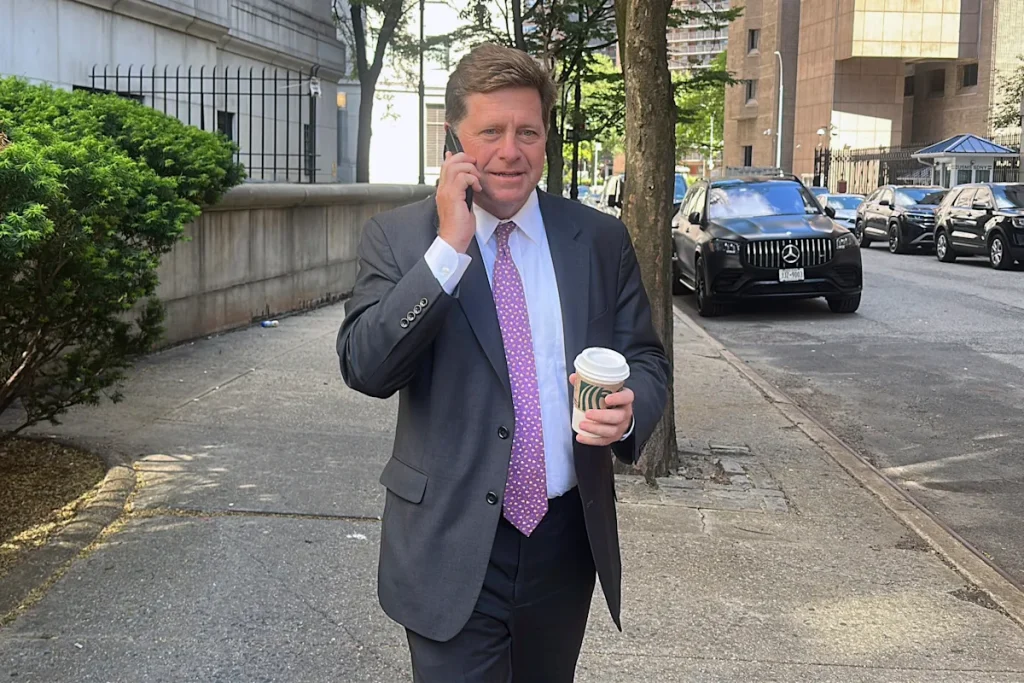
NEW YORK (AP) — A former top U.S. Drug Enforcement Administration agent and an associate are accused of conspiring to launder millions of dollars and obtain military-grade guns and explosives for Mexican drug cartels, according to an indictment unsealed in New York on Friday.
Paul Campo, 61, of Oakton, Virginia, retired from the DEA in 2016 after a 25-year career, and Robert Sensi, 75, of Boca Raton, Florida, was ensnared by a law enforcement informant posing as a member of the Jalisco New Generation drug cartel, prosecutors said.
The cartel, also known as the CJNG, was designated a foreign terrorist organization by the United States in February.
U.S. Attorney Jay Clayton said Campo betrayed his career with the Drug Enforcement Administration by helping the drug cartel, which he said was responsible for “countless deaths from violence and drug trafficking in the United States and Mexico.”
On Friday afternoon, Campo and Sensi appeared before a New York magistrate judge, who ordered them held without bail. Their attorneys entered not guilty pleas on their behalf.
Campo’s attorney, Mark Gombiner, called the indictment “somewhat sensational and somewhat incoherent.” He denied the two men had agreed to explore the possibility of obtaining weapons for the cartel.
Prosecutors say the two talked about laundering money, obtaining weapons
The indictment alleges that over the past year, Campo and Sensi agreed to launder approximately $12 million in drug proceeds for the cartel and convert approximately $750,000 in cash into cryptocurrency, which they believed ended up with the U.S. government but actually went to the organization. They also paid for about 220 kilograms of cocaine and were told it would be sold in the United States for about $5 million, believing they would get a cut of the proceeds, prosecutors said.
The two men also said they would consider purchasing commercial drones, AR-15 semi-automatic rifles, M4 carbines, grenade launchers and rocket-propelled grenades for the drug cartel, according to the indictment.
Authorities said Campo bragged about his law enforcement experience in conversations with informants and offered to serve as a “strategist” for the drug cartel. He began his career as a Drug Enforcement Administration agent in New York and was promoted to deputy chief of financial operations for the agency, the indictment said.
Evidence in the case includes hours of recordings of the two men talking to informants, as well as cellphone location data, emails and surveillance images, Assistant U.S. Attorney Varun Gumaster said in court Friday.
Sensi’s attorney, Amanda Kramer, argued unsuccessfully that Sensi should be released while awaiting trial, saying he would not run away in part because he has multiple health problems, including an injury sustained in a fall two months ago, early-stage dementia and Type 2 diabetes.
Prosecutor Gumaster said Sensi was convicted of mail fraud, defrauding the government and stealing $2.5 million in the late 1980s and early 1990s. He said there was evidence Sensi was also involved in a program to procure military-grade helicopters for Middle Eastern countries.
Other criminal cases have roiled the D.E.A.
DEA Director Terrence Cole said in a statement that while Campo is no longer employed by the DEA, the charges undermine trust in law enforcement.
The Drug Enforcement Administration has been in trouble in recent years for several embarrassing incidents of misconduct within its ranks. Over the past decade, at least 16 agents have been indicted on federal charges ranging from child pornography and drug trafficking to leaking intelligence to defense attorneys and selling guns to cartel associates, according to an AP count.
Starting in 2021, the agency imposed new controls on how DEA funds are used for money laundering and warned agents that serious first-time offenses could result in firing, unlike previous administrations.
Campo and Sensi were charged with four counts of conspiracy related to narco-terrorism, terrorism, drug distribution and money laundering.
____
Collins reported from Hartford, Connecticut. Associated Press writer Joshua Goodman in Miami contributed to this report.