


-
North Korean soldiers remain deployed in Russia’s Kursk region to fight against Ukraine.
-
A Ukrainian lawmaker said the soldiers were initially tasked with carrying out assault operations but were now focusing on drones and artillery.
-
Artillery has been Ukraine’s biggest problem in this area.
North Korean soldiers fighting for Russia are still causing trouble for Ukrainian troops more than a year after they were first deployed to support Moscow’s war.
North Korean soldiers deployed to Russia’s Kursk region to stop a Ukrainian invasion were initially tasked with carrying out brutal infantry attacks that resulted in massive casualties. Their role has since shifted to drone reconnaissance and artillery operations.
“North Korea’s biggest problem is not its soldiers but its artillery shells,” said Yehor Cherniev, deputy chairman of the Ukrainian parliament’s National Security, Defense and Intelligence Committee.
“They didn’t have that many soldiers involved in Operation Kursk,” Cherniyev told Business Insider in an interview this week.
North Korea shipped millions of artillery shells and multiple rocket launcher munitions to Russia during the war, as well as the artillery and launchers that could fire them. Pyongyang has also supplied Moscow with at least 100 ballistic missiles and anti-tank weapons.
In the fall of 2024, about 11,000 North Korean troops deployed to Kursk in western Russia to help Moscow regain hundreds of square miles of territory lost to Ukraine in a surprise invasion months earlier. Their deployment marks a sharp expansion of Pyongyang’s involvement in the conflict.


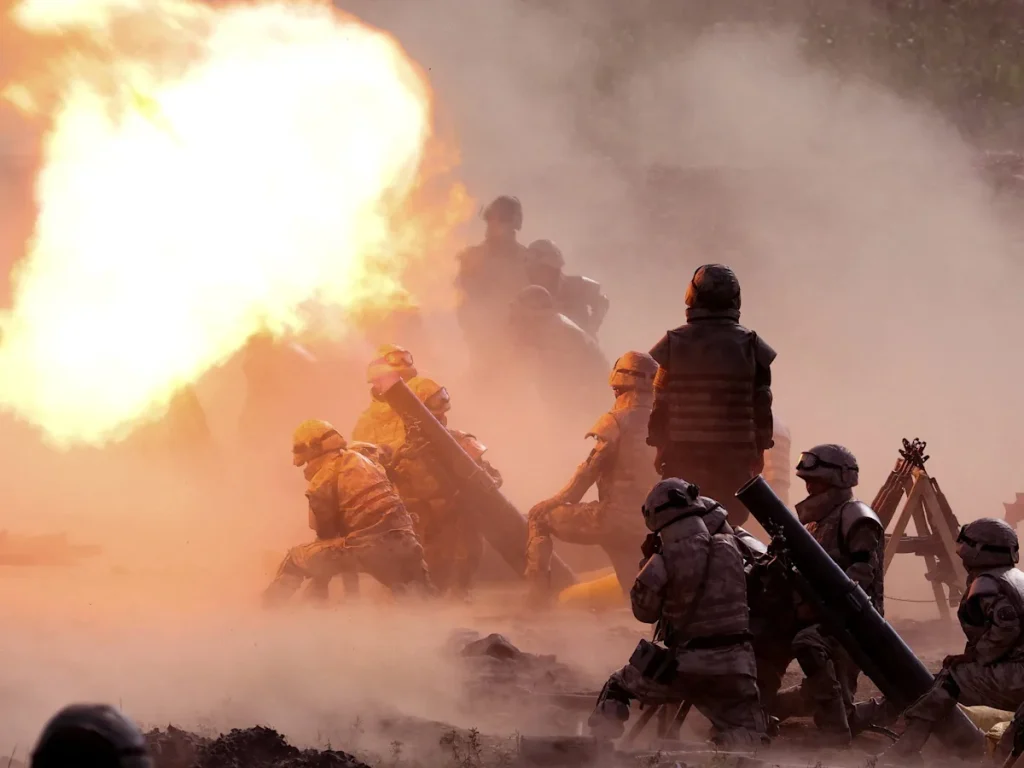
North Korea has sent millions of artillery shells to Russia, along with the artillery that fires them.KCNA (Reuters)
North Korean troops have no modern experience in major combat operations, so Russia trained them in drones, artillery, infantry and trench-clearing operations.
They were initially used to conduct front-line attacks against Ukrainians in what the United States described at the time as largely ineffective “sea of human” tactics, but they now appear to have taken on a more support role.
Ukraine’s military intelligence agency said in an update last week that “as of January 2026, a group of North Korean troops are stationed in the Kursk region, from where they launch attacks against Ukrainian border communities.”
North Korean soldiers stationed there fired at Ukraine with artillery and multiple rocket launcher systems and used reconnaissance drones to collect targeting data to tailor their attacks, using technology in the same way as the Russians, the GUR said.
The intelligence agency said North Korea regularly sends soldiers to Kursk, and most of the approximately 3,000 soldiers who have returned have become military instructors, teaching Pyongyang’s troops the modern combat tactics they have learned.
“I think North Korea is more about gaining experience in modern warfare and learning from that experience in their military,” Cherniyev said of Pyongyang’s involvement in the conflict.


In August 2024, Ukrainian troops suddenly invaded the Kursk region of Russia.Serhiy Morgunov/The Washington Post via Getty Images
Neither the Russian Defense Ministry nor its U.S. embassy responded to requests for comment on the involvement of North Korean troops in the war.
Western intelligence agencies estimate that thousands of North Korean soldiers have been killed or wounded while fighting for Russia. The deployment comes after Pyongyang and Moscow signed a mutual defense agreement in 2024, one of many signs of increased military cooperation between the two countries under crippling sanctions.
A multilateral sanctions monitoring group composed of the United States and 10 other countries said North Korea and Russia’s expansion of military, political and economic cooperation violated United Nations Security Council resolutions.
North Korean leader Kim Jong Un acknowledged that his troops had suffered losses in the war, a rare acknowledgment of combat losses in the conflict.
The British Ministry of Defense said in mid-January that Russia may have caused 1.2 million casualties since launching a full-scale invasion nearly four years ago, including 415,000 soldier casualties in 2025 alone.
Read the original article on Business Insider