


A new study suggests that hand-drawn outlines in red pigment on an Indonesian cave wall dating back at least 67,800 years may be the world’s oldest rock art.
The faded hand-made stencils and other spectacular cave paintings on Sulawesi were likely made by early humans who were part of a population that spread into the lost continent known as Sahul, which today includes parts of Australia, Papua New Guinea and Indonesia.
“They were made of ocher. They put their hands there and then sprayed the paint. We can’t tell what technique they used. They probably put the paint in their mouths and sprayed it. They probably used some kind of instrument,” said Maxime Obert, an archaeologist and geochemist at Australia’s Griffith University. Obert, senior author of a study published Wednesday in the journal Nature, described the discovery as “exciting and humbling.”
The minimum age of the handmade template, which was modified at some point to form the distinctive narrow fingers, is older than dozens of other prehistoric artifacts found in the area’s fascinating limestone caves. Another example is a scene of a half-human, half-animal figure hunting a warthog, the oldest evidence of storytelling in art history.
“What we are seeing in Indonesia may not be a series of isolated surprises, but the gradual revelation of a deeper, older cultural tradition that we were unaware of until recently,” Obert said.
The new study examined 44 sites in southeastern Sulawesi and dated 11 rock art patterns, including seven hand-made templates. The team discovered the oldest handmade templates in the Metanduno Cave on Muna Island. The cave also depicts more recent images of horses, deer and pigs, which were painted about 3,500 to 4,000 years ago, the study said. These paintings have long fascinated tourists.
Dating cave art is tricky, and the team used a technique that analyzes chemical traces in the mineral crusts that form on top of the paintings, sometimes called cave popcorn, to provide a minimum age for the art.
Sulawesi’s rock art is also older than famous European cave art, such as France’s Lascaux Cave Art, and suspected Neanderthal hand-made stencils in Spanish caves.
Prehistoric Picasso
The prehistoric humans who made handmade templates were likely early members of our species, Homo sapiens, who lived in Southeast Asia during the Ice Age. The study notes that sea levels were much lower at the time and the area looked very different.


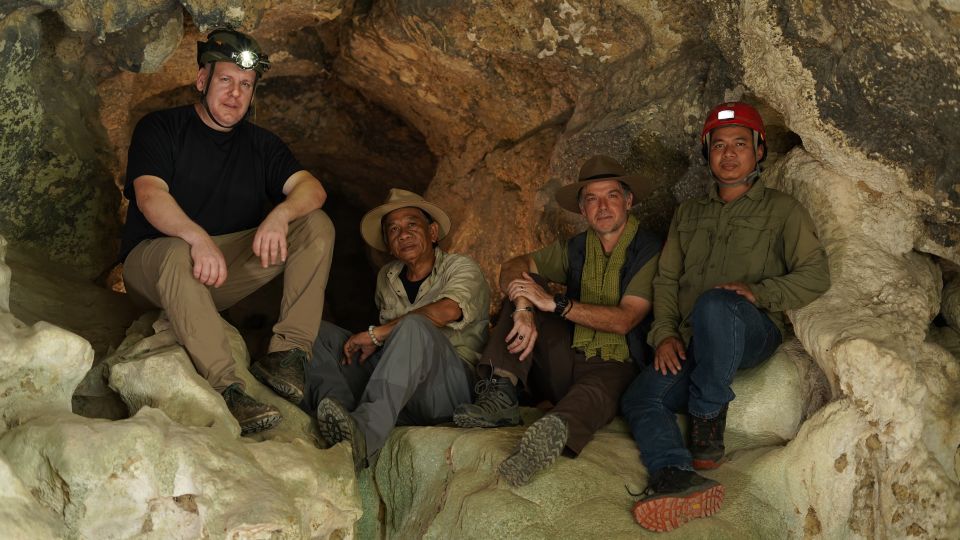
Adhi Agus Oktaviana, one of the first study authors to discover hand shapes in Meduna Cave, is working on site. – Maxime Aubert/Griffith University
After humans made hand templates, they shrunk the fingers to make them look like claws, Obert said. He sees the negative imprints of hands as artistic examples that reveal complex behaviors, although these templates are not as figurative or narrative as the mesmerizing scenes of warthog hunting.
For example, he said the hands are marking places that are important to the artist. “This is not a leisure activity. It requires planning, sharing of knowledge and cultural significance.”
The handmade templates are fundamentally different from a 73,000-year-old stone flake unearthed in a South African cave that contains lines that some call the oldest known drawing. Aubert noted that the lines are abstract and may not be intentionally graphic.

For tens of thousands of years, prehistoric humans have been crafting unique hand shapes in the caves of Sulawesi. The image below is an undated example from Leang Jarie, Maros, Sulawesi. The handmade templates detailed in the new study were left on the wall of another cave and were made at least 67,800 years ago. – Ahdi Agus Oktaviana/Griffith University
Paul Pettit, a professor of Paleolithic archeology at Durham University in England who studies prehistoric art, said the date given on the handmade template is the minimum age. It’s probably much older, he said, and it shouldn’t be assumed that the hand mold was made by Homo sapiens. Pettit, who was not involved in the study, explained that other human species, such as the poorly understood Denisovans, may have lived in the area.
“It’s unclear whether the narrow/pointy finger hand template is intentionally modified or simply the result of moving the fingers, but calling it complex is an overinterpretation of the hand template,” he said via email.
“Before writing grand narratives about complexity and success Homo sapiens We should really consider other, possibly more interesting, explanations for this fascinating phenomenon. “
dangerous journey

The map shows Muna Island, where the handmade templates were found, and the now-vanished landmasses of Sunda and Sahul. – M. Kotterair and A. Jalandoni/Griffith University
The presence of extremely ancient cave art in Sulawesi also helps archaeologists answer hotly debated questions about how and when early humans arrived at the lost land known as Sahul. This land once connected Australia to the island of New Guinea, which is now divided into Papua New Guinea and Indonesian Papua.
Some scholars believe humans arrived at Sahul around 50,000 years ago, but others assume they arrived at least 65,000 years ago. They also discussed possible routes they could take. The age of Sulawesi cave art suggests that the ancestors of the first Australians may have been in Sahul, which is consistent with an earlier timeline, and that these early humans traveled north through Sulawesi when it was still an island.
Such a journey would be dangerous, the study said, as it would be the first planned long-distance ocean crossing for our species. The route likely involved traveling from Borneo (then part of Sundaland) through Sulawesi and other islands to form what scientists call Wallacea, and then to Sahul.
Martin Richards, research professor of archaeological genetics at the University of Huddersfield in the UK, which uses ancient DNA and genetic evidence from living people to understand how and when humans first arrived in Australia, said the new research was “very interesting”.
“It provides the first clear evidence (hints, from the complexity of rock art) of the existence of modern Homo sapiens in Wallace about 70,000 years ago,” Richards, who was not involved in the new study, said in an email.
“Arriving at Sahul around 60,000 years ago and appearing on Sulawesi 10,000 years ago would be significant and support a ‘northern route’ pattern of the first settlement at Sahul,” he said.
Other experts believe the people may have taken a southern route through Java, Bali and the Lesser Sunda Islands before reaching northwestern Australia.
So far, Obert said, there is little archaeological evidence on either route to unequivocally support one route over the other.
“During the Ice Age, sea levels were lower but people still had to travel between islands by boat, and Sulawesi could have been a key stopping point,” he said.
“The amount and age of the rock art found here suggest that this was not a marginal area but a cultural heartland where early humans lived, traveled and expressed their thoughts through art for tens of thousands of years.”
For more CNN news and newsletters, create an account at CNN.com