


Physical activity has many health benefits, one of which is a reduced risk of Alzheimer’s disease. A new study in mice now takes a closer look at the specific mechanisms and proteins by which exercise protects our brains.
Scientists have previously determined that physical activity increases a protein called glycosylphosphatidylinositol-specific phospholipase D1 in the blood of mice and that this protein is associated with good brain health.
This protein—more succinctly called GPLD1—strengthens the barrier that protects the brain from a variety of unwelcome visitors in the blood, preventing inflammation and subsequent cognitive decline.
A recent study led by a team at the University of California, San Francisco (UCSF) discovered a link between GPLD1 and TNAP (tissue nonspecific alkaline phosphatase), an enzyme that normally ensures that the barrier remains permeable under stress conditions.
However, over time, TNAP can accumulate within blood-brain barrier cells, impairing their function. The study found that GPLD1 “removes” TNAP from tissues, enhancing the brain’s protection against inflammation.
“This finding shows how important the body is to understanding how the brain declines as we age,” said neuroscientist Saul Villeda of the University of California, San Francisco.


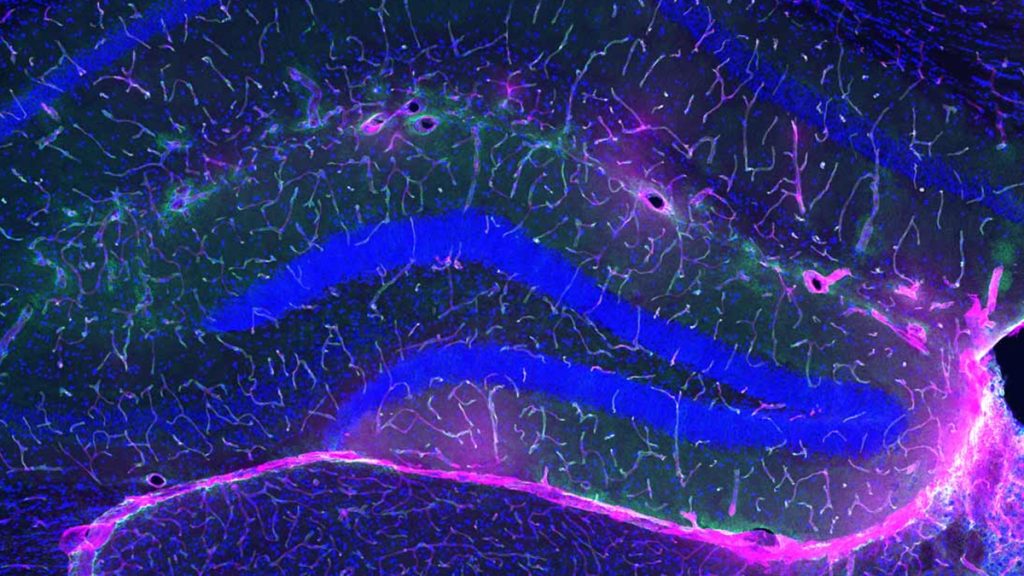
Older animals that exercised (bottom) had less TNAP (black area) in the brain blood vessels. (Villeda Laboratories)
Young mice genetically engineered to have more TNAP in their blood-brain barrier showed cognitive decline consistent with older mice.
When older mice were genetically modified to have lower TNAP levels than normal mice, the blood-brain barrier became less leaky, inflammation decreased, and cognition improved.
In mice with Alzheimer’s disease models, elevated GPLD1 levels or reduced TNAP levels were associated with fewer harmful clumps of amyloid-beta, a hallmark of Alzheimer’s disease and another positive sign.
Inflammation, or neuronal stress, is known to be a key factor in Alzheimer’s disease and other aspects of brain aging and cognitive decline, and the blood-brain barrier protects against chemicals that can trigger inflammation.
Thanks to the results of this investigation, it is now clear that exercise produces GPLD1, which controls TNAP, meaning a stronger blood-brain barrier and lower risk of cognitive decline and diseases like Alzheimer’s disease.
Understanding this opens the way for treatments that mimic the combined positive effects of GPLD1.


“We were able to exploit this mechanism late in the mouse’s life and it still worked,” said Gregor Bieri, a neuroscientist at the University of California, San Francisco.
It’s a limitation of the study that it was conducted only in mice, but it’s likely that similar processes occur in humans — something future studies could examine.
Such studies have a dual benefit because they can determine how specific health problems begin and provide some clues about how to fix them.
RELATED: Can Exercise Help Osteoarthritis? A new review makes surprising findings
Regular exercise isn’t always suitable for everyone, especially older adults, and taking it a step further, there may be a way to develop drugs that are as cognitively protective as exercise without any physical activity.
It will be a long time before we get to this stage—more research and safety testing is needed first—but we now know a lot more about the brain-enhancing powers of exercise.
“We are uncovering biological principles that have been largely overlooked in Alzheimer’s disease research,” Villeda said. “It may open up new therapeutic possibilities beyond traditional strategies that focus almost exclusively on the brain.”
The study was published in cell.