


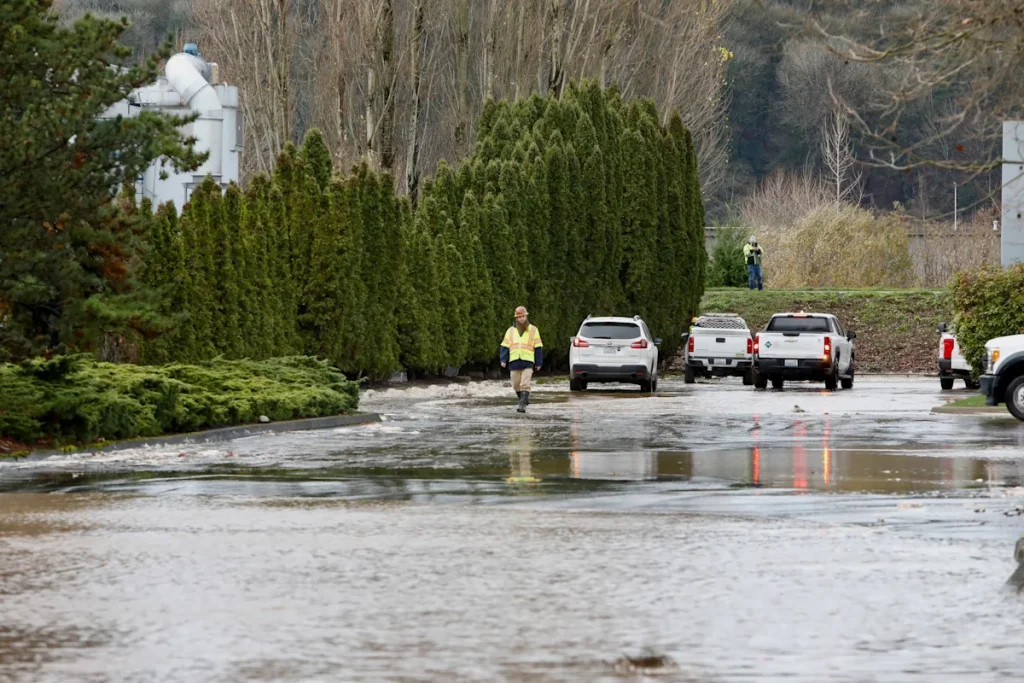
SEATTLE (AP) — Washington Gov. Bob Ferguson said Tuesday that the extent of damage in Washington state is severe but unclear after more than a week of torrential rain and record flooding, and more high water levels, mudslides and power outages are expected.
A string of storms brought by a weather system across the Pacific brought nearly 2 feet (0.6 meters) of rain to parts of the Cascade Mountains, causing rivers to rise well above their banks and prompting more than 600 people to respond in 10 counties.
As of Tuesday, only one person had died – a man who drove through a warning sign into a flooded area – but major highways were buried or washed out, entire communities were submerged and saturated levees have failed. Ferguson said it could take several months for State Route 2, which connects the western Washington city to the Stevens Pass ski area and the man-made Bavarian tourist town of Leavenworth across the mountains, to reopen.
“We’re in it for the long haul,” Ferguson told a news conference. “If you get an evacuation order, for the love of God, obey it.”
He said crews won’t be able to fully assess the damage until flood waters recede and the risk of landslides subsides. The state and some counties are providing millions of dollars to help people pay for hotels, groceries and other necessities, pending broader federal aid that Ferguson and Washington’s congressional delegation are expected to approve.
According to the governor’s office, first responders have conducted at least 629 rescues and assisted in 572 evacuations. At times, as many as 100,000 people were under evacuation orders, many of whom lived in the flood plains of the Skagit River north of Seattle.
Elevated river and flood risks are likely to persist through at least the end of the month, according to the National Weather Service. Wind damage and flood warnings are expected for much of the Northwest over the coming days as the storm brings rain, mountain snow and high winds.
Residents near one Pacific End levee south of Seattle were told to leave their homes before dawn Tuesday, just hours after an evacuation alert was lifted for residents near another levee. The King County Sheriff’s Office uses a helicopter equipped with a loudspeaker to knock on doors, said Brandyn Hull, communications manager for the office.
The first sign of a levee breach at the Valley Regional Fire Department came around 1:20 a.m. Tuesday when a 911 caller reported water coming into an apartment in Pacific, spokesperson Kelly Hawks said. Crews evacuated about 100 people early Tuesday, pulling some out of first-floor apartment windows, she said.
“That’s how fast the water is coming in,” Hawkes said.
Eventually, approximately 220 households were evacuated. No injuries were reported.
In response to the violation, the Pacific Police Department put out a call on social media Tuesday morning for the purchase of a tractor with a bucket that can reach 8 feet (2.4 meters) high for use in filling sandbag machines. After the tractor was acquired, the department asked the public to help fill the sandbags.
A man who drove through a warning sign was found dead in a car in a flooded ditch early Tuesday in the Snohomish area northeast of Seattle. Rescue swimmers found the vehicle in about 6 feet (1.8 meters) of water, the Snohomish County Sheriff’s Office said in a news release. The driver, believed to be a 33-year-old man, was pronounced dead at the scene after life-saving measures failed.
Snohomish Area Fire Rescue Battalion Chief Jamal Beckham said during a briefing on flooding damage from last week’s storm that most of the calls his crews received were from people trying to drive through water or being trapped in their vehicles.
“They don’t understand how quickly the water rises,” Beckham said Saturday. “We were pulling people off their roofs. If we hadn’t gotten there, the cars would have been completely covered.”
He said they also responded to people who didn’t expect their homes to flood and didn’t leave when they were told.
___
Associated Press writer Martha Bellaire contributed to this report.