


China is far ahead in the race to build humanoid robots, with the number of related patents issued over the past five years being five times that of the United States, Morgan Stanley said in its latest Robotics Yearbook.
China recorded 7,705 humanoid robot patents over the past five years, compared with 1,561 in the United States, Morgan Stanley said in the six-volume series “Robotics Yearbook, Volume 3: Humanoid and Industrial Robots” released on Tuesday. Japan ranks second at 1,102, followed by the World Intellectual Property Organization (WIPO) at 1,100.
WIPO is a United Nations specialized agency headquartered in Geneva that promotes international cooperation on intellectual property.
Do you have questions about the hottest topics and trends from around the world? Get the answers with SCMP Knowledge, a new platform of curated content with explainers, FAQs, analyzes and infographics brought to you by our award-winning team.
The report, produced by Morgan Stanley’s global embedded artificial intelligence team, lists 32 authors. The analysis also highlights the cost advantages China brings to the humanoid robot supply chain.
Morgan Stanley estimates that the cost of developing a supply chain for Tesla’s Optimus Gen 2 would be nearly three times higher without China’s involvement.
In a hypothetical “non-China supply chain,” the cost of actuators (the mechanisms that move joints) would rise from about $22,000 to $58,000, while chip and software costs would rise from about $3,000 to $7,000.
The report says the Optimus Gen 2’s bill of materials will jump from about $46,000 to $131,000 in total, with similar jumps for key hardware components including dexterous hands, feet, vision systems and batteries.


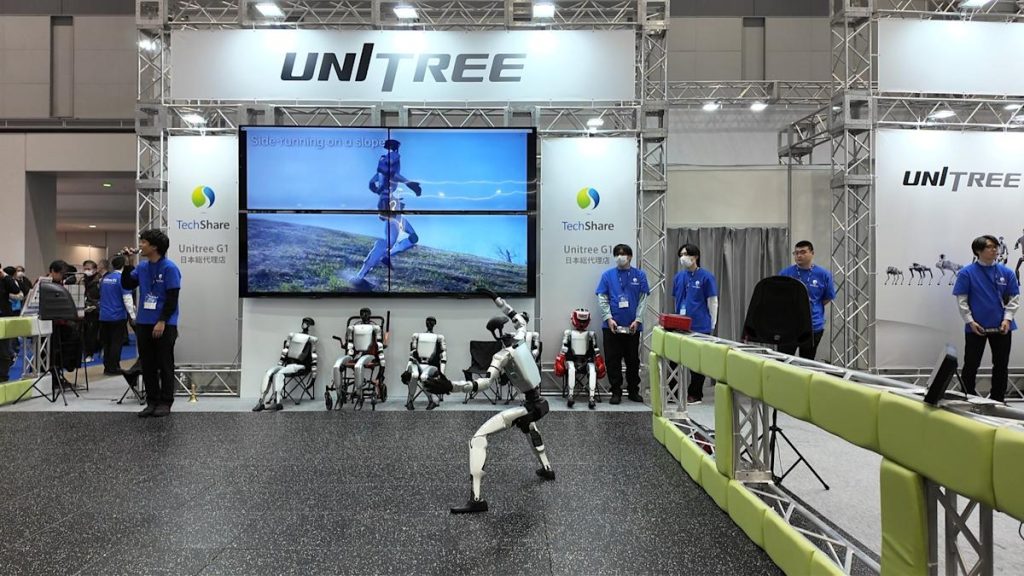
Yushu’s humanoid G1 showed off its kung fu at the International Robot Exhibition. Photo: Wency Chen alt=Unitree’s humanoid robot G1 demonstrates its kung fu moves at the International Robot Exhibition. Photo: Chen Wenxi>
Another major finding is that, driven by the rapid expansion of the domestic robot industry, China’s industrial robot installations account for 54% of global industrial robot installations, exceeding the rest of the world combined.
Morgan Stanley said major Chinese companies such as BYD, Geely, Xpeng, NIO, Li Auto, Xiaomi and Midea are testing and deploying humanoid robots in factories and logistics environments.
Earlier this month, home appliance maker Midea launched a six-arm industrial humanoid robot that it plans to deploy at its Wuxi washing machine factory by the end of December. Xpeng Motors said it aims to sell 1 million humanoid robots by 2030 and start mass production at the end of 2026.
China’s efforts to promote “physical intelligence” are supported by policy support and public-private partnerships aimed at accelerating innovation and deployment in industrial settings.
Morgan Stanley also said that Unitree Robotics’ G1 humanoid robot is currently the most widely used humanoid robot in the world.
Looking ahead, analysts estimate that 1 billion humanoid robots will be deployed globally by 2050, led by East Asia and the Pacific.
This article originally appeared in the South China Morning Post (SCMP), the most authoritative voice on China and Asia for more than a century. For more SCMP stories, explore the SCMP app or visit SCMP on Facebook and twitter Page. Copyright © 2025 South China Morning Post Publishing Limited. All rights reserved.
Copyright (c) 2025. All rights reserved by South China Morning Post Publishing Limited.