


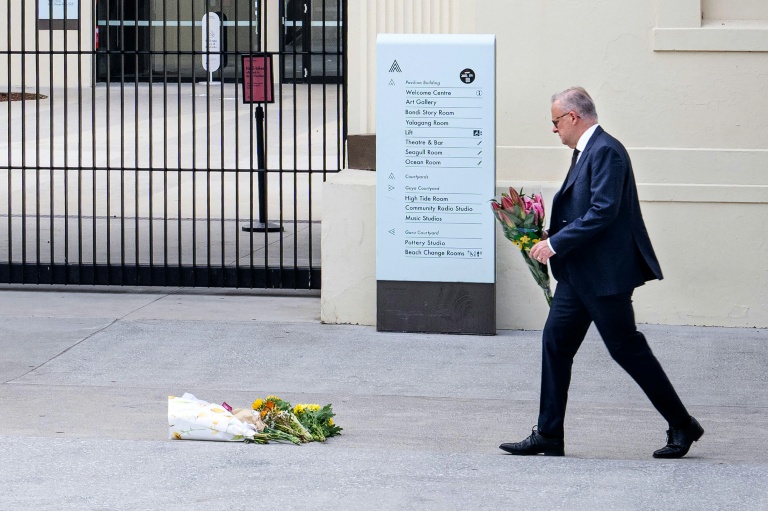
Australian Prime Minister Anthony Albanese said on Sunday he had ordered a review of police and intelligence services after two gunmen killed 15 people at a Jewish holiday at Bondi Beach.
A father and son have been accused of firing bullets at a family Hanukkah celebration on Sydney’s most famous beach on December 14, allegedly inspired by “Islamic State ideology”.
Albanese said his government would examine whether the police and spy services had the powers, structures and sharing arrangements “to keep Australians safe”.
“Last Sunday’s atrocities committed by ‘Islamic State’ exacerbated our country’s rapidly changing security environment,” he said, using the acronym for the Islamic State group.
“Our security agencies must be in the best position to respond.”
The gunman, Sajid Akram, 50, was shot dead by police in the Bondi attack. He is an Indian national who entered Australia on a visa in 1998.
His 24-year-old son Naveed, an Australian-born citizen, remains in hospital under police guard and faces multiple charges, including terrorism and 15 counts of murder.
– ‘Shocking incident’ –
In 2019, ASIO investigated Son for possible radicalization but found at the time that he did not pose a threat, according to Australian authorities.
His father was also questioned by intelligence services as part of the review but managed to obtain a firearms license allowing him to possess six firearms.
The Bondi Beach attack comes just weeks after the pair returned to Sydney from a four-week tour of the southern Philippines, which is being investigated by detectives in the southern Philippines and Australia.
Albanese said there were “real problems” with Australian intelligence in light of the attack.
“We need to examine exactly how the system works. We need to look back at what happened in 2019, when this person was investigated and an assessment was made,” he told state broadcaster ABC.
In a separate interview, when asked about the alleged gunmen’s stay at a hotel on the southern Philippine island of Mindanao, Albanese said their radical behavior was under investigation.
“But the fact that they were not considered a person of interest is why this is such a shocking incident,” he said.
– ‘Very, very unusual’ –
The Mindanao region has a long history of Islamist insurgency, but local authorities say there is no evidence the Philippines is being used to train extremists.
Staff at the GV Hotel in Davao City told AFP the two men spent much of their 28-day stay holed up in their small rooms.
The Philippines’ national security agency said they typically left their rooms for only two or three hours, with the longest trip lasting eight hours.
Regional police used CCTV images to trace the pair’s footsteps and identify people they encountered, and said the father had visited a gun shop.
Clark Jones, a criminologist at the Australian National University, said it was “very, very unusual” for a father and son to be suspects.
Once in the Philippines, the pair could easily travel to Mindanao without raising any flags, he told AFP.
Jones, who has worked with violent offenders in the Philippines, said the alleged gunman’s radicalization was clearly “on the radar” years after the Australian intelligence investigation.
“I think we really need to look at what’s going on and whether that child should have been put into some kind of support program when he was first discovered to prevent this potential thing from happening,” he said.
djw-lec-burs/sft/ane/pbt