


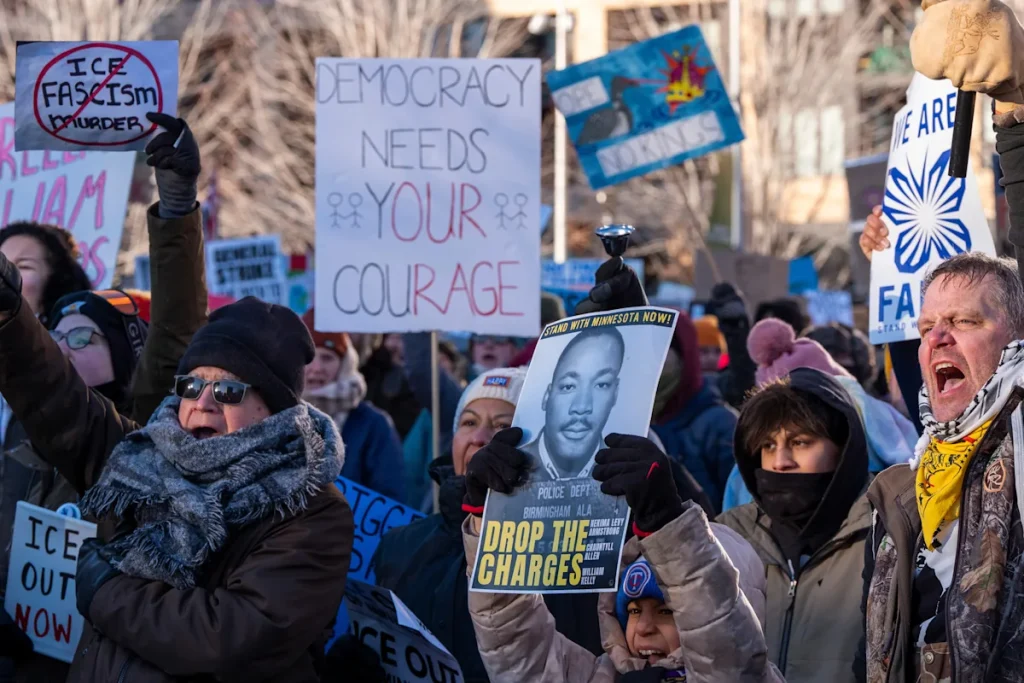
The shootings of white protesters Alex Pretty and Renee Goode by federal officers in Minneapolis followed a script all too familiar to Black Americans: Authorities move quickly to belittle the victims, only to be rebutted as more evidence emerges.
Black families who have lost loved ones to police violence say the killings in Minnesota have brought back painful memories of their own struggles for justice as law enforcement agencies spin stories to suggest officers had no choice but to kill their loved ones.
Experts say these law enforcement agencies often make no effort to publicly correct misstatements or lies that could undermine a fair judicial process.
Timothy Welbeck, director of the Center for Antiracism at Temple University, said it was “sadly” that it took the deaths of Pretty and Goode to draw renewed attention to the issue.
“Black people have been critical of law enforcement for as long as there have been police officers in the United States,” said Welbeck, an assistant professor in Temple University’s Department of Africana Studies and African American Studies.
He also called it a “painful irony” that Pretty and Good died in “the same place,” an issue that has been highlighted by other high-profile cases: George Floyd was murdered by Minneapolis police in 2020, and Philando Castile was shot while trying to show a police officer in suburban Minneapolis a license to carry a concealed gun in 2016.
Clarence Castile, Philando Castile’s uncle, said it was strange to hear federal authorities jump to hasty conclusions about the shootings of Pretty and Goode.
“They immediately supported the officer and said their shooting was justified, their lives were in danger and they feared for their lives,” Castile said. “When that officer shot my nephew, I heard the same thing, (the officer) said the same thing.”
“We knew from the beginning that they didn’t take the time to investigate,” he said. “They just post something because they think they have to respond. Sometimes the best response is not to respond.”
‘Protecting the integrity of the investigation’
Leonard Sipes, a former police officer who has worked in public affairs and communications for federal and state law enforcement agencies for 35 years, said the standard approach for shootings or any other major emergencies is to simply state “under investigation.” Sipes said he typically waits 24 hours before releasing information to the public.
“The accuracy of reporting is critical to the agency’s reputation,” Sipes said. “You also have a duty to protect the integrity of the investigation. Rushing to judgment may breach that.”
The killings of Pretty, an intensive care unit nurse at a Veterans Affairs hospital, and Goode, a self-described poet, mother and wife, quickly became a rallying cry for Minnesotans protesting the largest deployment of federal law enforcement into an American city.
After the killings of Pretty and Goode, administration officials from Homeland Security Secretary Kristi Noem to President Donald Trump claimed the two men were far-left radicals with malicious intent to harm federal officials.
“The government’s sickening lies about our son are reprehensible and disgusting,” Preti’s family said in a statement this week, noting that video showed Preti holding a cell phone, not a gun, as she was restrained by federal agents and then shot multiple times. “Please find out the truth about our son.”
Goode is remembered by her family as “a beautiful light to our family who brought joy to everyone she met.”
“She was our protector, our shoulder to cry on, and our sparkling source of joy.”
While Justice Department officials declined to open a civil rights investigation into Goode’s death, they announced a civil rights investigation into Pretty’s killing on Friday.
Still, officials did not deny claims that Pretty and Goode were avowed extremists and intended to harm federal agents after they were killed.
Frustrated by past and present cases
Some Black activists and police reform advocates have expressed frustration that people outraged by the handling of Pretty and Goode’s cases often overlook the same dynamics when the victims are Black.
“Ultimately, this demonstrates the insidious nature of racism and how it is woven into social systems and structures,” Welbeck said. “When Black people try to point out not only its logical fallacy, but simply its callousness, we are often lambasted or told we are overreacting and need to wait for justice to be served.”
Melina Abdullah, co-founder of Black Lives Matter Grassroots, said a common misconception is that Black racial justice organizers don’t take action when white people die at the hands of law enforcement.
“I want to make it clear that I am deeply saddened and outraged by the murders of Alex Pretty and Renee Goode,” said Abdullah, an organizer with the BLM chapter’s national center. “The pain they’re suffering is what black people suffer every day, and it’s not okay for them, but it’s not okay for us.”
Justin Hansford, who participated in Black Lives Matter protests after the 2014 police shooting of Michael Brown in Ferguson, Missouri, said the Minneapolis shooting should remind all Americans that injustices that disproportionately affect Black people also affect them.
“People think the black experience is always a signal to the rest of the country of what’s going to happen,” said Hansford, a professor at Howard University School of Law and executive director of the Thurgood Marshall Center for Civil Rights.
“Because it’s the black experience, you look at it narrowly and fail to address it. And then that experience gets copied across the country.”
Tulsa shooting victim’s sister understands Minneapolis family’s pain
Tiffany Crutcher, the twin sister of Terence Crutcher, who was killed by a Tulsa, Oklahoma, police officer in 2016, said she was unable to watch the video showing the killings of Pretty and Goode. Just hearing authorities talk about their deaths was retraumatizing, she said.
She said she had “been there before” and recalled how law enforcement officials made snap judgments about her brother.
Crutcher’s family insists Terrence needed help after his car broke down on the road. The officer who shot him claimed she was concerned he was reaching into the car for a weapon. Terrence Crutcher was unarmed.
Video footage from the scene recorded an operator saying Terrence “looked like a bad guy” and “could be up to something.” Ultimately, the officer who shot him was acquitted of manslaughter at trial.
“In the midst of our trauma and shock, we must take control of the narrative about who Terrence is,” Tiffany said. “As we grieve and mourn, we must come together and let the world know that our loved ones did not deserve to die.”
She said the Pretty and Goode shootings are helping to bring awareness to the issue of justice being denied to people killed by police.
“Naturally, there’s a broader affinity between law enforcement and the people who believe in them,” Tiffany said. “But, I think that’s changing.”
“Our voices are all we have. We made a conscious decision that we would use our voices and rise above harmful narratives.”
___
Associated Press writer Matt Brown in Washington, D.C., contributed.