


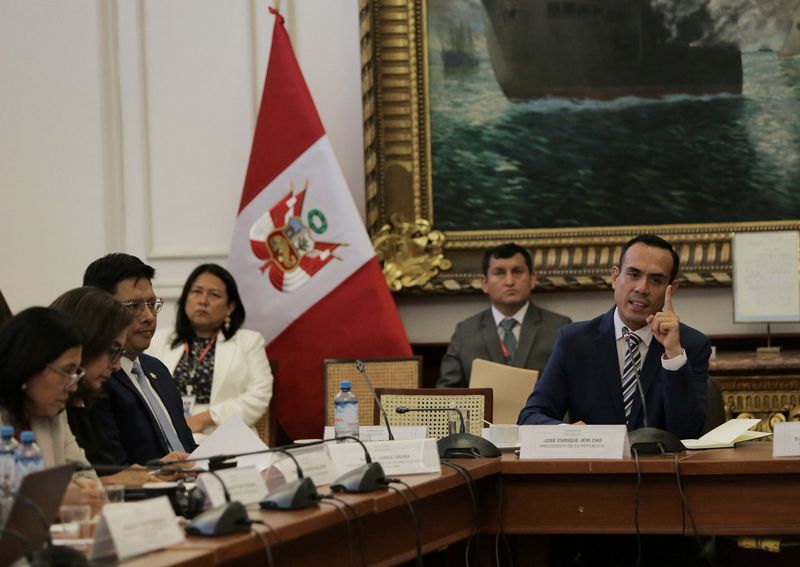
LIMA (Reuters) – A scandal over an undisclosed meeting between Peru’s acting president and a Chinese businessman has thrust the top copper exporter’s ties with China into the spotlight as the United States intensifies scrutiny of Beijing’s footprint in the region.
Jose Jeri, who took office in October after former President Dina Boluarte was ousted, admitted to denying any wrongdoing in three meetings with businessman Yang Zhihua between December and January.
The businessman owns a Chinese import store and holds a concession for an energy project. He has also previously been named in a congressional investigation for allegedly providing logistical support to Chinese companies suspected of corruption.
The dispute comes as the United States is increasing its influence in the region, aiming to weaken China’s deep ties in Latin America.
Martin Casinelli, a trade and investment analyst at the Atlantic Council think tank, said: “It is not surprising that the Trump administration has questioned Chinese investment in Peru. It has done so in Mexico and Panama and may use pressure tools to force Peru to distance itself from China.”
The case, dubbed “Chifagate” by local media, prompted opposition lawmakers to file an impeachment motion seeking to remove Jerry, who is tasked with completing the current government’s term until July. The prosecutor’s office has launched a preliminary investigation into alleged influence peddling, which Jerry denies.
Peruvians will vote for a new president on April 12. Peru has elected seven presidents since 2018, but the country still has one of the fastest growth rates in Latin America thanks to steady mining revenues.
Analysts say Washington’s recent capture of Venezuelan President Nicolás Maduro, an ally of China and Russia, sends a message that it aims to exclude extra-regional powers from the Western Hemisphere, a stance that puts additional pressure on governments such as Peru as they deal with internal crises.
“In reality, criticism of Chinese businessmen is also criticism of China,” said Jhon Valdiglesias of the Center for Asian Studies at the Universidad Nacional de San Marcos in Peru.
“I think it certainly casts a pall over all relations with China,” he added.
Still, damaging Peru’s deep commercial ties with China won’t be easy. The free trade agreement signed in 2009 pushed China to surpass the United States and become Peru’s largest trading partner starting in 2015.
China accounted for 33% of Peru’s trade, while the United States accounted for 14%, according to government data as of November.
China also controls one of Peru’s largest copper mines and buys about 70% of the country’s metal production. Chinese companies own Peru’s largest power generators and will start operating the megaport of Chancay in late 2024, opening a new South America-Asia direct trade route.
Juan Carlos Capunay, a former Peruvian ambassador to China, said the South American country’s economic relationship with Beijing was “probably one of the best in terms of administrative and political structure in recent years”.
“We have several key tools to maintain them, including the free trade agreement with China,” he said, adding that this would leave the United States challenged to dismantle or even weaken it in the long term.
Even so, the Chifagate scandal has shone a spotlight on some less-than-stellar aspects of the relationship.
“If Peruvians, who have so far viewed Chinese investment projects favorably, question the credibility of this investment, new Chinese investments and government contracts will not be welcomed by a society sensitive to corruption and accusations of undue favoritism toward foreign companies,” Casinelli said.
A representative of the Chinese Embassy in Peru did not respond to a request for comment.
Jerry’s approval rating appears to have dropped from 51 percent to 41 percent since the scandal broke, according to polling firm Datum Internacional.
As many as 78% of Peruvians told an Ipsos poll over the weekend that they had detected signs of corruption in Jerry’s meetings with businessmen.
(Reporting by Marco Aquino, additional reporting by Cassandra Garrison; Editing by Christian Plumb and Alistair Bell)