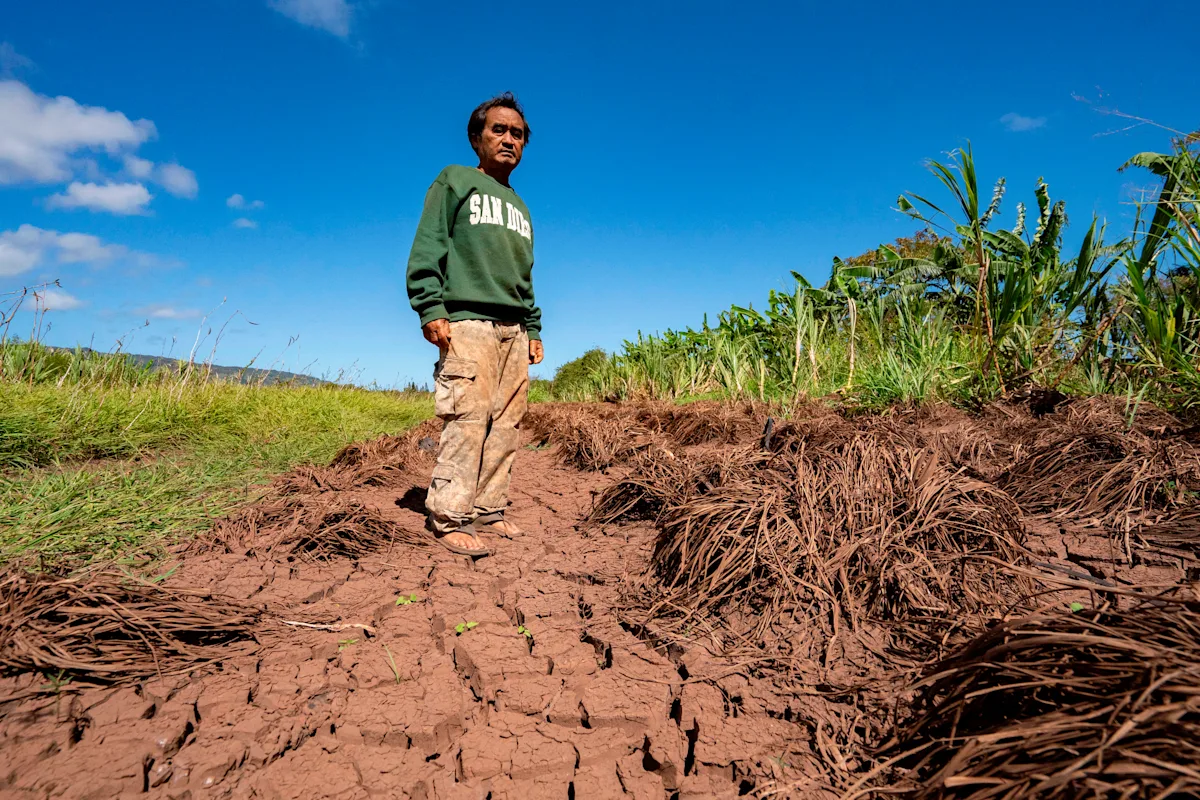
WAIALUA, Hawaii (AP) — The reddish-brown soil of Bok Kongphan’s Hawaiian farm has hardened under the tropical sun. Irrigation pipes lie tangled where his lemongrass, cucumbers and okra once flourished.
His niece Jeni Balanay also lost her crops – mustard greens called cabbage, bitter melon, tomatoes. The leaves of her recently planted bananas, coconuts and mangoes have turned yellow and the trees are unlikely to survive.
On Oahu’s North Shore, known for its big-wave surfing, back-to-back storms in March brought the state’s worst flooding in two decades, crippling small farms that help supply the island’s food. Officials implored farmers not to give up, stressing that local agriculture was vital to the isolated archipelago.
“In some cases, entire farms were leveled,” said Brian Miyamoto, executive director of the Hawaii Farm Bureau. “These farmers were just days or weeks away from harvesting and now they have to start all over again.”
More than 600 of Hawaii’s 6,500 farms reported nearly $40 million in damage to crops, livestock and machinery, according to data collected by agriculture advocates. But Miyamoto said the Farm Bureau estimates the overall scope of the damage is much more widespread — nearly 2,000 farms with $50 million in damage.
specific types of agriculture
Plantation-style agriculture dominated Hawaii during the late 19th century and much of the 20th century, with companies such as Dole and conglomerates founded by missionary descendants growing tracts of sugar cane or pineapples for export. These operations attracted large numbers of immigrants, mainly from Asia and Portugal.
But by the 1990s, such large-scale monocultures were fading away in the face of international competition, and officials began promoting small farms—some, like Kongphan’s, just a few acres—to grow a wider variety of crops that could be sold to local grocers or farmers’ markets.
Global transportation disruptions during the COVID-19 pandemic have highlighted the importance of Hawaii’s local food supply, and the state has provided additional support to farms in recent years. This includes funding for infrastructure, farm-to-school programs and loans for those who have been denied credit by banks.
But they still face challenges. Unlike many farms on the mainland, Hawaiian farms are often too small and diverse to afford or qualify for crop insurance.
Miyamoto noted that many of the farmers were immigrants and were barely making ends meet even before the storm.
According to the U.S. Department of Agriculture, most farms in Hawaii have annual sales of less than $10,000. Flooding, high winds and power outages killed or stressed livestock and destroyed equipment, vehicles and infrastructure.
desperate farmer
Without insurance, Khonphan, an immigrant from Thailand, has been trying to get government aid and figure out how to level the land that was washed away by the floods. His niece has been helping him and other Thai farmers with the process. Available help includes federal disaster relief, one-time $1,500 emergency grants and long-term loans from the state, as well as a charitable fund that raised about $850,000 in the weeks after the flooding. Many farmers also have online fundraising pages.
In an interview translated by Balanay, Kongphan called the flooding “extremely devastating” but said he would continue to work on the 5 acres (2 hectares) he has rented for five years, growing vegetables to sell at farmers markets, swap meets and at shops and stalls in Honolulu’s Chinatown.
Kongphan points to a faint, thigh-high line on the plywood wall, showing where water reaches his home built out of shipping containers. There is now a donated tent inside, but he usually sleeps outside.
Flies swarmed as he carried a mud-covered generator he hoped to salvage. Parked nearby was a Toyota Yaris covered in the same dried sludge inside and out.
After her family immigrated to Hawaii, Balanai learned to farm from her mother, but she wasn’t sure if she wanted to continue. She recalled the torrent reaching her waist in seconds and washing away her crops in the middle of the night.
“Will this happen again?” she asked. “When you see all this land destroyed, you want to give up.”
Sharon Hurd, the state’s top agriculture official, said flooding is the latest crisis facing Hawaii’s farmers, in addition to wildfires, pests and volcanic ash and debris from Big Island volcanic eruptions.
“These are the farms where we really need to start over,” Hurd said. “We can’t let them give up.”
She said officials have been conducting tests to reassure farmers that their soil is safe and provide them with seeds and plants to start.
Farmers’ markets have fewer and fewer products
Some farmers lack access to farmers’ markets, which are their main source of income. Many have less to offer, Miyamoto said.
Farmer Kula Uli´i said her family brought in about a quarter of their usual production. Instead of 200 pounds (90.7 kilograms) of tomatoes, they might sell 60 pounds (27.2 kilograms) of tomatoes at the weekend farmers market.
She said they lost crops scheduled to be planted this month and faced months of limited harvests. She’s unsure about her farm’s contract status with grocery stores because it can’t keep up with demand.
Even taro, which thrived in water, disappeared after being overwhelmed by pollutants carried by floodwaters, she said.
“Everything is gone,” Uliyi said. “We can’t use any of them.”
___
Associated Press reporter Audrey McAvoy in Honolulu contributed.

